pole
English
Pronunciation
- (Received Pronunciation) IPA(key): /pəʊl/, [pʰɒʊɫ]
- (doll–dole merger) IPA(key): /pɒl/, [pʰɒɫ]
- (General American, Canada) IPA(key): /poʊl/, [pʰoʊɫ]
Audio (US): (file)
- (General Australian) IPA(key): /pəʉl/, [pʰəʉɫ], [pʰɐʉɫ]
- (New Zealand) IPA(key): /pɐʉl/, [pʰɐʉɫ]
- (Scotland) IPA(key): /pol/, [pʰoɫ]
- Rhymes: -əʊl
- Homophones: Pole, poll (one pronunciation or with the doll–dole merger)
Etymology 1
From Middle English pole, pal, from Old English pāl (“a pole, stake, post; a kind of hoe or spade”), from Proto-West Germanic *pāl (“pole”), from Latin pālus (“stake, pale, prop, stay”), perhaps from Old Latin *paxlos, from Proto-Italic *pākslos, ultimately from Proto-Indo-European *peh₂ǵ- (“to nail, fasten”). Doublet of peel, pale, and palus.
Cognate with Scots pale, paill (“stake, pale”), North Frisian pul, pil (“stake, pale”), Saterland Frisian Pool (“pole”), West Frisian poal (“pole”), Dutch paal (“pole”), German Pfahl (“pile, stake, post, pole”), Danish pæl (“pole”), Swedish påle (“pole”), Icelandic páll (“hoe, spade, pale”), Old English fæc (“space of time, while, division, interval; lustrum”).
Noun
pole (plural poles)
- Originally, a stick; now specifically, a long and slender piece of metal or (especially) wood, used for various construction or support purposes.
- 1913, Joseph C[rosby] Lincoln, chapter I, in Mr. Pratt’s Patients, New York, N.Y.; London: D[aniel] Appleton and Company, →OCLC:
- For a spell we done pretty well. Then there came a reg'lar terror of a sou'wester same as you don't get one summer in a thousand, and blowed the shanty flat and ripped about half of the weir poles out of the sand.
- 2019, Abby Chava Stein, Becoming Eve, Seal Press, page 26:
- There she was, walking around with an IV pole, and we were only told that "Mommy isn't feeling so well, so she has to be connected to a special soda."
- A construction by which an animal is harnessed to a carriage.
- Synonyms: carriage pole, beam, shaft, drawbar
- Meronyms: pole-guard, pole-hook, pole-hound, pole-pad, pole-pin, pole-pin-strap, pole-plate, pole-ring, pole-screen, pole-socket, pole-stop, pole-strap
- (fishing) A type of basic fishing rod.
- A long sports implement used for pole-vaulting; now made of glassfiber or carbon fiber, formerly also metal, bamboo and wood have been used.
- (slang, spotting) A telescope used to identify birds, aeroplanes or wildlife.
- (historical) A unit of length, equal to a rod (1⁄4 chain or 51⁄2 yards).
- (motor racing) A pole position.
- (US, African-American Vernacular, slang) A rifle.
- (vulgar, slang) A penis.
- (cricket, slang) A wicket, especially in the context of the number of wickets taken by a particular bowler.
- Only three cricketers have taken all 10 poles in a Test innings.
Synonyms
- See also Thesaurus:stick
- (unit of length): rod
Derived terms
- alepole
- barber pole
- barge pole, bargepole
- beanpole
- boom pole
- bush pole
- carrying pole
- cartpole
- catchpole
- clodpole
- clothespole
- coupling pole
- cross-pole
- dance pole
- depress the pole
- double pole
- double-pole technique
- eighth pole
- family pole
- fencepole
- Festivus pole
- firepole
- fishing pole
- fishpole
- flagpole
- footpole
- foul pole
- fuckpole
- gee pole
- gin pole
- greasy pole
- habitat pole
- headpole
- hiking pole
- Hop Pole
- hop pole
- hydro pole
- ice pole
- icy pole
- J-pole antenna
- lightpole
- lodgepole
- lodge pole
- maypole
- meatpole
- memorial pole
- milepole
- monkey pole
- mortuary pole
- negative pole
- nerd pole
- not touch something with a ten-foot pole
- over-the-pole
- perch pole
- pike pole
- pitchpole
- polearm
- poleaxe
- pole barn
- poleboat
- pole building
- pole-chain
- pole charge
- pole cleaver
- pole corn
- pole-crab
- pole dance
- pole dancer
- pole dancing
- pole fitness
- pole hammer
- polehead
- pole hook
- pole jam
- pole-jocking
- pole lathe
- poleless
- polelike
- poleman
- polepiece
- pole plate
- pole position
- poler
- polescreen
- pole-sitter
- polesitter
- polesman
- pole-smoker
- polespear
- polestar
- polester
- poletimber
- pole up one's ass
- pole vault
- pole vaulter
- pole weapon
- power pole
- punting pole
- quant pole
- quarter pole
- range pole
- ranging pole
- rhythm pole
- ridgepole
- ridicule pole
- roundpole
- setting pole
- shame pole
- shoulder pole
- ski pole
- smoke pole
- smoke someone's pole
- snow pole
- socket pole
- spinnaker pole
- springpole
- Stobie pole
- stripper pole
- tail-pole
- taxi pole
- telegraph pole
- telephone pole
- tentpole
- the longest pole knocks the persimmon
- totem pole
- trekking pole
- trolley pole
- up the pole
- utility pole
- walking pole
- welcome pole
- whisker pole
Translations
|
|
Verb
pole (third-person singular simple present poles, present participle poling, simple past and past participle poled)
- To propel by pushing with poles, to push with a pole.
- Huck Finn poled that raft southward down the Mississippi because going northward against the current was too much work.
- To identify something quite precisely using a telescope.
- He poled off the serial of the Gulfstream to confirm its identity.
- (transitive) To furnish with poles for support.
- to pole beans or hops
- (transitive) To convey on poles.
- to pole hay into a barn
- (transitive) To stir, as molten glass, with a pole.
- (transitive, baseball) To strike (the ball) very hard.
- 2007, Tony Silvia, Baseball Over the Air:
- Long had poled the ball into the lower deck in right center.
- (transitive, metallurgy) To treat (copper) by blowing natural gas or other reducing agent through the molten oxide, burning off the oxygen.
- to pole copper
Translations
Etymology 2
From Middle French pole, pôle, from Latin polus, from Ancient Greek πόλος (pólos, “axis of rotation”).
Noun
pole (plural poles)
- Either of the two points on the earth's surface around which it rotates; also, similar points on any other rotating object.
- A point of magnetic focus, especially each of the two opposing such points of a magnet (designated north and south).
- (figuratively, by extension) Any of a small set of extremes; especially, either of two extremes that are possible or available.
- In discussing alternatives to the polar extremes, Professor Nguyen mentioned two poles of a filthy floor versus a sterile surgical site.
- 1929, Abraham Zevi Idelsohn, Jewish Music: Its Historical Development, page 194:
- Genuine music is the offspring of profound emotion: of exaltation, pain, or joy. Music produced outside of a situation between these poles of the human heart is of banal character, bloodless, watery.
- (geometry) A fixed point relative to other points or lines.
- (electricity) A contact on an electrical device (such as a battery) at which electric current enters or leaves.
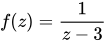
- (complex analysis) For a meromorphic function , any point for which as .
- The function has a single pole at .
- (obsolete) The firmament; the sky.
- 1634 October 9 (first performance), [John Milton], edited by H[enry] Lawes, A Maske Presented at Ludlow Castle, 1634: […] [Comus], London: […] [Augustine Matthews] for Hvmphrey Robinson, […], published 1637, →OCLC; reprinted as Comus: […] (Dodd, Mead & Company’s Facsimile Reprints of Rare Books; Literature Series; no. I), New York, N.Y.: Dodd, Mead & Company, 1903, →OCLC:
- And the slope sun his upward beam / Shoots against the dusky pole,
- Either of the states that characterize a bipolar disorder.



Antonyms
- (antonym(s) of “complex analysis”): zero
Derived terms
- analogous pole
- animal pole
- antilogous pole
- antipole
- bipole
- celestial pole
- cold pole
- counterpole
- cross-pole
- dipole
- Earth's third pole
- epipole
- hexadecapole
- hexapole
- interpole
- magnetic pole
- monopole
- multipole
- north pole
- north-seeking pole
- N-pole
- octopole
- octupole
- paleopole
- polar
- polarity
- polary
- pole arctic
- pole face
- poleless
- polelike
- pole of cold
- polepiece
- poles apart
- polestar, pole star
- poleward
- polewards
- Polie
- polocyte
- positive pole
- quadripole
- quadrupole
- salient pole
- shaded pole
- south pole
- south-seeking pole
- S-pole
- tripole
- unipole
- vegetal pole
- Voronoi pole
Translations
|
|
|
- The translations below need to be checked and inserted above into the appropriate translation tables. See instructions at Wiktionary:Entry layout § Translations.
Verb
pole (third-person singular simple present poles, present participle poling, simple past and past participle poled)
- (transitive) To induce piezoelectricity in (a substance) by aligning the dipoles.
Derived terms
Anagrams
Äiwoo
Verb
pole
- to work (in a garden or field)
References
- Ross, M. & Næss, Å. (2007), “An Oceanic origin for Äiwoo, the language of the Reef Islands?”, in Oceanic Linguistics, volume 46, number 2. Cited in: "Äiwoo" in Greenhill, S.J., Blust, R., & Gray, R.D. (2008). The Austronesian Basic Vocabulary Database: From Bioinformatics to Lexomics. Evolutionary Bioinformatics, 4:271–283.
Alemannic German
Etymology
From Middle High German boln.
Verb
pole
References
- Abegg, Emil, (1911) Die Mundart von Urseren (Beiträge zur Schweizerdeutschen Grammatik. IV.) [The Dialect of Urseren], Frauenfeld, Switzerland: Huber & Co., page 35.
Czech
Etymology
Inherited from Old Czech pole, from Proto-Slavic *poľe.
Pronunciation
- IPA(key): [ˈpolɛ]
Audio: (file)
Noun
pole n
- (agriculture) field
- (physics) field
- (algebra) field
- Synonym: komutativní těleso
- (computing) field
- (programming) array
Declension
Derived terms
Further reading
- “pole”, in Příruční slovník jazyka českého (in Czech), 1935–1957
- “pole”, in Slovník spisovného jazyka českého (in Czech), 1960–1971, 1989
- “pole”, in Internetová jazyková příručka (in Czech), 2008–2026
Esperanto
Pronunciation
- IPA(key): /ˈpole/
Audio 1: (file) Audio 2: (file) - Rhymes: -ole
- Syllabification: po‧le
Adverb
pole
Estonian
Etymology
Contraction of ep ole (Modern: ei ole). ep is the old 3rd person singular form of the negative verb.
Verb
pole
Galician
Etymology 1
Noun
pole m (plural poles)
Synonyms
Etymology 2
See the etymology of the corresponding lemma form.
Verb
pole
- third-person singular present indicative of pulir
Latin
Noun
pole
- vocative singular of polus
References
- "pole", in Charles du Fresne du Cange, Glossarium Mediæ et Infimæ Latinitatis (augmented edition with additions by D. P. Carpenterius, Adelungius and others, edited by Léopold Favre, 1883–1887)
- “pole”, in Harry Thurston Peck, editor (1898), Harper’s Dictionary of Classical Antiquities, New York: Harper & Brothers
Middle English
Alternative forms
Etymology
From Old English pāl, from Latin pālus.
Pronunciation
- IPA(key): /pɔːl/, /pɔl/
Noun
pole (plural poles)
Descendants
References
- “pōl(e, n.2”, in MED Online, Ann Arbor, Mich.: University of Michigan, 2007.
Nubi
Etymology
Interjection
póle
- sorry
- pole ma kasul!
- sorry for washing (the clothes)!
References
- The template Template:R:kcn:Wellens does not use the parameter(s):
page=193
Please see Module:checkparams for help with this warning.Wellens, Ineke (2005), The Nubi Language of Uganda: an Arabic Creole in Africa, Leiden, The Netherlands: Brill, →ISBN
Old Czech
Alternative forms
- poľe (alternative writing)
Etymology
Inherited from Proto-Slavic *pȍľe.
Pronunciation
Noun
pole n
- field (land area; wide open space)
- polem / na poli ― outside
- přěs pole přějěti/jězditi ― to have sex
- plain
- battlefield, battleground
- polem / v poli ležěti ― (please add an English translation of this usage example)
Declension
Derived terms
Descendants
- Czech: pole
Further reading
- Jan Gebauer (1903–1916), “pole”, in Slovník staročeský (in Czech), Prague: Česká grafická společnost "unie", Česká akademie císaře Františka Josefa pro vědy, slovesnost a umění
Old Polish
Etymology
Inherited from Proto-Slavic *pȍľe. First attested in 1250.
Pronunciation
Noun
pole n (related adjective polny)
- field (arable land)
- 1930 [c. 1455], “Ex”, in Ludwik Bernacki, editor, Biblia królowej Zofii (Biblia szaroszpatacka)transliteration, transcription, 9, 25:
- Zbyl gest grad we wszey szemy egipskyey wszitko, czsosz bilo na polyech (in agris)
- [Zbił jest grad we wszej ziemi ejipskiej wszytko, csoż było na polech (in agris)]
- 1962 [c. 1420], Stanisław Urbańczyk, editor, Wokabularz trydencki[2], number 7:
- Rus pole, inde rusticus
- [Rus pole, inde rusticus]
- (figuratively, attested in Sieradz-Łęczyca, Greater Poland) crops from a field
- 1415, Przecław Słota, O zachowaniu się przy stole[3], Łęczyca, Poznań, line 4:
- Sgarne na szø wszytko pole, ... czszole szø na niwe swøze, tho wszytko na stole løsze
- [Zgarnie na się wszytko pole, ... csole się na niwie swięże, to wszytko na stole lęże]
- (attested in Lesser Poland) field (open land)
- 1930 [c. 1455], “Gen”, in Ludwik Bernacki, editor, Biblia królowej Zofii (Biblia szaroszpatacka)transliteration, transcription, 4, 8:
- A gdisz na polu (in agro) bilasta, podnosl szø Kayn ku Ablowy
- [A gdyż na polu (in agro) byłasta, podniosł się Kain ku Ablowi]
- 1962-1975 [1439], Stanisław Kuraś, Irena Sułkowska-Kuraś, editors, Zbiór dokumentów małopolskich [A collection of documents from Lesser Poland][4], volume II, Lesser Poland, page 311:
- Quia ex recognicione fratrum predictorum... cessit castrum Bankowecz cum villis..., item in campo al. w polyu ville Gebolthow, et utraque Cowalicow, Maloschow... de his fratri predicto iuniori cesserunt
- [Quia ex recognicione fratrum predictorum... cessit castrum Bąkowiec cum villis..., item in campo al. w polu ville Giebołtow, et utraque Kowalikow, Małoszow... de his fratri predicto iuniori cesserunt]
- 1939 [end of the 14th century], Ryszard Ganszyniec, Witold Taszycki, Stefan Kubica, Ludwik Bernacki, editors, Psałterz florjański łacińsko-polsko-niemiecki [Sankt Florian Psalter]scan transliteration, transcription, numbers 131, 6, Krakow: Zakład Narodowy imienia Ossolińskich, z zasiłkiem Sejmu Śląskiego [The Ossoliński National Institute: with the benefit of the Silesian Parliament]:
- Naleszly gesmy gy w polech (in campis) lassa
- [Naleźli jeśmy ji w polech (in campis) lasa]
- 1939 [end of the 14th century], Ryszard Ganszyniec, Witold Taszycki, Stefan Kubica, Ludwik Bernacki, editors, Psałterz florjański łacińsko-polsko-niemiecki [Sankt Florian Psalter]scan transliteration, transcription, numbers 103, 12, Krakow: Zakład Narodowy imienia Ossolińskich, z zasiłkiem Sejmu Śląskiego [The Ossoliński National Institute: with the benefit of the Silesian Parliament]:
- Pycz bødzye wszytek zwyerz pola (agri)
- [Pić będzie wszytek źwierz pola (agri)]
- (attested in Masovia) campsite; battlefield
- 1895 [1448–1450], Mikołaj Suled, edited by Franciszek Piekosiński, Tłumaczenia polskie statutów ziemskich, Kodeks Świętosławów, Warka, page 15:
- Gydączy na woyną na ląnkach any we wszi staacz mayą, yano na polyv (nisi in campo)
- [Jidący na wojnę na łąkach ani we wsi stać mają, jano na polu (nisi in campo)]
- outside (area not in a building)
- Middle of the 15th century, Rozmyślanie o żywocie Pana Jezusa[5], page 132:
- Vyschly na polye (ad campum), nalyezly Yesvsa chodzącz y tam, y szam
- [Wyszli na pole i naleźli Jesusa chodząc i tam i sam]
- (heraldry) background
- 1856-1870 [1455], Antoni Zygmunt Helcel, editor, Starodawne Prawa Polskiego Pomniki[6], volume VII, number 610:
- Niccolaus post awam suam est de sangwine et armis ipsorum dictis Stanczowye, proclamacio autem ipsorum Nabra, deferentes in clipeo tres lineas vlg. trzy *polye in longitudine clipei
- [Niccolaus post awam suam est de sangwine et armis ipsorum dictis Stańcowie, proclamacio autem ipsorum Nabra, deferentes in clipeo tres lineas vlg. trzy pola in longitudine clipei5]
- (attested in Greater Poland) corruption of opole
- 1840 [1252], Edward Raczyński, editor, Kodex dyplomatyczny Wielkiej Polski zawierający bulle papieżów, nadania książąt, przywileje miast, klasztorów i wsi, wraz z innemi podobnej treści dyplomatami tyczącemi się historyi tej prowincyi od roku 1136 do roku 1597[7], Greater Poland, page 257:
- Dedimus omnimodam libertatem... a podworowe, ab pole, a bove et vacca annuali
- [Dedimus omnimodam libertatem... a podworowe, ab pole, a bove et vacca annuali]
Derived terms
- czyste pole
- przasne pole
- płone pola
- pole gonić impf
Descendants
References
- Boryś, Wiesław (2005), “pole”, in Słownik etymologiczny języka polskiego (in Polish), Kraków: Wydawnictwo Literackie, →ISBN
- Mańczak, Witold (2017), “pole”, in Polski słownik etymologiczny (in Polish), Kraków: Polska Akademia Umiejętności, →ISBN
- Bańkowski, Andrzej (2000), “pole”, in Etymologiczny słownik języka polskiego [Etymological Dictionary of the Polish Language] (in Polish)
- B. Sieradzka-Baziur, Ewa Deptuchowa, Joanna Duska, Mariusz Frodyma, Beata Hejmo, Dorota Janeczko, Katarzyna Jasińska, Krystyna Kajtoch, Joanna Kozioł, Marian Kucała, Dorota Mika, Gabriela Niemiec, Urszula Poprawska, Elżbieta Supranowicz, Ludwika Szelachowska-Winiarzowa, Zofia Wanicowa, Piotr Szpor, Bartłomiej Borek, editors (2011–2015), “pole”, in Słownik pojęciowy języka staropolskiego [Conceptual Dictionary of Old Polish] (in Polish), Kraków: IJP PAN, →ISBN
Polish
Pronunciation
- IPA(key): /ˈpɔ.lɛ/
- (Middle Polish) IPA(key): /ˈpɔ.lɛ/
- (Greater Poland):
- (Kuyavia) IPA(key): [ˈpɔ.lɛ]
- (Central Greater Poland) IPA(key): [ˈpɔ.lɛ]
- (Masovia):
- (Near Masovian) IPA(key): [ˈpɔ.lɛ]
- (Lesser Poland):
Audio 1: (file) Audio 2: (file) - Rhymes: -ɔlɛ
- Syllabification: po‧le
- Homophones: Pole, Polę
Etymology 1
Inherited from Old Polish pole. Doublet of polje.
Noun
pole n (diminutive pólko or poletko, related adjective polny)
- (countable, agriculture) field (land for cultivation)
- (countable) field (land designated for some activity)
- field (area characterized by some activity, i.e. battle)
- Synonym: teren
- (uncountable, Kraków, Żywiec) outside (area not inside a building)
- Synonym: dwór
- (countable, sports) field. ground, pitch
- (countable) field (part of some surface)
- (countable) field (extent of someone's interest or activities)
- Synonym: dziedzina
- (uncountable) field (freedom of action or choice) [with do (+ genitive) ‘for what’]
- Synonym: możliwość
- (countable, physics) field (physical phenomenon (such as force, potential or fluid velocity) that pervades a region)
- (uncountable, mathematics) field (number that expresses the area of a given geometric figure in square units)
- Synonym: powierzchnia
- (computing) field (area of memory or storage reserved for a particular value, subject to virtual access controls)
- (obsolete) background (part of an image that is not the main part)
- (obsolete, anatomy) group of nerve cells located close to each other in the central nervous system and performing the same function
- (obsolete, hunting) hunting ground
- Synonym: łowisko
- (obsolete) measure of land
- (Middle Polish, chess) field (area on a chessboard)
- (Middle Polish) The meaning of this term is uncertain.
- 1564, J. Mączyński, Lexicon[8], page 9a:
- Fortuna anatina et anataria, Szcżeśćie ná kácze pole.
- [Fortuna anatina et anataria, Szczęście na kacze pole.]
- (Near Masovian) strip of clothing
- Synonym: bryt
Declension
Derived terms
- biopole
- martwe pole
- pole biologiczne
- pole chwały
- pole do popisu
- pole karne
- pole naftowe
- pole namiotowe
- pole przemiany
- pole semantyczne
- pole siłowe
- pole widzenia
- zapole
- dotrzymać pola pf, dotrzymywać pola impf
- szukać wiatru w polu impf
- ustąpić pola pf, ustępować pola impf
- wyprowadzić w pole pf, wyprowadzać w pole impf
- polować impf
Trivia
According to Słownik frekwencyjny polszczyzny współczesnej (1990), pole is one of the most used words in Polish, appearing 40 times in scientific texts, 6 times in news, 17 times in essays, 28 times in fiction, and 17 times in plays, each out of a corpus of 100,000 words, totaling 108 times, making it the 581st most common word in a corpus of 500,000 words.[1]
Etymology 2
See podle.
Preposition
pole
- (Kuyavia, Central Greater Poland) alternative form of podle (“next to, near”)
Etymology 3
See the etymology of the corresponding lemma form.
Noun
pole f
- dative/locative singular of poła
References
Further reading
- pole in Wielki słownik języka polskiego, Instytut Języka Polskiego PAN
- pole in Polish dictionaries at PWN
- Maria Renata Mayenowa; Stanisław Rospond; Witold Taszycki; Stefan Hrabec; Władysław Kuraszkiewicz (2010-2023), “pole”, in Słownik Polszczyzny XVI Wieku [A Dictionary of 16th Century Polish]
- Dorota Adamiec (25.03.2019), “POLE”, in Elektroniczny Słownik Języka Polskiego XVII i XVIII Wieku [Electronic Dictionary of the Polish Language of the XVII and XVIII Century]
- Samuel Bogumił Linde (1807–1814), “pole”, in Słownik języka polskiego
- Aleksander Zdanowicz (1861), “pole”, in Słownik języka polskiego, Wilno 1861
- A. Kryński, W. Niedźwiedzki, editors (1908), “pole”, in Słownik języka polskiego (in Polish), volume 4, Warsaw, page 525
- Oskar Kolberg (1867), “pole”, in Dzieła wszystkie: Kujawy (in Polish), page 275
- Zygmunt Wasilewski (1889), “pole”, in Jagodne: wieś w powiecie łukowskim, gminie Dąbie: zarys etnograficzny[9] (in Polish), Warsaw: M. Arct, page 245
- Oskar Kolberg (1877), “pole”, in “Rzecz o mowie ludu wielkopolskiego”, in Zbiór wiadomości do antropologii krajowéj (in Polish), volume 1, III (Materyjały etnologiczne), page 22
- Stanisław Ciszewski (1916), “pole”, in “Przyczynek do słownika gwary wielkopolskiej”, in Prace Filologiczne[10] (in Polish), volume 8, z. 1, Warsaw: skł. gł. w Księgarni E. Wende i Ska, page 97
- Izydor Kopernicki (1875), “pole”, in “Spostrzeżenia nad właściwościami językowémi w mowie Górali Bieskidowych z dodatkiem słowniczka wyrazów góralskich”, in Rozprawy i Sprawozdania z Posiedzeń Wydziału Filologicznego Akademii Umiejętności (I)[11], volume 3, Kraków: Akademia Umiejętności, page 374
Serbo-Croatian
Noun
pole (Cyrillic spelling поле)
- vocative singular of pol
Silesian
Etymology
Inherited from Old Polish pole.
Pronunciation
- IPA(key): /ˈpɔ.lɛ/
Audio: (file) - Rhymes: -ɔlɛ
- Syllabification: po‧le
Noun
pole n (related adjective polny)
- field (open earth, especially for cultivation)
- (computing) field (area of memory or storage reserved for a particular value, subject to virtual access controls)
- (Cieszyn) (singular only) outside
- Synonyms: dwōr, plac
- Idym na pole. ― I'm going outside.
Declension
| singular | plural | |
|---|---|---|
| nominative | pole | pola |
| genitive | pola | polōw |
| dative | polu | polōm |
| accusative | pole | pola |
| instrumental | polym | polami/polōma |
| locative | polu | polach |
| vocative | pole | pola |
Further reading
Slovak
Etymology
Inherited from Proto-Slavic *poľe. First attested in the 12th century.[1]
Pronunciation
- IPA(key): /pɔʎe/, (high register) [ˈpɔʎe], (common) [ˈpɔle]
- Rhymes: -ɔʎe
- Hyphenation: po‧le
Noun
pole n (relational adjective poľný, diminutive políčko)
Declension
| singular | plural | |
|---|---|---|
| nominative | pole | polia |
| genitive | poľa | polí |
| dative | poľu | poliam |
| accusative | pole | polia |
| locative | poli | poliach |
| instrumental | poľom | poľami |
References
- ^ Králik, Ľubor (2016), “pole”, in Stručný etymologický slovník slovenčiny [Concise Etymological Dictionary of Slovak] (in Slovak), Bratislava: VEDA; JÚĽŠ SAV, →ISBN, page 454
Further reading
- Peciar, Štefan, editor (1959–1968), “pole”, in Slovník slovenského jazyka [Dictionary of the Slovak Language] (in Slovak), volumes 1–6 (A – Ž; Doplnky, Dodatky), Bratislava: Vydavateľstvo SAV, →OCLC
- “pole”, in Slovníkový portál Jazykovedného ústavu Ľ. Štúra SAV [Dictionary portal of the Ľ. Štúr Institute of Linguistics, Slovak Academy of Science] (in Slovak), https://slovnik.juls.savba.sk, 2003–2026
Spanish
Etymology 1
Borrowed from English pole position.
Noun
pole m (plural poles)
- (motor racing) pole position
- Synonym: primera posición
Etymology 2
Verb
pole
- inflection of polir:
- third-person singular present indicative
- second-person singular imperative
Swahili
Etymology
Pronunciation
Audio (Kenya): (file)
Interjection
pole (plural poleni)
See also
Adjective
-pole (declinable)
Declension
| Noun class | singular | plural |
|---|---|---|
| m-wa class(I/II) | mpole | wapole |
| m-mi class(III/IV) | mpole | mipole |
| ji-ma class(V/VI) | pole | mapole |
| ki-vi class(VII/VIII) | kipole | vipole |
| n class(IX/X) | pole | pole |
| u class(XI) | mpole | see n(X) or ma(VI) class |
| pa class(XVI) | papole | |
| ku class(XVII) | kupole | |
| mu class(XVIII) | mupole |
Derived terms
- Nominal derivations:
- upole (“gentleness”)
Descendants
- → Nubi: pole