-ene
English
Pronunciation
- IPA(key): /-iːn/
Audio (Southern England): (file) Audio (Southern England): (file)
Etymology 1
From Latin -ēnus, from Ancient Greek -ηνός (-ēnós), forming adjectives from place names.
Suffix
-ene
- Forms adjectives relating to places and nouns for their inhabitants.
- Forms adjectives and nouns denoting religious groups from personal names.
See also
References
- “-ene, suffix”, in OED Online , Oxford: Oxford University Press, launched 2000.
Etymology 2
Borrowed from French -ène, chosen by French chemist Jean-Baptiste Dumas to avoid confusion with chemicals in -ine.
Suffix
-ene
- (organic chemistry) An unsaturated hydrocarbon having at least one double bond; an alkene.
- (organic chemistry) An aromatic hydrocarbon based on benzene.
- A polymer derived from an alkene.
Usage notes
The common names of some other organic compounds also end in ene.
Derived terms
- acetylene
- anthracene
- benzene
- butadiene
- camphene
- carotene
- cymene
- ethene
- ethylene
- fullerene
- indene
- isoprene
- limonene
- lycopene
- mesitylene
- methylene
- naphthalene
- naphthene
- neoprene
- nitrobenzene
- phenanthrene
- phenylene
- pinene
- polyene
- polyethylene
- polypropylene
- polystyrene
- polythene
- propene
- propylene
- pyrene
- retene
- retinene
- squalene
- stearoptene
- stilbene
- styrene
- terpene
- toluene
- trinitrotoluene
- xanthene
- xylene
Translations
|
See also
References
- “-ene, comb. form”, in OED Online , Oxford: Oxford University Press, launched 2000.
Etymology 3
Derived from graphene, expressing its monolayer characteristic
Suffix
-ene
- a single-atom thick two-dimensional layer of atoms
Derived terms
Anagrams
Hungarian
Etymology
From -e- (linking vowel) + -ne (conditional suffix).
Pronunciation
- IPA(key): [ɛnɛ]
Suffix
-ene
- (conditional suffix) Forms the third-person singular present tense of verbs (conditional mood, indefinite conjugation).
Usage notes
| Person | Back vowel |
Front vowel | ||
|---|---|---|---|---|
| unrounded | rounded | |||
| én | 1st person singular | -nék | ||
| after two consonants or a long vowel + t |
-anék | -enék | ||
| te | 2nd person singular | -nál | -nél | |
| after two consonants or a long vowel + t |
-anál | -enél | ||
| ő maga ön |
3rd person singular | -na | -ne | |
| after two consonants or a long vowel + t |
-ana | -ene | ||
| mi | 1st person plural | -nánk | -nénk | |
| after two consonants or a long vowel + t |
-anánk | -enénk | ||
| ti | 2nd person plural | -nátok | -nétek | |
| after two consonants or a long vowel + t |
-anátok | -enétek | ||
| ők maguk önök |
3rd person plural | -nának | -nének | |
| after two consonants or a long vowel + t |
-anának | -enének | ||
| See also: present-tense definite-object suffixes and second-person-object suffixes for informal addressing. | ||||
- (conditional suffix) Variants:
See also
- Category:Hungarian verb forms
- Appendix:Hungarian suffixes
Latvian
Alternative forms
Etymology
Suffix
-ene
- female equivalent of -enis (for female beings)
- feminine of -enis (for feminine-gender objects)
- female equivalent of -ēns (for female beings)
- feminine of -ēns (for feminine-gender objects)
Derived terms
Middle Dutch
Pronoun
-ene
Middle English
Etymology 1
From Old English -ena, for earlier -ana, from Proto-West Germanic *-anō, *-ōnō, from Proto-Germanic *-anǫ̂, *-ōnǫ̂, from the Proto-Indo-European genitive plural suffix *-oHom when attached to n-stems.
Alternative forms
Pronunciation
- IPA(key): /-ən(ə)/, /-nə/
Suffix
-ene
- (chiefly Kent, Southern or West Midland) Used to form the genitive plural of nouns.
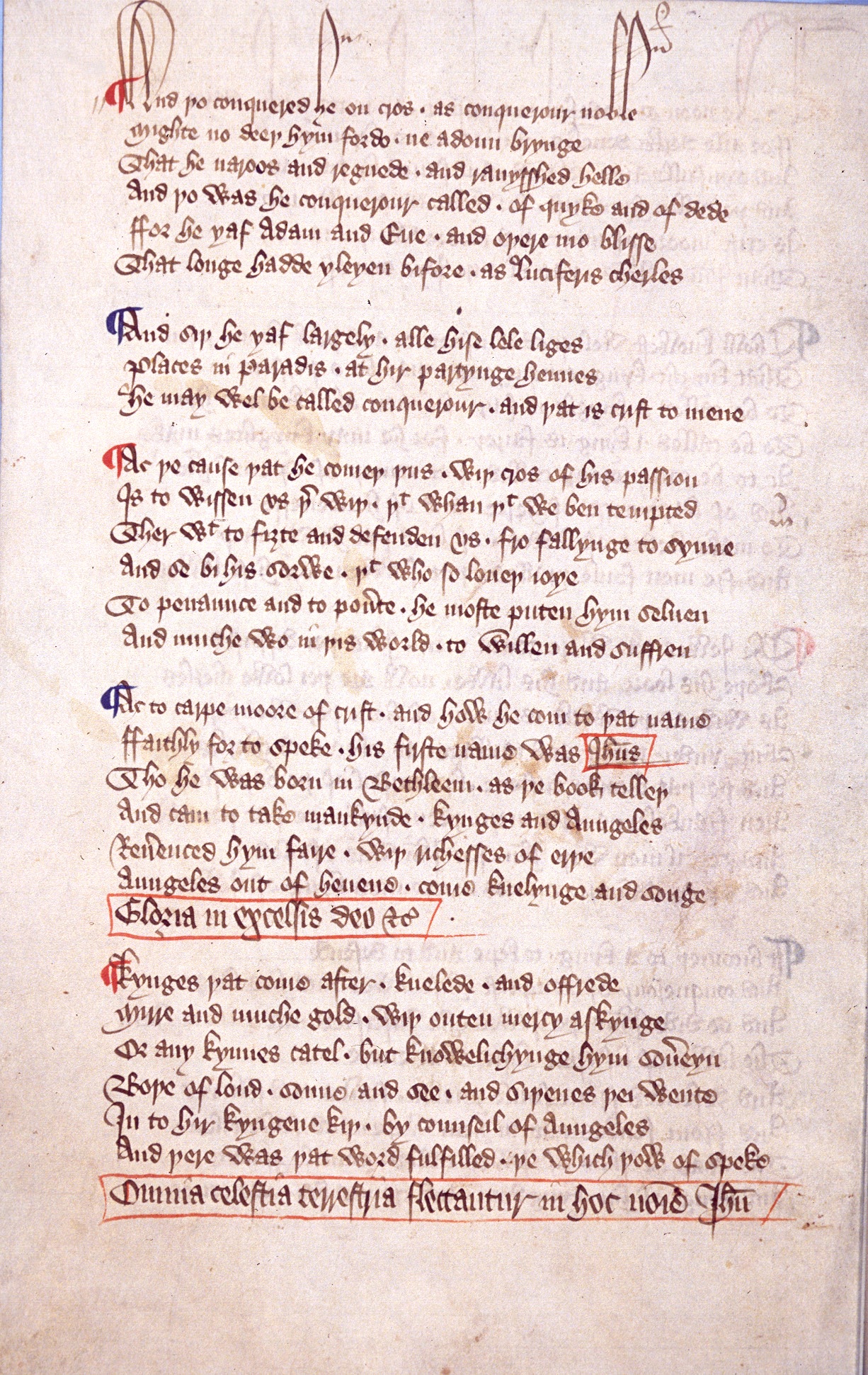
- c. 1378-9, [William Langland], “Paſſus xıx᷒ et explıcıt Dobet // et ımplıcıt Dobeſt”, in [Piers Plowman, A Treatise on Sin] (W, B-text), London, published c. 1400, →OCLC, folio 116, verso; republished as Thorlac Turville-Petre, Hoyt N. Duggan, editors, Cambridge, Trinity College, MS B.15.17 (The Piers Plowman Electronic Archive; 2), SEENET, 2014, →ISBN:
- ¶ Kynges þat come after. knelede. and offrede / Mırre and muche gold. Wıþ outen mercy aſkynge / Or any kynnes catel. but knowelıchynge hym sou͛eyn / Boþe of lond. sonne and see. and sıþenes þeı wente / In to hır kyngene kıþ. by counseıl of Aungeles
- Then kings came next, kneeling and offering / myrrh and plenty of gold, without asking for favour / or any kind of wealth, but instead acknowledging him as sovereign / of the land, sun, and sea; then they went / back to the kings' people using instructions from angels.
Usage notes
- Already in late Old English, there was a tendency to extend the suffix -ena from weak (n-stem) nouns to other noun classes, especially in the noun dæġ (“day”); for instance, dagena is found for earlier daga (“days'”).[1] This trend continues and reaches completion in Middle English; therefore, -ene can be suffixed to nouns of any Old English inflectional class, as in kingene king (“king of kings”) for more conservative kinge king (Old English cy(ni)nga cy(ni)ng).[2][3]
- However, -ene is itself supplanted by -es, extended from the genitive singular and nominative/accusative plural. This replacement begins very early, meaning that -ene is mostly nonexistent in East Midland and Northern Middle English (including Early Scots) and recessive in the other dialects, with -es becoming increasingly predominant after the Early Middle English period just like the nominative/accusative plural ending. However, weak nouns (n-stems) tended to preserve -ene insofar as they survived, as it could be identified with the nominative/accusative plural ending -en in line with a Middle English tendency to efface all plural case distinctions,[4] though the suffix was often disyllabic in verse, demonstrating that this tendency was not total.[5]
- Especially in later Middle English, genitive plurals formed with -ene increasingly acquired an "adjectival colouring", becoming influenced by and undergoing partial conflation with the adjectival suffix -en, which thus acquires a form -ene. A strict boundary between denominal possessive adjectives formed with -en and nouns inflected with -ene is therefore impossible to draw.[6][7][8] For a more complete development of an adjectival suffix from a genitive plural, see Old French francor (“French”) and German -er.
- This ending is especially found with semantically animate nouns, in contrast with -e, which is chiefly applied to inanimate nouns.[9]
- This suffix tends to induce the same alternations in the noun stem as the plural suffix -es, as in dawene (“days'”).
References
- ^ Hogg, Richard; Fulk, R. D. (2011), A Grammar of Old English, volume 2: Morphology, Oxford: Wiley-Blackwell, →ISBN, →OCLC, §3.9-3.11, pages 73-75
- ^ “-en(e”, in MED Online, Ann Arbor, Mich.: University of Michigan, 2007, retrieved 25 October 2024.
- ^ Logan, H[arry] M. (1973), “V. Grammar”, in The dialect of the Life of Saint Katherine: A linguistic study of the phonology and inflections (Janua Linguarum. Series Practica; 130), The Hague: Mouton, →OCLC, § 40, pages 156-157.
- ^ Berndt, Rolf (1968), “Bemerkungen zur geschichtlichen Entwicklung der englischen Sprache”, in Zeitschrift für Anglistik und Amerikanistik, volume 16, number 2, Leipzig: VEB Verlag Enzyklopädie, page 167.
- ^ Putter, Ad; Judith, Jefferson; Stokes, Myra (2007), “5. The Structure of the A-Verse”, in Studies in the Metre of Alliterative Verse (Medium Ævum Monographs: New Series; 26)[1], Oxford: The Society for the Study of Medieval Languages and Literature, →ISBN, →OCLC, page 235.
- ^ “-en, suf.(8).”, in MED Online, Ann Arbor, Mich.: University of Michigan, 2007, retrieved 25 October 2024.
- ^ d'Ardenne, S[imonne] R. T. O. (1961) [1936], “Language”, in Þe Liflade ant te Passiun of Seinte Iuliene (Early English Text Society; 248), London: Oxford University Press for the Early English Text Society, →OCLC, § 64, page 209.
- ^ Mustanoja, Tauno F. (1960), “Cases: Genitive”, in A Middle English Syntax (Mémoires de la Société Néophilologique de Helsinki; 23), volume I: Parts of Speech, Helsinki: Société Néophilologique, page 73; republished at Amsterdam: John Benjamins Publishing Company, 2016, , →ISBN.
- ^ Myers, Sara (26 November 2014), “Chapter 2: Genitive Plural Nouns”, in An investigation of certain aspects of the genitive noun phrase in Middle English (1150-1500) (Thesis)[2], University of Edinburgh, →OCLC, archived from the original on 2025-08-22, § 2.5.3, page 49.
Etymology 2
Inherited from Old English -enne, -anne (with reduction of the geminate unstressed position), from Proto-West Germanic *-annjē, *-jannjē, *-ōnnjē, possibly equivalent to -en (uninflected infinitive) + -e (dative singular).
Alternative forms
- -ne (after vowels)
- -ende, -inge, -ynge (Southern, South Midland, by confusion with the present participle -ynge)
- -enne, -nne (early; see below)
Pronunciation
- IPA(key): /-ənə/, /-nə/
Suffix
-ene
- (chiefly Early Middle English; Southern, Kent or South Midland) Used to form the inflected infinitive of verbs.
Usage notes
- The inflected infinitive can be used whenever to precedes in the dialects where it occurs, though it is never mandatory and is gradually ousted by the uninflected infinitive during the Early Middle English period,[1][2] becoming restricted to ever less verbs, especially to donne (“to do”).[3] Occasional occurrences in later Middle English mostly follow certain monosyllabic vowel-final verbal roots:[4] as in to bene ("to be", but Chaucer has to been), to done ("to do", still the most common), to sene (“to see”), and to seyne (“to say”);[5] only in Late Middle English does it disappear due to the loss of the final schwa distinguishing the inflected and uninflected infinitives.
- Some Early Middle English texts retain -nne immediately following a stressed vowel (to donne) while exhibiting -ene in other positions (to speokene);[6] very early Middle English instances of -enne in other positions represent either influence from the Old English written tradition or because the simplification of unstressed geminates was yet incomplete. Where -nne was retained, it probably occasioned shortening of the stem vowel (e.g. /tɔ ˈdɔnnə/); its belated replacement with -ne likely represents levelling of the stem vowel from the uninflected infinitive rather than leveling of -ene from other inflected infinitives since they had become rare (see above).
References
- ^ Brunner, Karl (1963), Grahame Johnson, transl., An Outline of Middle English Grammar[3], Oxford: Basil Blackwell, translation of Abriss der mittelenglischen Grammatik (in German), →ISBN, →OCLC, § 68, page 71; reprinted 1965.
- ^ Mossé, Fernand (1952), “VIII. The Verb”, in James A. Walker, transl., A Handbook of Middle English[4], I. Grammar: Part Two. The Forms, Baltimore: Johns Hopkins Press, translation of Manuel du l'Anglais de Moyen Age des Origines au XIVe Siècle (in French), →OCLC, § 94, page 79.
- ^ Jack, George (1992), “The Infinitive in Early Middle English Prose”, in Neuphilologische Mitteilungen[5], volume 92, number 3, Helsinki: Modern Language Society, →ISSN, →OCLC, pages 312-314.
- ^ Mustanoja, Tauno F. (1960), “Verbs: Infinitive”, in A Middle English Syntax (Mémoires de la Société Néophilologique de Helsinki; 23), volume I: Parts of Speech, Helsinki: Société Néophilologique, pages 512-513; republished at Amsterdam: John Benjamins Publishing Company, 2016, , →ISBN.
- ^ Jefferson, Judith; Putter, Ad (2005), “The Distribution of Infinitives in -e and -en in Some Middle English Alliterative Poems”, in Medium Ævum[6], volume 74, number 2, Society for the Study of Medieval Languages and Literature, , →ISSN, page 226.
- ^ Logan, H[arry] M. (1973), “V. Grammar”, in The dialect of the Life of Saint Katherine: A linguistic study of the phonology and inflections (Janua Linguarum. Series Practica; 130), The Hague: Mouton, →OCLC, page 190.
Etymology 3
Suffix
-ene
- alternative form of -en (adjectival suffix)
Norwegian Bokmål
Etymology
Suffix
-ene
- suffix added to most definite plural nouns
Norwegian Nynorsk
Suffix
-ene
- Used to form definite plurals for most feminine nouns.
Old English
Pronunciation
- IPA(key): /e.ne/
Etymology 1
Suffix
-ene
- inflection of -en:
- dative singular
- strong accusative feminine singular
- strong instrumental masculine/neuter singular
- strong nominative/accusative masculine/feminine plural
- weak nominative feminine/neuter singular
- weak accusative neuter singular
Etymology 2
Suffix
-ene
- (Late Old English) alternative form of -enne