pera
Asturian
Etymology
From Vulgar Latin *pira, from the plural of Latin pirum, reanalyzed as a feminine singular.
Pronunciation
- IPA(key): /ˈpeɾa/ [ˈpe.ɾa]
- Rhymes: -eɾa
- Syllabification: pe‧ra
Noun
pera f (plural peres)
Related terms
Further reading
- “pera”, in Diccionariu de la llingua asturiana [Dictionary of the Asturian Language] (in Asturian), 1ª edición, Academia de la Llingua Asturiana, 2000, →ISBN
- Xosé Lluis García Arias (2002–2004), “pera”, in Diccionario general de la lengua asturiana [General Dictionary of the Asturian Language] (in Spanish), Editorial Prensa Asturiana, →ISBN
Basque
Noun
pera
Catalan
Etymology
Inherited from Old Catalan pera, from Vulgar Latin *pira, from the plural of Latin pirum, reanalyzed as a feminine singular.
Pronunciation
- IPA(key): (Central) [ˈpɛ.ɾə]
- IPA(key): (Balearic) [ˈpə.ɾə]
- IPA(key): (Valencia) [ˈpe.ɾa]
Audio (Valencia): (file) - Rhymes: -ɛɾa
- Rhymes: -eɾa
Noun
pera f (plural peres)
Derived terms
- partir peres
- perer
- perera
- tocar la pera
Further reading
- “pera”, in Diccionari de la llengua catalana [Dictionary of the Catalan Language] (in Catalan), second edition, Institute of Catalan Studies [Catalan: Institut d'Estudis Catalans], April 2007
- “pera”, in Gran Diccionari de la Llengua Catalana, Grup Enciclopèdia Catalana, 2026
- “pera” in Diccionari normatiu valencià, Acadèmia Valenciana de la Llengua.
- “pera” in Diccionari català-valencià-balear, Antoni Maria Alcover and Francesc de Borja Moll, 1962.
Chavacano
Etymology
Pronunciation
- IPA(key): /ˈpeɾa/, [ˈpe.ɾa]
- Hyphenation: pe‧ra
Noun
pera
- pear (fruit)
Corsican
Noun
pera f (plural pere)
Related terms
- peru (“pear tree”)
References
- “pera” in INFCOR: Banca di dati di a lingua corsa
Czech
Pronunciation
- IPA(key): [ˈpɛra]
Etymology 1
Noun
pera
- inflection of pero:
- genitive singular
- nominative/accusative/vocative plural
Etymology 2
Verb
pera
- masculine singular present transgressive of prát
Faroese
Etymology
From Old Norse pera, probably from Old English pere, peru, from Latin pirum.
Pronunciation
- IPA(key): /ˈpʰeːɹa/
- Rhymes: -eːɹa
Noun
pera f (genitive singular peru, plural perur)
- pear (fruit)
- light bulb
Declension
| f1 | singular | plural | ||
|---|---|---|---|---|
| indefinite | definite | indefinite | definite | |
| nominative | pera | peran | perur | perurnar |
| accusative | peru | peruna | perur | perurnar |
| dative | peru | peruni | perum | perunum |
| genitive | peru | perunnar | pera | peranna |
Galician
Etymology
From Old Galician-Portuguese pera (13th century, Alfonso X), from Vulgar Latin *pira, from the plural of Latin pirum, reanalyzed as a feminine singular.
Pronunciation
- IPA(key): [ˈpeɾɐ]
Noun
pera f (plural peras)
- pear (fruit)
- (slang) masturbation
Derived terms
- pereira (“pear tree”)
- leite de pera (“semen”)
References
- Seoane, Ernesto Xosé González; Granja, María Álvarez de la; Agrelo, Ana Isabel Boullón (2006–2022), “pera”, in Dicionario de Dicionarios do galego medieval [Dictionary of dictionaries of Medieval Galician] (in Galician), Santiago de Compostela: Instituto da Lingua Galega
- Antón Luís Santamarina Fernández, editor (2006–2013), “pera”, in Dicionario de Dicionarios da lingua galega [Dictionary of Dictionaries of the Galician language] (in Galician), Santiago de Compostela: Instituto da Lingua Galega
- Antón Luís Santamarina Fernández, Ernesto Xosé González Seoane, María Álvarez de la Granja, editors (2003–2018), “pera”, in Tesouro informatizado da lingua galega (in Galician), Santiago de Compostela: Instituto da Lingua Galega
- Rosario Álvarez Blanco, editor (2014–2024), “pera”, in Tesouro do léxico patrimonial galego e portugués (in Galician), Santiago de Compostela: Instituto da Lingua Galega, →ISSN
Further reading
- “pera”, in Dicionario da Real Academia Galega (in Galician), A Coruña: Royal Galician Academy, 2012–2026
Icelandic
Etymology
From Old Norse pera, probably from Old English pere, peru, from Latin pirum.
Pronunciation
- IPA(key): /ˈpʰɛːra/
- Rhymes: -ɛːra
Noun
pera f (genitive singular peru, nominative plural perur)
- pear (fruit)
- light bulb
Declension
| singular | plural | |||
|---|---|---|---|---|
| indefinite | definite | indefinite | definite | |
| nominative | pera | peran | perur | perurnar |
| accusative | peru | peruna | perur | perurnar |
| dative | peru | perunni | perum | perunum |
| genitive | peru | perunnar | pera | peranna |
Istriot
Etymology
From Latin petra, from Ancient Greek πέτρα (pétra).
Noun
pera f
Italian
Etymology
From Vulgar Latin *pira, from the plural of Latin pirum, reanalyzed as a feminine singular.
Pronunciation
- IPA(key): /ˈpe.ra/
- Rhymes: -era
- Hyphenation: pé‧ra
Audio: (file)
Noun
pera f (plural pere)
Related terms
Descendants
- → Ottoman Turkish: پرو (pero)
Anagrams
Latin
Etymology
From Ancient Greek πήρα (pḗra).
Pronunciation
- (Classical Latin) IPA(key): [ˈpeː.ra]
- (modern Italianate Ecclesiastical) IPA(key): [ˈpɛː.ra]
Noun
pēra f (genitive pērae); first declension
Declension
First-declension noun.
| singular | plural | |
|---|---|---|
| nominative | pēra | pērae |
| genitive | pērae | pērārum |
| dative | pērae | pērīs |
| accusative | pēram | pērās |
| ablative | pērā | pērīs |
| vocative | pēra | pērae |
Derived terms
Related terms
References
- “pera”, in Charlton T. Lewis and Charles Short (1879), A Latin Dictionary, Oxford: Clarendon Press
- “pera”, in Charlton T. Lewis (1891), An Elementary Latin Dictionary, New York: Harper & Brothers
- "pera", in Charles du Fresne du Cange, Glossarium Mediæ et Infimæ Latinitatis (augmented edition with additions by D. P. Carpenterius, Adelungius and others, edited by Léopold Favre, 1883–1887)
- “pera”, in Harry Thurston Peck, editor (1898), Harper’s Dictionary of Classical Antiquities, New York: Harper & Brothers
- “pera”, in William Smith, editor (1848), A Dictionary of Greek and Roman Biography and Mythology, London: John Murray
- “pera”, in William Smith et al., editor (1890), A Dictionary of Greek and Roman Antiquities, London: William Wayte. G. E. Marindin
Anagrams
Leonese
Etymology
(This etymology is missing or incomplete. Please add to it, or discuss it at the Etymology scriptorium.)
Noun
pera f (plural peras)
References
- “pera”, in Diccionario Castellano-Leonés / Leonés-Castellano [Spanish-Leonese / Leonese-Spanish Dictionary] (in Spanish), La Asociación L'Alderique, 2012–2026
- “pera”, in Pallabreiru Llïonés [Leonese Dictionary] (in Spanish), 2026
Lindu
Noun
pera
Makasar
Etymology
From Proto-Malayo-Polynesian *pəʀəq, from Proto-Austronesian *pəʀəq.
Pronunciation
- IPA(key): [ˈpera]
Verb
pera (Lontara spelling ᨄᨙᨑ, semi-transitive ammera)
- (transitive) to wring out
Māori
Pronunciation
- IPA(key): /ˈpera/ [ˈpɛɾɐ]
Etymology 1
(This etymology is missing or incomplete. Please add to it, or discuss it at the Etymology scriptorium.)
Noun
pera
Etymology 2
Noun
pera
Derived terms
- uhwi pera (“pillowcase”)
Further reading
- “pera” in John C. Moorfield, Te Aka: Maori–English, English–Maori Dictionary and Index, 3rd edition, Longman/Pearson Education New Zealand, 2011, →ISBN.
Occitan
Etymology
From Old Occitan pera, from Vulgar Latin *pira, from the plural of Latin pirum, reanalyzed as a feminine singular.
Pronunciation
Noun
pera f (plural peras)
Related terms
- perer / perièr
Old Galician-Portuguese
Pronunciation
- IPA(key): /ˈpe.ɾa/
Etymology 1
From Latin per (“through”) + ad (“to”).
Preposition
pera
- for, towards
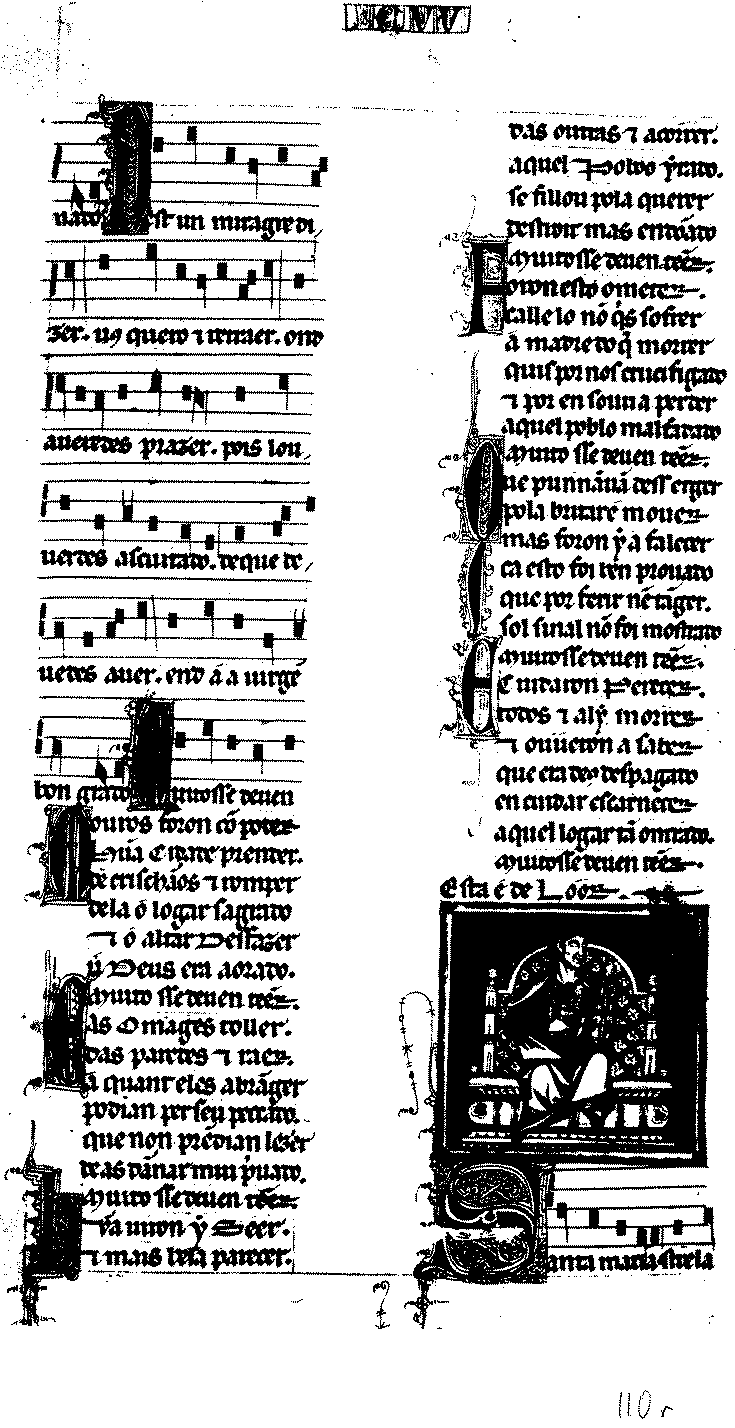
- a. 1284, Alfonso X of Castile, Cantigas de Santa Maria, Códice de los músicos, cantiga 100 (facsimile):
- Santa maria / ſtrela do dia / moſtra nos uia / pera deus ⁊ nos guia.
- Holy Mary, / star of the daytime; / show us the way / towards God, and guide us.
- Santa maria / ſtrela do dia / moſtra nos uia / pera deus ⁊ nos guia.
Descendants
- Galician: para, pra
- Portuguese: para, pra, pa (syncopated), p'ra (pre-standardization spelling, now nonstandard), p/ (abbreviation), pera (archaic)
Etymology 2
From Vulgar Latin *pira, from the plural of Latin pirum, reanalyzed as a feminine singular. Doublet of pero.
Noun
pera f (plural peras)
- pear
- maçãas e peras ― apples and pears
Descendants
Polish
Etymology
Unknown.
Pronunciation
- IPA(key): /ˈpɛ.ra/
- Rhymes: -ɛra
- Syllabification: pe‧ra
Noun
pera f (diminutive perka)
Declension
References
- “Pyra”, in Słownik gwary miejskiej Poznania, (Can we date this quote?)
Further reading
- pera in Polish dictionaries at PWN
Portuguese
Etymology 1
Inherited from Old Galician-Portuguese pera, from Vulgar Latin *pira, from the plural of Latin pirum, reanalyzed as a feminine singular.
Alternative forms
Pronunciation
- (Brazil) IPA(key): /ˈpe.ɾɐ/
- (Southern Brazil) IPA(key): /ˈpe.ɾa/
- (Portugal) IPA(key): /ˈpe.ɾɐ/
- Rhymes: -eɾɐ
- Hyphenation: pe‧ra
Noun
pera f (plural peras)
- pear
- (colloquial) a knuckle sandwich
- (Portugal) goatee
- Synonym: (Brazil) cavanhaque
Derived terms
Descendants
Etymology 2
Alternative forms
Pronunciation
- (Brazil) IPA(key): /ˈpɛ.ɾɐ/
- (Southern Brazil) IPA(key): /ˈpɛ.ɾa/
- (Portugal) IPA(key): /ˈpɛ.ɾɐ/
- Hyphenation: pe‧ra
Noun
pera f (plural peras)
- archaic form of pedra
Usage notes
Fossilized in constructions such as perafita (formerly spelled péra-fita).
Etymology 3
Pronunciation
- (Brazil) IPA(key): (unstressed) /pɛ.ɾɐ/, (with syncope) /pɾa/
- (Southern Brazil) IPA(key): (unstressed) /pɛ.ɾa/, (with syncope) /pɾa/
- (Portugal) IPA(key): (unstressed) /pɛ.ɾɐ/, (with syncope) /pɾɐ/
- Hyphenation: pe‧ra
Preposition
pera
- archaic form of para
Etymology 4
Clipping of espera, imperative of esperar (“to wait”).
Pronunciation
- (Brazil) IPA(key): /ˈpɛ.ɾɐ/
- (Southern Brazil) IPA(key): /ˈpɛ.ɾa/
- (Portugal) IPA(key): /ˈpɛ.ɾɐ/
- Rhymes: -ɛɾɐ
- Hyphenation: pe‧ra
Interjection
pera
- (colloquial) just a minute
- (colloquial) wait (asking for stop to make an observation)
Further reading
- “pera”, in Michaelis Dicionário Brasileiro da Língua Portuguesa (in Portuguese), São Paulo: Editora Melhoramentos, 2015–2026, →ISBN
- “pera”, in Dicionário infopédia da Lingua Portuguesa (in Portuguese), Porto: Porto Editora, 2003–2026
- “pera”, in Dicionário da Língua Portuguesa (in Portuguese), Lisboa: Academia das Ciências de Lisboa, 2001–2026
- “pera”, in Dicionário Priberam da Língua Portuguesa (in Portuguese), Lisbon: Priberam, 2008–2026
- “pera”, in Dicionário Aulete Digital (in Portuguese), Rio de Janeiro: Lexikon Editora Digital, 2008–2026
Serbo-Croatian
Noun
pera (Cyrillic spelling пера)
- inflection of pero:
- genitive singular
- nominative/genitive/accusative/vocative plural
Slovak
Etymology
(This etymology is missing or incomplete. Please add to it, or discuss it at the Etymology scriptorium.)
Pronunciation
- IPA(key): /pera/, [ˈpera]
- Rhymes: -era
- Hyphenation: pe‧ra
Noun
pera
- genitive singular of pero
Noun
pera f
Declension
| singular | plural | |
|---|---|---|
| nominative | pera | pery |
| genitive | pery | perí, pier |
| dative | pere | perám |
| accusative | peru | pery |
| locative | pere | perách |
| instrumental | perou | perami |
Further reading
- “pera”, in Slovníkový portál Jazykovedného ústavu Ľ. Štúra SAV [Dictionary portal of the Ľ. Štúr Institute of Linguistics, Slovak Academy of Science] (in Slovak), https://slovnik.juls.savba.sk, 2003–2026
Spanish
Etymology
Inherited from Old Spanish pera, from Vulgar Latin *pira, from the plural of Latin pirum, reanalyzed as a feminine singular.
Pronunciation
- IPA(key): /ˈpeɾa/ [ˈpe.ɾa]
Audio (Colombia): (file) - Rhymes: -eɾa
- Syllabification: pe‧ra
Noun
pera f (plural peras)
Derived terms
Descendants
- → Jicarilla: béela
Further reading
- “pera”, in Diccionario de la lengua española [Dictionary of the Spanish Language] (in Spanish), online version 23.8.1, Royal Spanish Academy [Spanish: Real Academia Española], 15 December 2025
Anagrams
Swahili
Etymology
Borrowed from Portuguese pera (“pear”).[1]
Pronunciation
Audio (Kenya): (file)
Noun
pera class V (plural mapera class VI)
Derived terms
References
- ^ Brook, Zev (2022), “Which Arabic Dialect Are Swahili Words From?”, in Studia Orientalia Electronica[1], volume 10, number 1, page 2 of 1-10: “Swahili, however, uses the Portuguese borrowing pera for ‘guava’”
Tagalog
Etymology
Borrowed from Spanish perra (“cash; 5 and 10 centimo peseta coins”, literally “bitch / female dog”),[1][2] feminine of perro (“dog”), due to the circulation of perra gorda (“ten centimo peseta coin”), perra chica (“five centimo peseta coin”). Such coins depicted a poorly drawn Spanish heraldic lion rampant regardant and people called the lion humorously a perra.
Potet (2016) also remarked that the word seems to be a cross between Malay perak and Spanish perra, wherein an interference could have occurred between the colloquial senses of Spanish perra (“cash; dough (money)”, literally “bitch (dog)”) and Malay perak (“coin”, literally “silver”). See also pilak.
Alternatively, possibly from Spanish pela (“one peseta coin”, literally “a hit or beating”), also with a similar lion design.
Pronunciation
- (Standard Tagalog) IPA(key): /ˈpeɾa/ [ˈpɛː.ɾɐ]
- Rhymes: -eɾa
- (Bataan) IPA(key): /ˈpiɾa/ [ˈpiː.ɾɐ]
- Rhymes: -iɾa
- Syllabification: pe‧ra
Noun
pera (Baybayin spelling ᜉᜒᜇ)
- money; cash
- Synonyms: see Thesaurus:salapi
- (colloquial, dated) centavo
- Synonym: sentimo
Derived terms
- mamera
- mapera
- mukhang pera
- pera-pera
- perahan
- perahin
- perang-hapon
- sampera
See also
- panday-pira
References
Further reading
- “pera”, in KWF Diksiyonaryo ng Wikang Filipino, Komisyon sa Wikang Filipino, 2025
Anagrams
Veps
Etymology
From Proto-Finnic *perä, from Proto-Finno-Ugric *perä. Cognates include Finnish perä.
Noun
pera
- stern (rear end of a ship)
Inflection
| Inflection of pera (inflection type 5/sana) | |||
|---|---|---|---|
| nominative sing. | pera | ||
| genitive sing. | peran | ||
| partitive sing. | perad | ||
| partitive plur. | peroid | ||
| singular | plural | ||
| nominative | pera | perad | |
| accusative | peran | perad | |
| genitive | peran | peroiden | |
| partitive | perad | peroid | |
| essive-instructive | peran | peroin | |
| translative | peraks | peroikš | |
| inessive | peras | peroiš | |
| elative | peraspäi | peroišpäi | |
| illative | peraha | peroihe | |
| adessive | peral | peroil | |
| ablative | peralpäi | peroilpäi | |
| allative | perale | peroile | |
| abessive | perata | peroita | |
| comitative | peranke | peroidenke | |
| prolative | peradme | peroidme | |
| approximative I | peranno | peroidenno | |
| approximative II | perannoks | peroidennoks | |
| egressive | perannopäi | peroidennopäi | |
| terminative I | perahasai | peroihesai | |
| terminative II | peralesai | peroilesai | |
| terminative III | perassai | — | |
| additive I | perahapäi | peroihepäi | |
| additive II | peralepäi | peroilepäi | |