fame
English
Etymology
From Middle English fame, from Old French fame (“celebrity, renown”), itself borrowed from Latin fāma (“talk, rumor, report, reputation”), from Proto-Indo-European *bʰéh₂-meh₂, from *bʰeh₂- (“to speak, say, tell”). Cognate with Ancient Greek φήμη (phḗmē, “talk”). Related also to Latin for (“speak, say”, verb), Old English bōian (“to boast”), Old English bēn (“prayer, request”), Old English bannan (“to summon, command, proclaim”). More at ban.
Displaced native Old English hlīsa.
Pronunciation
- IPA(key): /feɪm/
Audio (US): (file) - Rhymes: -eɪm
Noun
fame (usually uncountable, plural fames)
- (now rare) Something said or reported; gossip, rumour.
- 1667, John Milton, “Book I”, in Paradise Lost. […], London: […] [Samuel Simmons], and are to be sold by Peter Parker […]; [a]nd by Robert Boulter […]; [a]nd Matthias Walker, […], →OCLC; republished as Paradise Lost in Ten Books: […], London: Basil Montagu Pickering […], 1873, →OCLC, lines 651-4:
- There went a fame in Heav'n that he ere long / Intended to create, and therein plant / A generation, whom his choice regard / Should favour […].
- 2012, Faramerz Dabhoiwala, The Origins of Sex, Penguin, published 2013, page 23:
- If the accused could produce a specified number of honest neighbours to swear publicly that the suspicion was unfounded, and if no one else came forward to contradict them convincingly, the charge was dropped: otherwise the common fame was held to be true.
- One's reputation.
- The state of being famous or well-known and spoken of, especially for something positive.
- Synonym: famousness
- Antonyms: obscurity, unknownness
- c. 1597 (date written), William Shakespeare, “The First Part of Henry the Fourth, […]”, in Mr. William Shakespeares Comedies, Histories, & Tragedies […] (First Folio), London: […] Isaac Iaggard, and Ed[ward] Blount, published 1623, →OCLC, [Act II, scene iii]:
- I find thou art no less than fame hath bruited.
- 1897 December (indicated as 1898), Winston Churchill, chapter I, in The Celebrity: An Episode, New York, N.Y.: The Macmillan Company; London: Macmillan & Co., Ltd., →OCLC:
- I was about to say that I had known the Celebrity from the time he wore kilts. But I see I will have to amend that, because he was not a celebrity then, nor, indeed, did he achieve fame until some time after I left New York for the West.
Hyponyms
Derived terms
- 15 megabytes of fame
- 15 minutes of fame
- antifame
- claim to fame
- cyberfame
- disfame
- e-fame
- enfame
- famacide
- fame digger
- fame-ish
- fameless
- famesque
- fame whore
- fameworthy
- fifteen megabytes of fame
- fifteen minutes of fame
- hall of fame
- herostratic fame
- horse fame
- house of ill fame
- ill fame
- Instafame
- microfame
- outfame
- semifame
- unfame
- walk of fame
- woman of ill fame
Translations
|
Verb
fame (third-person singular simple present fames, present participle faming, simple past and past participle famed)
- (transitive) to make (someone or something) famous
Related terms
See also
Anagrams
Asturian
Etymology
From Vulgar Latin *faminem or *famen, from Latin famēs (“hunger”), from Proto-Indo-European *dʰH- (“to disappear”).
Noun
fame f (plural fames)
- hunger
- Teníemos fame.
- We were hungry.
- (literally, “We had hunger.”)
Related terms
Further reading
- “fame”, in Diccionariu de la llingua asturiana [Dictionary of the Asturian Language] (in Asturian), 1ª edición, Academia de la Llingua Asturiana, 2000, →ISBN
- Xosé Lluis García Arias (2002–2004), “fame”, in Diccionario general de la lengua asturiana [General Dictionary of the Asturian Language] (in Spanish), Editorial Prensa Asturiana, →ISBN
Esperanto
Pronunciation
- IPA(key): /ˈfame/
- Rhymes: -ame
- Syllabification: fa‧me
Adverb
fame
Related terms
Galician
Alternative forms
Etymology
From Old Galician-Portuguese, from Vulgar Latin *fam(i)ne(m) or more likely *famen, from Latin famēs (“hunger”), from Proto-Indo-European *dʰH- (“to disappear”). Cognate with Portuguese fome, French faim, Spanish hambre, Italian fame and Romanian foame.
Pronunciation
- IPA(key): [ˈfamɪ]
Noun
fame f (plural fames)
- hunger
- 1390, Pensado Tomé, edited by José Luís, Os Miragres de Santiago. Versión gallega del Códice latino del siglo XII atribuido al papa Calisto I, Madrid: C.S.I.C, page 136:
- onde eu moytas chagas et deostos et pelejas et escarnos et caenturas et cãsaço et fame et frio et moytos outros traballos padeçin
- here, where I have suffered many sores and insults and fights and derision and fever and tiredness and hunger and cold and so many other pains
- famine
- 1419, Pérez Rodríguez, F. (ed.), "San Jorge de Codeseda: un monasterio femenino bajomedieval", in Studia Monastica (33), page 84:
- eno tempo da abadesa Donna Moor Peres, que foy ante do anno da grande fame
- in times of the abbess Lady Mor Pérez, which was the year before the great famine
- 1419, Pérez Rodríguez, F. (ed.), "San Jorge de Codeseda: un monasterio femenino bajomedieval", in Studia Monastica (33), page 84:
Derived terms
References
- Seoane, Ernesto Xosé González; Granja, María Álvarez de la; Agrelo, Ana Isabel Boullón (2006–2022), “fame”, in Dicionario de Dicionarios do galego medieval [Dictionary of dictionaries of Medieval Galician] (in Galician), Santiago de Compostela: Instituto da Lingua Galega
- Antón Luís Santamarina Fernández, editor (2006–2013), “fame”, in Dicionario de Dicionarios da lingua galega [Dictionary of Dictionaries of the Galician language] (in Galician), Santiago de Compostela: Instituto da Lingua Galega
- Antón Luís Santamarina Fernández, Ernesto Xosé González Seoane, María Álvarez de la Granja, editors (2003–2018), “fame”, in Tesouro informatizado da lingua galega (in Galician), Santiago de Compostela: Instituto da Lingua Galega
- Rosario Álvarez Blanco, editor (2014–2024), “fame”, in Tesouro do léxico patrimonial galego e portugués (in Galician), Santiago de Compostela: Instituto da Lingua Galega, →ISSN
German
Etymology
Probably a clipped borrowing from English famous, likely influenced by the similarly borrowed Fame which serves as its noun equivalent. Attested by the mid-2000s.
Pronunciation
- IPA(key): /fɛɪ̯m/
Adjective
fame (indeclinable)
- (slang, social media, rap, only predicatively) famous, well-known (of a person)
- 2006, F.R./Fabian Römer, “Abstand”, in Mittelweg:
- Und ich fänd es eher eklig wenn mich Bitches ansprechen
Die mich schon länger kennen, doch plötzlich wolln sie sich mit mir treffen?
Wenn du nur dein Ding machst, dann kannst du nichts dafür
Wenn du mal richtig Fame bist, stehn sie dann nackt vor deiner Tür?- And I think it'd be rather disgusting if bitches wanted to talk to me
That have known me for a while, and only now they want to meet?
If you're just doing your own thing, then it isn't your own fault
Once you're proper famous, will they be standing naked outside your door?
- And I think it'd be rather disgusting if bitches wanted to talk to me
- 2011, Kollegah & Sun Diego, “I.H.D.P.”, in Bossaura:
- Doch es ist schwer, ein gutes Mädchen zu finden, wenn du fame bist und Money hast
- But it's hard finding a nice girl when you're famous and have money
- 2020 September 9, Jörg Kramer, Carly Laurence, quoting Katja Krasavice, “Katja Krasavice: "Ich bin gerne aufreizend"”, in Die Zeit[1], archived from the original on 25 October 2025:
- Ich habe gemacht, was ich liebe. Eigentlich wollte ich nur fame sein. Dann kam das Geld, das war ein megageiler Bonus.
- I did what I love doing. Honestly, I only wanted to be famous. Then I also got the money on top, that was an awesome bonus.
Related terms
- famos
- Fame
Interlingua
Etymology
Derived from Italian fame, Spanish fame and French faim, all from Latin famēs.
Pronunciation
- IPA(key): /ˈfa.me/
Noun
fame (uncountable)
Further reading
- Alexander Gode (1951), Interlingua-English: A Dictionary of the International Language, New York: Storm Publishers, →OL
Italian
Etymology
Inherited from Latin famem (“hunger”), probably from Proto-Indo-European *dʰH- (“to disappear”). Compare Galician fame, French faim, Portuguese fome and Romanian foame, Sicilian fami.
Pronunciation
- IPA(key): /ˈfa.me/
Audio: (file) - Rhymes: -ame
- Hyphenation: fà‧me
Noun
fame f (plural fami)
- hunger
- 2006, Società Biblica di Ginevra, Nuova Riveduta 2006, Psalm 33:19:
- per liberarli dalla morte e conservarli in vita in tempo di fame.
- to deliver them from death and to keep them alive in times of hunger.
- Ho fame.
- I'm hungry.
- (literally, “I have hunger.”)
- 2006, Società Biblica di Ginevra, Nuova Riveduta 2006, Psalm 33:19:
Derived terms
- affamare (“to starve”)
- affamato (“starving”)
- fame da lupo (“excessive hunger”)
- sfamare (“to feed”)
Related terms
- famelico (“ravenous”)
Noun
fame f pl
- plural of fama
Latin
Pronunciation
- (Classical Latin) IPA(key): [ˈfa.mɛ]
- (modern Italianate Ecclesiastical) IPA(key): [ˈfaː.me]
Noun
famē f
- ablative singular of famēs (“hunger”)
References
- "fame", in Charles du Fresne du Cange, Glossarium Mediæ et Infimæ Latinitatis (augmented edition with additions by D. P. Carpenterius, Adelungius and others, edited by Léopold Favre, 1883–1887)
- “fame”, in The Perseus Project (1999), Perseus Encyclopedia[2]
Louisiana Creole
Etymology
Noun
fame
References
- Alcée Fortier, Louisiana Folktales
Old French
Alternative forms
Etymology
Pronunciation
- IPA(key): /ˈfã.mə/
Noun
fame oblique singular, f (oblique plural fames, nominative singular fame, nominative plural fames)
- wife, female partner
- woman, especially one of lower social status (dame being the usual word for upper-class women)
Descendants
- Bourbonnais-Berrichon: fonne
- Bourguignon: fanne, fonne
- Champenois: fanme, fonme, fomme
- Gallo: fame, fom
- Lorrain: fomme
- Middle French: femme (see there for further descendants)
- Norman: femme, fâme, faume, faumme (Guernsey), foume (continental), fenme (Cotentin), foume, fenme
- Picard: fanme, féme, feume
- Walloon: feme
- → Middle English: femme, feme
Old Galician-Portuguese
Alternative forms
Etymology
From Vulgar Latin *fam(i)ne(m), or more likely *famen, from Latin famēs (“hunger”), from Proto-Indo-European *dʰH- (“to disappear”). Cognate with Old Spanish fambre.
Pronunciation
- IPA(key): /ˈfa.me/
Noun
fame f (plural fames)
- hunger
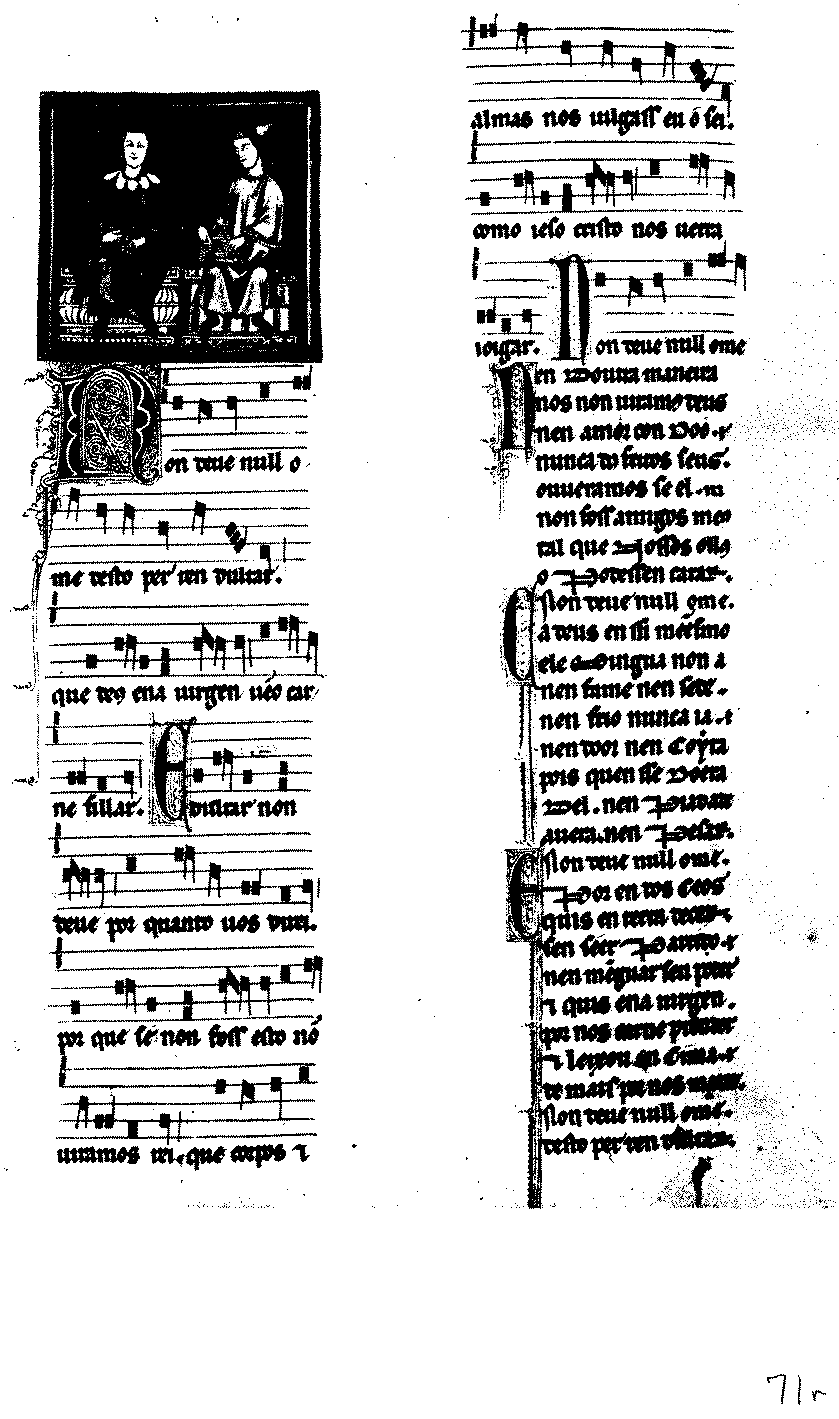
- a. 1284, Alfonso X of Castile, Cantigas de Santa Maria, Códice de los músicos, cantiga 50 (facsimile):
- nen fame nen ſede. nen frio
- nor hunger nor thirst nor cold
- nen fame nen ſede. nen frio
Descendants
Spanish
Etymology
Probably borrowed from Asturian fame (“hunger”), from Proto-Indo-European *dʰH- (“to disappear”). Cognate with Portuguese fome, French faim, Italian fame and Romanian foame. Doublet of hambre.
Pronunciation
- IPA(key): /ˈfame/ [ˈfa.me]
- Rhymes: -ame
- Syllabification: fa‧me
Noun
fame f (plural fames)
Verb
fame
- inflection of far:
Further reading
- “fame”, in Diccionario de la lengua española [Dictionary of the Spanish Language] (in Spanish), online version 23.8.1, Royal Spanish Academy [Spanish: Real Academia Española], 15 December 2025