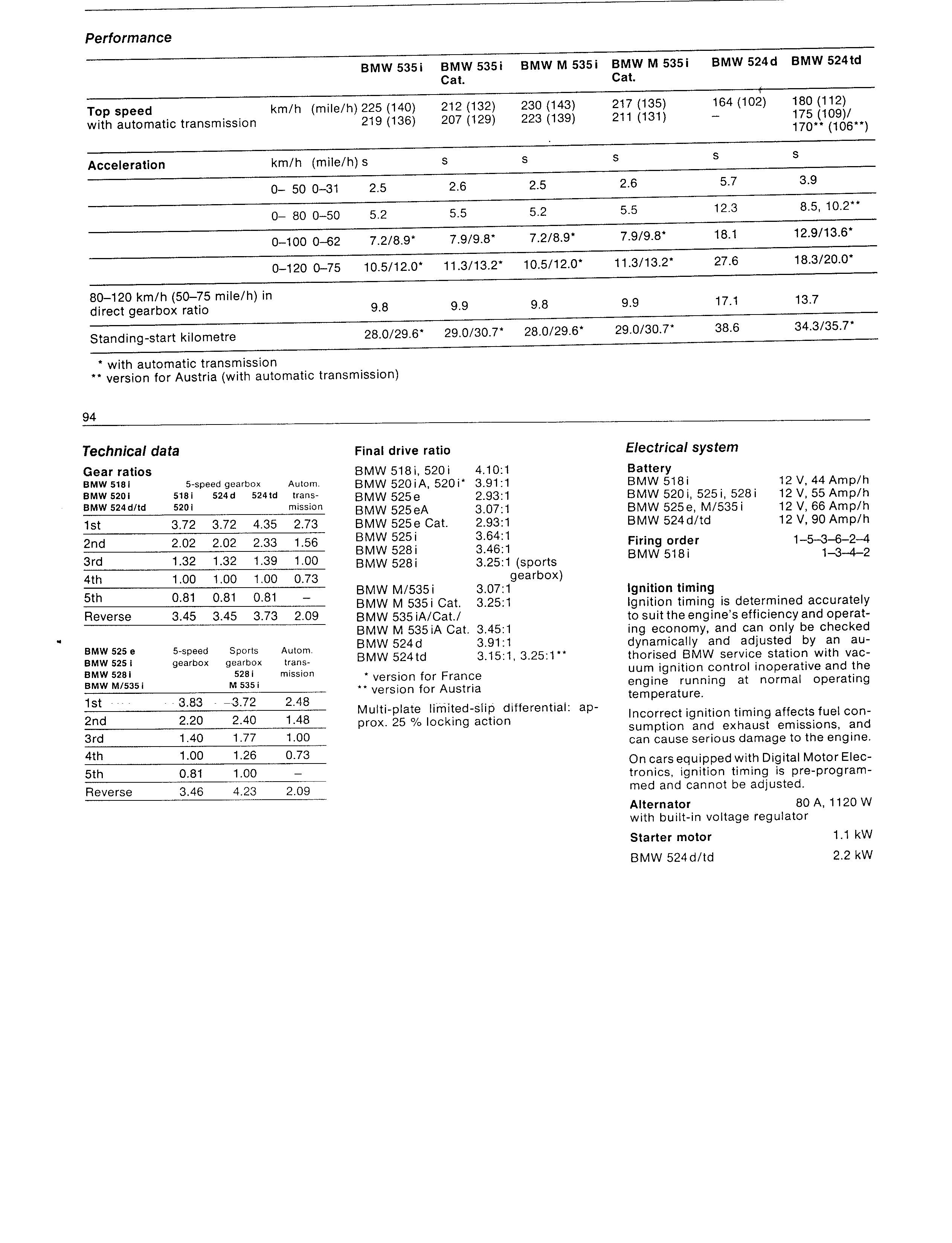
The 4HP is a 4-speed automatic transmission family with a hydrodynamic torque converter with an electronic hydraulic control for passenger cars from ZF Friedrichshafen AG. In selector level position "P", the output is locked mechanically. The Simpson planetary gearset types were first introduced in 1980, the Ravigneaux planetary gearset types in 1984 and produced through 2003 in different versions and were used in a large number of vehicles.
Gear Ratios[a]
| Model
|
First
Delivery
|
Gear
|
Total Span
|
Avg.
Step
|
Components
|
| R
|
1
|
2
|
3
|
4
|
Nomi-
nal
|
Effec-
tive
|
Cen-
ter
|
Total
|
per
Gear[b]
|
|
|
4HP 22
Large Engines
|
1980
|
−2.086
|
2.479
|
1.479
|
1.000
|
0.728
|
3.406
|
2.865
|
1.344
|
1.505
|
3 Gearsets
4 Brakes
3 Clutches
|
2.500
|
4HP 22
Small Engines
|
1980
|
−2.086
|
2.733
|
1.562
|
1.000
|
0.728
|
3.754
|
2.865
|
1.411
|
1.554
|
|
|
| 4HP 14
|
1984
|
−2.828
|
2.412
|
1.369
|
1.000
|
0.739
|
3.265
|
3.265
|
1.335
|
1.483
|
2 Gearsets
2 Brakes
3 Clutches
|
1.750
|
| 4HP 18
|
1987
|
−2.882
|
2.579
|
1.407
|
1.000
|
0.742
|
3.474
|
3.474
|
1.384
|
1.514
|
|
|
- ^ Differences in gear ratios have a measurable, direct impact on vehicle dynamics, performance, waste emissions as well as fuel mileage
- ^ Forward gears only
|
|
|
1980: Simpson Planetary Gearset Types
The 4HP 20 was introduced in 1995 and has been used in a variety of cars from Citroën, Lancia, Mercedes-Benz, Peugeot, and Renault.[1] The maximum torque capacity is 330 N⋅m (243 lb⋅ft).
The 4HP 22 was produced for vehicles with rear wheel drive or 4X4 layout. Introduced in 1980, it was produced through 2003, and has been used in a variety of cars from BMW, General Motors, Jaguar, Land Rover, Maserati, Peugeot, Porsche, and Volvo.
The 4HP 24 was introduced in 1987 and was used in a variety of cars from Audi, BMW, Jaguar, and Land Rover.
Gearset Concept Simpson Types: Cost Effectiveness
Gearset Concept: Cost-Effectiveness[a]
With
Assessment
|
Output:
Gear
Ratios
|
Innovation
Elasticity[b]
Δ Output : Δ Input
|
Input: Main Components
|
| Total
|
Gearsets
|
Brakes
|
Clutches
|
|
|
4HP
Ref. Object
|


|
Topic[b]
|


|


|


|


|
| Δ Number
|

|

|

|

|

|
| Relative Δ
|
Δ Output

|
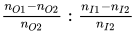
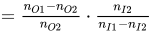
|
Δ Input

|

|

|

|
|
|
4HP
ZF 3HP[c]
|
4
3
|
Progress[b]
|
10
7
|
3
2
|
4
3
|
3
2
|
| Δ Number
|
1
|
3
|
1
|
1
|
1
|
| Relative Δ
|
0.333

|
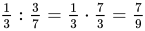
0.778[b]
|
0.429

|
0.500

|
0.333
|
0.500
|
|
|
ZF 4HP
4G-Tronic
|
4[d]
4[e][d]
|
Market Position[b]
|
10
8
|
3[e]
3[e]
|
4
3
|
3
2
|
| Δ Number
|
0
|
2
|
0
|
1
|
1
|
| Relative Δ
|
0.000

|
0.000[b]

|
0.250

|
0.000

|
0.333

|
0.500
|
|
|
4HP
3-Speed[f]
|
4[d]
3[d]
|
Historical
Market Position[b]
|
10
7
|
3
2
|
4
3
|
3
2
|
| Δ Number
|
1
|
3
|
1
|
1
|
1
|
| Relative Δ
|
0.333
|
0.778[b]
|
0.429
|
0.500
|
0.333
|
0.500
|
|
|
- ^ Progress increases cost-effectiveness and is reflected in the ratio of forward gears to main components.
It depends on the power flow:
- parallel: using the two degrees of freedom of planetary gearsets
- to increase the number of gears
- with unchanged number of components
- serial: in-line combined planetary gearsets without using the two degrees of freedom
- to increase the number of gears
- a corresponding increase in the number of components is unavoidable
- ^ a b c d e f g h Innovation Elasticity Classifies Progress And Market Position
- Automobile manufacturers drive forward technical developments primarily in order to remain competitive or to achieve or defend technological leadership. This technical progress has therefore always been subject to economic constraints
- Only innovations whose relative additional benefit is greater than the relative additional resource input, i.e. whose economic elasticity is greater than 1, are considered for realization
- The required innovation elasticity of an automobile manufacturer depends on its expected return on investment. The basic assumption that the relative additional benefit must be at least twice as high as the relative additional resource input helps with orientation
- negative, if the output increases and the input decreases, is perfect
- 2 or above is good
- 1 or above is acceptable (red)
- below this is unsatisfactory (bold)
- ^ Direct Predecessor
- To reflect the progress of the specific model change
- ^ a b c d plus 1 reverse gear
- ^ a b c which are combined as a compound Ravigneaux gearset
- ^ Historical Reference Standard (Benchmark)
- 3-speed transmissions with torque converters have established the modern market for automatic transmissions and thus made it possible in the first place, as this design proved to be a particularly successful compromise between cost and performance
- It became the archetype and dominated the world market for around 3 decades, setting the standard for automatic transmissions. It was only when fuel consumption became the focus of interest that this design reached its limits, which is why it has now completely disappeared from the market
- What has remained is the orientation that it offers as a reference standard (point of reference, benchmark) for this market for determining progressiveness and thus the market position of all other, later designs
- All transmission variants consist of 7 main components
- Typical examples are
|
|
|
Gearset Concept Simpson Types: Quality
Gear Ratio Analysis
In-Depth Analysis
With Assessment[a]
|
Planetary Gearset: Teeth[b]
|
Count
|
Nomi-
nal[c]
Effec-
tive[d]
|
Cen-
ter[e]
|
| Simpson
|
Simple
|
Avg.[f]
|
|
|
Model
Type
|
Version
First Delivery
|
S1[g]
R1[h]
|
S2[i]
R2[j]
|
S3[k]
R3[l]
|
Brakes
Clutches
|
Ratio
Span
|
Gear
Step[m]
|
Gear
Ratio
|
|
R

|
|
1

|
2

|
3

|
4

|
| Step[m]
|
|
 [n] [n]
|
|

|
 [o] [o]
|

|

|
| Δ Step[p][q]
|
|
|
|
|

|

|
|
Shaft
Speed
|
|

|
|
|
|

|

|
Δ Shaft
Speed[r]
|
|

|
|

|

|

|

|
Specific
Torque[s]
|
|
 [t] [t]
|
|
 [t] [t]
|
 [t] [t]
|
 [t] [t]
|
 [t] [t]
|
Efficiency
 [s] [s]
|
|

|
|

|

|

|

|
|
|
4HP 22
Large Engines
|
380 N⋅m (280 lb⋅ft)
1980
|
35
73
|
35
73
|
31
83
|
4
3
|
3.4055
2.8647
[d][n]
|
1.3436
|
| 1.5045[m]
|
Gear
Ratio
|
|
−2.0857
[n][d]

|
|
2.4795

|
1.4795[o]

|
1.0000

|
0.7281

|
| Step
|
|
0.8412[n]
|
|
1.0000
|
1.6759[o]
|
1.4795
|
1.3735
|
| Δ Step[p]
|
|
|
|
|
1.1328
|
1.0771
|
|
| Speed
|
|
-1.1888
|
|
1.0000
|
1.6759
|
2.4795
|
3.4055
|
| Δ Speed
|
|
1.1888
|
|
1.0000
|
0.6759
|
0.8035
|
0.9261
|
Specific
Torque[s]
|
|
–2.0440
–2.0231
|
|
2.4303
2.4060
|
1.4699
1.4651
|
1.0000
|
0.7241
0.7220
|
Efficiency
[s]
|
|
0.9800
0.9700
|
|
0.9802
0.9704
|
0.9935
0.9903
|
1.0000
|
0.9945
0.9917
|
|
|
4HP 22
Small Engines
|
220 N⋅m (162 lb⋅ft)
1980
|
35
73
|
41
73
|
31
83
|
4
3
|
3.7539
2.8647
[d][n]
|
1.4106
|
| 1.5541[m]
|
Gear
Ratio
|
|
−2.0857
[n][d]
|
|
2.7331

|
1.5616
[o][q]

|
1.0000[m]
|
0.7281
|
| Step
|
|
0.7631[n]
|
|
1.0000
|
1.7501[o]
|
1.5616[m]
|
1.3735
|
| Δ Step[p]
|
|
|
|
|
1.1207[q]
|
1.1370
|
|
| Speed
|
|
-1.3104
|
|
1.0000
|
1.7501
|
2.7331
|
3.7539
|
| Δ Speed
|
|
1.3104
|
|
1.0000
|
0.7501
|
0.9829
|
1.0208
|
Specific
Torque[s]
|
|
–2.0440
–2.0231
|
|
2.6755
2.6470
|
1.5504
1.5448
|
1.0000
|
0.7241
0.7220
|
Efficiency
[s]
|
|
0.9800
0.9700
|
|
0.9789
0.9685
|
0.9928
0.9892
|
1.0000
|
0.9945
0.9917
|
|
|
| Actuated Shift Elements
|
| Brake A[u]
|
|
|
|
|
❶
|
|
|
| Brake B[v]
|
|
❶
|
|
❶
|
|
|
|
| Brake C[w]
|
|
|
|
|
❶
|
❶
|
❶
|
| Brake S[x]
|
|
|
|
|
|
|
❶
|
| Clutch E[y]
|
|
|
|
❶
|
❶
|
❶
|
❶
|
| Clutch F[z]
|
|
❶
|
|
|
|
❶
|
❶
|
| Clutch S[aa]
|
|
❶
|
|
❶
|
❶
|
❶
|
|
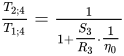
| Geometric Ratios
|
Ratio
R & 1
Ordinary[ab]
Elementary
Noted[ac]
|

|
|

|

|
|
|
Ratio
2 – 4
Ordinary[ab]
Elementary
Noted[ac]
|
|

|

|

|

|
| Kinetic Ratios
|
Specific
Torque[s]
R & 1
|
|

|
|
|
Specific
Torque[s]
2 – 4
|
|

|
|
|
|
- ^ Revised 17 December 2025
- ^ Layout
- Input and output are on opposite sides
- Planetary gearset 1 is on the input (turbine) side
- Input shafts is, if actuated S1, S2 or R2
- Output shaft is R3
- ^ Total Ratio Span (Total Gear/Transmission Ratio) Nominal
 - A wider span enables the
- downspeeding when driving outside the city limits
- increase the climbing ability
- when driving over mountain passes or off-road
- or when towing a trailer
- ^ a b c d e Total Ratio Span (Total Gear/Transmission Ratio) Effective
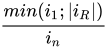 - The span is only effective to the extent that
- the reverse gear ratio
- matches that of 1st gear
- see also Standard R:1
- ^ Ratio Span's Center
 - The center indicates the speed level of the transmission
- Together with the final drive ratio
- it gives the shaft speed level of the vehicle
- ^ Average Gear Step
 - With decreasing step width
- the gears connect better to each other
- shifting comfort increases
- ^ Sun 1: sun gear of gearset 1
- ^ Ring 1: ring gear of gearset 1
- ^ Sun 2: sun gear of gearset 2
- ^ Ring 2: ring gear of gearset 2
- ^ Sun 3: sun gear of gearset 3
- ^ Ring 3: ring gear of gearset 3
- ^ a b c d e f Standard 50:50
— 50 % Is Above And 50 % Is Below The Average Gear Step —
- With steadily decreasing gear steps (yellow highlighted line Step)
- and a particularly large step from 1st to 2nd gear
- the lower half of the gear steps (between the small gears; rounded down, here the first 1) is always larger
- and the upper half of the gear steps (between the large gears; rounded up, here the last 2) is always smaller
- than the average gear step (cell highlighted yellow two rows above on the far right)
- lower half: smaller gear steps are a waste of possible ratios (red bold)
- upper half: larger gear steps are unsatisfactory (red bold)
- ^ a b c d e f g Standard R:1
— Reverse And 1st Gear Have The Same Ratio —
- The ideal reverse gear has the same transmission ratio as 1st gear
- no impairment when maneuvering
- especially when towing a trailer
- a torque converter can only partially compensate for this deficiency
- Plus 11.11 % minus 10 % compared to 1st gear is good
- Plus 25 % minus 20 % is acceptable (red)
- Above this is unsatisfactory (bold)
- see also Total Ratio Span (Total Gear/Transmission Ratio) Effective
- ^ a b c d e Standard 1:2
— Gear Step 1st To 2nd Gear As Small As Possible —
- With continuously decreasing gear steps (yellow marked line Step)
- the largest gear step is the one from 1st to 2nd gear, which
- for a good speed connection and
- a smooth gear shift
- must be as small as possible
- A gear ratio of up to 1.6667 : 1 (5 : 3) is good
- Up to 1.7500 : 1 (7 : 4) is acceptable (red)
- Above is unsatisfactory (bold)
- ^ a b c From large to small gears (from right to left)
- ^ a b c Standard STEP
— From Large To Small Gears: Steady And Progressive Increase In Gear Steps —
- Gear steps should
- increase: Δ Step (first green highlighted line Δ Step) is always greater than 1
- As progressive as possible: Δ Step is always greater than the previous step
- Not progressively increasing is acceptable (red)
- Not increasing is unsatisfactory (bold)
- ^ Standard SPEED
— From Small To Large Gears: Steady Increase In Shaft Speed Difference —
- Shaft speed differences should
- increase: Δ Shaft Speed (second line marked in green Δ (Shaft) Speed) is always greater than the previous one
- 1 difference smaller than the previous one is acceptable (red)
- 2 consecutive ones are a waste of possible ratios (bold)
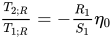
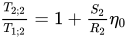
- ^ a b c d e f g h Specific Torque Ratio And Efficiency
- The specific torque is the Ratio of
- output torque

- to input torque

- with

- The efficiency is calculated from the specific torque in relation to the transmission ratio
- Power loss for single meshing gears is in the range of 1 % to 1.5 %
- helical gear pairs, which are used to reduce noise in passenger cars, are in the upper part of the loss range
- spur gear pairs, which are limited to commercial vehicles due to their poorer noise comfort, are in the lower part of the loss range
- ^ a b c d e Corridor for specific torque and efficiency
- in planetary gearsets, the stationary gear ratio
 is formed via the planetary gears and thus by two meshes is formed via the planetary gears and thus by two meshes
- for reasons of simplification, the efficiency for both meshes together is commonly specified there
- the efficiencies
 specified here are based on assumed efficiencies for the stationary ratio specified here are based on assumed efficiencies for the stationary ratio
- of
 (upper value) (upper value)
- and
 (lower value) (lower value)
- for both interventions together
- The corresponding efficiency for single-meshing gear pairs is

- at
 (upper value) (upper value)
- and
 (lower value) (lower value)
- ^ Blocks S1
- ^ Blocks C1 (the carrier of gearset 1)
- ^ Blocks S2
- ^ Blocks S3 (S: german "schnell" for fast)
- ^ Couples R2 with the turbine
- ^ Couples S1 with the turbine
- ^ Couples S3 with C3 (the carrier of gearset 3 · S: german "schnell" for fast)
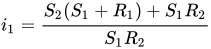
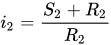
- ^ a b Ordinary Noted
- For direct determination of the ratio
- ^ a b Elementary Noted
- Alternative representation for determining the transmission ratio
- Contains only operands
- With simple fractions of both central gears of a planetary gearset
- Or with the value 1
- As a basis
- For reliable
- And traceable
- Determination of specific torque and efficiency
|
|
|
1984: Ravigneaux Planetary Gearset Types
The 4HP 14 was introduced in 1984 and produced through 2001 for Citroën, Peugeot, and Daewoo Front-wheel drive vehicles. The electronic-hydraulic control makes controlled power shifts and various shift programs possible.
The 4HP 16 is designed for use in vehicles with Front-wheel drive and a Transverse engine. The transmission is operated via selector lever and possibly also via switch. It has a controller slip Lock-up clutch.
The 4HP 18 is for both longitudinal and transverse installation. Introduced in 1987, and produced through 1998, it was used in a variety of cars from Alfa Romeo, Audi, Citroën, Dodge, Eagle, Fiat, Lancia, Porsche and Saab.
Gearset Concept Ravigneaux Types: Cost Effectiveness
Gearset Concept: Cost-Effectiveness[a]
With
Assessment
|
Output:
Gear
Ratios
|
Innovation
Elasticity[b]
Δ Output : Δ Input
|
Input: Main Components
|
| Total
|
Gearsets
|
Brakes
|
Clutches
|
|
|
4HP
Ref. Object
|
|
Topic[b]
|
|
|
|
|
| Δ Number
|
|
|
|
|
|
| Relative Δ
|
Δ Output
|
|
Δ Input
|
|
|
|
|
|
4HP
ZF 3HP[c]
|
4[d]
3[d]
|
Progress[b]
|
7
7
|
2[e]
2[e]
|
3
3
|
2
2
|
| Δ Number
|
1
|
0
|
0
|
0
|
0
|
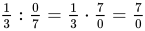
| Relative Δ
|
0.333
|
0.000[b]
|
0.000

|
0.000

|
0.000
|
0.000
|
|
|
ZF 4HP
4G-Tronic
|
4[d]
4[d]
|
Market Position[b]
|
7
8
|
2[e]
3[e]
|
3
3
|
2
2
|
| Δ Number
|
0
|
-1
|
-1
|
0
|
0
|
| Relative Δ
|
0.000
|
0.000[b]

|
−0.125

|
−0.333

|
0.000
|
−0.500
|
|
|
4HP
3-Speed[f]
|
4[d]
3[d]
|
Historical
Market Position[b]
|
7
7
|
2[e]
2
|
3
3
|
2
2
|
| Δ Number
|
1
|
0
|
0
|
0
|
0
|
| Relative Δ
|
0.333
|
0.000[b]
|
0.000
|
0.000
|
0.000
|
0.000
|
|
|
- ^ Progress increases cost-effectiveness and is reflected in the ratio of forward gears to main components.
It depends on the power flow:
- parallel: using the two degrees of freedom of planetary gearsets
- to increase the number of gears
- with unchanged number of components
- serial: in-line combined planetary gearsets without using the two degrees of freedom
- to increase the number of gears
- a corresponding increase in the number of components is unavoidable
- ^ a b c d e f g h Innovation Elasticity Classifies Progress And Market Position
- Automobile manufacturers drive forward technical developments primarily in order to remain competitive or to achieve or defend technological leadership. This technical progress has therefore always been subject to economic constraints
- Only innovations whose relative additional benefit is greater than the relative additional resource input, i.e. whose economic elasticity is greater than 1, are considered for realization
- The required innovation elasticity of an automobile manufacturer depends on its expected return on investment. The basic assumption that the relative additional benefit must be at least twice as high as the relative additional resource input helps with orientation
- negative, if the output increases and the input decreases, is perfect
- 2 or above is good
- 1 or above is acceptable (red)
- below this is unsatisfactory (bold)
- ^ Direct Predecessor
- To reflect the progress of the specific model change
- ^ a b c d e f plus 1 reverse gear
- ^ a b c d e which are combined as a compound Ravigneaux gearset
- ^ Historical Reference Standard (Benchmark)
- 3-speed transmissions with torque converters have established the modern market for automatic transmissions and thus made it possible in the first place, as this design proved to be a particularly successful compromise between cost and performance
- It became the archetype and dominated the world market for around 3 decades, setting the standard for automatic transmissions. It was only when fuel consumption became the focus of interest that this design reached its limits, which is why it has now completely disappeared from the market
- What has remained is the orientation that it offers as a reference standard (point of reference, benchmark) for this market for determining progressiveness and thus the market position of all other, later designs
- All transmission variants consist of 7 main components
- Typical examples are
|
|
|
Gearset Concept Ravigneaux Types: Quality
Gear Ratio Analysis
In-Depth Analysis
With Assessment[a]
|
Planetary Gearset:
Teeth[b]
|
Count
|
Nomi-
nal[c]
Effec-
tive[d]
|
Cen-
ter[e]
|
| Ravigneaux
|
Avg.[f]
|
|
|
Model
Type
|
Version
First Delivery
|
S1[g]
R1[h]
|
S2[i]
R2[j]
|
Brakes
Clutches
|
Ratio
Span
|
Gear
Step[k]
|
Gear
Ratio
|
|
R
|
1
|
2
|
3
|
4
|
| Step[k]
|
|
[l]
|
|
[m]
|
|
|
| Δ Step[n][o]
|
|
|
|
|
|
|
Shaft
Speed
|
|
|
|
|
|
|
Δ Shaft
Speed[p]
|
|
|
|
|
|
|
Specific
Torque[q]
|
|
[r]
|
[r]
|
[r]
|
[r]
|
[r]
|
Efficiency
[q]
|
|
|
|
|
|
|
|
|
| 4HP 14
|
1984
|
34
29[s]
|
29
82
|
2
3
|
3.2647
3.2647
|
1.3348
|
| 1.4835[k]
|
Gear
Ratio
|
|
−2.8276[l]

|
2.4118

|
1.3688[m]

|
1.0000[p]
|
0.7281

|
| Step
|
|
1.1724[l]
|
1.0000
|
1.7619[m]
|
1.3688
|
1.3537
|
| Δ Step[n]
|
|
|
|
1.2872
|
1.0112
|
|
| Speed
|
|
-0.8529
|
1.0000
|
1.7619
|
2.4118
|
3.2647
|
| Δ Speed
|
|
0.8529
|
1.0000
|
0.7619
|
0.6499[p]
|
0.8526
|
Specific
Torque[q]
|
|
–2.7710
–2.7428
|
2.3398
2.3041
|
1.3490
1.3391
|
1.0000
|
0.7348
0.7328
|
Efficiency
[q]
|
|
0.9800
0.9700
|
0.9702
0.9553
|
0.9855
0.9783
|
1.0000
|
0.9947
0.9920
|
|
|
| 4HP 18
|
FLE
1987
|
38
34[s]
|
34
98
|
2
3
|
3.4737
3.4737
|
1.3837
|
| 1.5145[k]
|
Gear
Ratio
|
|
−2.8824[l]

|
2.5789

|
1.4067[m]

|
1.0000[p]
|
0.7281

|
| Step
|
|
1.1176[l]
|
1.0000
|
1.8333[m]
|
1.4067
|
1.3469
|
| Δ Step[n]
|
|
|
|
1.3033
|
1.0444
|
|
| Speed
|
|
-0.8947
|
1.0000
|
1.8333
|
2.5789
|
3.4737
|
| Δ Speed
|
|
0.8947
|
1.0000
|
0.8333
|
0.7456[p]
|
0.8947
|
Specific
Torque[q]
|
|
–2.8247
–2.7959
|
2.5020
2.4638
|
1.3861
1.3758
|
1.0000
|
0.7385
0.7366
|
Efficiency
[q]
|
|
0.9800
0.9700
|
0.9702
0.9553
|
0.9854
0.9780
|
1.0000
|
0.9948
0.9921
|
|
|
| Actuated Shift Elements
|
| Brake A[t]
|
|
|
|
❶
|
|
❶
|
| Brake B[u]
|
|
❶
|
❶
|
|
|
|
| Clutch C[v]
|
|
|
❶
|
❶
|
❶
|
|
| Clutch D[w]
|
|
❶
|
|
|
|
|
| Clutch E[x]
|
|
|
|
|
❶
|
❶
|
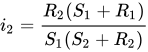
| Geometric Ratios
|
Ratio
R & Odd
Ordinary[y]
Elementary
Noted[z]
|

|

|
|

|

|
|
|
Ratio
Even
Ordinary[y]
Elementary
Noted[z]
|
|
|

|

|
| Kinetic Ratios
|
Specific
Torque[q]
R & Odd
|
|
|
|
|
|
Specific
Torque[q]
Even
|
|
|
|
|
- ^ Revised 17 December 2025
- ^ Layout
- Input and output are on opposite sides
- Planetary gearset 2 (the outer Ravigneaux gearset) is on the input (turbine) side
- Input shafts is, if actuated S1, R2 or C1 and C2 (the common Ravigneaux carrier 1 + 2)
- Output shaft is R2 (the ring gear of the outer Ravigneaux gearset
- ^ Total Ratio Span (Total Gear/Transmission Ratio) Nominal
- A wider span enables the
- downspeeding when driving outside the city limits
- increase the climbing ability
- when driving over mountain passes or off-road
- or when towing a trailer
- ^ Total Ratio Span (Total Gear/Transmission Ratio) Effective
- The span is only effective to the extent that
- the reverse gear ratio
- matches that of 1st gear
- see also Standard R:1
- ^ Ratio Span's Center
- The center indicates the speed level of the transmission
- Together with the final drive ratio
- it gives the shaft speed level of the vehicle
- ^ Average Gear Step
- With decreasing step width
- the gears connect better to each other
- shifting comfort increases
- ^ Sun 1: sun gear of gearset 1: inner Ravigneaux gearset
- ^ Ring 1: ring gear of gearset 1: inner Ravigneaux gearset
- ^ Sun 2: sun gear of gearset 2: outer Ravigneaux gearset
- ^ Ring 2: ring gear of gearset 2: outer Ravigneaux gearset
- ^ a b c d Standard 50:50
— 50 % Is Above And 50 % Is Below The Average Gear Step —
- With steadily decreasing gear steps (yellow highlighted line Step)
- and a particularly large step from 1st to 2nd gear
- the lower half of the gear steps (between the small gears; rounded down, here the first 1) is always larger
- and the upper half of the gear steps (between the large gears; rounded up, here the last 2) is always smaller
- than the average gear step (cell highlighted yellow two rows above on the far right)
- lower half: smaller gear steps are a waste of possible ratios (red bold)
- upper half: larger gear steps are unsatisfactory (red bold)
- ^ a b c d e Standard R:1
— Reverse And 1st Gear Have The Same Ratio —
- The ideal reverse gear has the same transmission ratio as 1st gear
- no impairment when maneuvering
- especially when towing a trailer
- a torque converter can only partially compensate for this deficiency
- Plus 11.11 % minus 10 % compared to 1st gear is good
- Plus 25 % minus 20 % is acceptable (red)
- Above this is unsatisfactory (bold)
- see also Total Ratio Span (Total Gear/Transmission Ratio) Effective
- ^ a b c d e Standard 1:2
— Gear Step 1st To 2nd Gear As Small As Possible —
- With continuously decreasing gear steps (yellow marked line Step)
- the largest gear step is the one from 1st to 2nd gear, which
- for a good speed connection and
- a smooth gear shift
- must be as small as possible
- A gear ratio of up to 1.6667 : 1 (5 : 3) is good
- Up to 1.7500 : 1 (7 : 4) is acceptable (red)
- Above is unsatisfactory (bold)
- ^ a b c From large to small gears (from right to left)
- ^ Standard STEP
— From Large To Small Gears: Steady And Progressive Increase In Gear Steps —
- Gear steps should
- increase: Δ Step (first green highlighted line Δ Step) is always greater than 1
- As progressive as possible: Δ Step is always greater than the previous step
- Not progressively increasing is acceptable (red)
- Not increasing is unsatisfactory (bold)
- ^ a b c d e Standard SPEED
— From Small To Large Gears: Steady Increase In Shaft Speed Difference —
- Shaft speed differences should
- increase: Δ Shaft Speed (second line marked in green Δ (Shaft) Speed) is always greater than the previous one
- 1 difference smaller than the previous one is acceptable (red)
- 2 consecutive ones are a waste of possible ratios (bold)
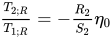
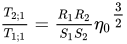
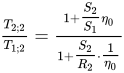
- ^ a b c d e f g h Specific Torque Ratio And Efficiency
- The specific torque is the Ratio of
- output torque
- to input torque
- with
- The efficiency is calculated from the specific torque in relation to the transmission ratio
- Power loss for single meshing gears is in the range of 1 % to 1.5 %
- helical gear pairs, which are used to reduce noise in passenger cars, are in the upper part of the loss range
- spur gear pairs, which are limited to commercial vehicles due to their poorer noise comfort, are in the lower part of the loss range
- ^ a b c d e Corridor for specific torque and efficiency
- in planetary gearsets, the stationary gear ratio is formed via the planetary gears and thus by two meshes
- for reasons of simplification, the efficiency for both meshes together is commonly specified there
- the efficiencies specified here are based on assumed efficiencies for the stationary ratio
- of (upper value)
- and (lower value)
- for both interventions together
- The corresponding efficiency for single-meshing gear pairs is
- at (upper value)
- and (lower value)
- ^ a b inner and outer sun gears of the Ravigneaux planetary gearset are inverted
- ^ Blocks R1 (ring gear of the inner Ravigneaux gearset) and S2 (sun gear of the outer Ravigneaux gearset)
- ^ Blocks C1 and C2 (the common Ravigneaux carrier 1 + 2)
- ^ Couples S1 (sun gear of the inner Ravigneaux gearset) with the turbine
- ^ Couples S2 (sun gear of the outer Ravigneaux gearset) with the turbine
- ^ Couples C1 and C2 (the common Ravigneaux carrier 1 + 2) with the turbine
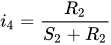
- ^ a b Ordinary Noted
- For direct determination of the ratio
- ^ a b Elementary Noted
- Alternative representation for determining the transmission ratio
- Contains only operands
- With simple fractions of both central gears of a planetary gearset
- Or with the value 1
- As a basis
- For reliable
- And traceable
- Determination of specific torque and efficiency
|
|
|
Applications
1980: Simpson Planetary Gearset Types
1984: Ravigneaux Planetary Gearset Types
See also
References
- ^ a b c d e f g h i j k l m "ZF North America Application Chart (automatic)" (PDF). ZF-Group.com. Archived from the original (PDF) on 4 January 2006. Retrieved 11 February 2006.
- ^ a b c "BMW E30 3 Series Specifications".
- ^ a b c d e f g h "BMW E28 Specifications".
- ^ "BMW E23 735i user manual, PDF p. 125" (PDF).
- ^ "South African version BMW E23 745i user manual, PDF p. 117" (PDF).
- ^ a b "BMW E34 user manual, 1989, p. 111". Archived from the original on June 29, 2013.
- ^ a b c "BMW E32 user manual, PDF p. 51" (PDF). Archived from the original (PDF) on 2016-03-04. Retrieved 2013-06-28.
- ^ a b "Chevrolet Opala Specifications".
- ^ a b "Chevrolet Opala Original table of gear ratios". Archived from the original on May 8, 2014.
- ^ a b c A. K. Legg, Peugeot 505 Owners Workshop Manual, Haynes Publishing Group, 1989, ISBN 0-85696-762-9, p. 132
- ^ a b c Octavio Trentini, Reparación y ajuste de automoviles Peugeot 505, Cosmopolita publisher, 1995, ISBN 950-9069-69-8, p. 148, 149
- ^ a b c d e Peugeot 505 User manual, Peugeot, 1987, Paris, p. 146, 147
- ^ Peugeot 505 User manual, Peugeot, 1987, Madrid, p. 109
- ^ Peugeot 505 User manual, Peugeot, 1987, Madrid, p. 131
- ^ Volvo 740 User manual, 1985
- ^ "Volvo 740 User manual, 1986, PDF p. 126, 127" (PDF).
- ^ Volvo 240-740-760 Essence, Diesel (in French). France: Revue Technique Automobile. pp. 5–6. ISBN 978-2726847947.
- ^ "Volvo 760 GLE user manual, 1984, PDF p. 110" (PDF).
- ^ "Peugeot 309 1987 Automatic brochure". Peugeot.
- ^ "Vraagbaak Volvo 440/460/480 Benzinemodellen" by P.H. Olving, April 2011, ISBN 9789021534091
- ^ Transmissions Parts catalogue : https://global-uploads.webflow.com/5d4ad27f935075baaeb45f60/5fb67c61d98f56954b343a33_2020.11.18%20APC%20Catalog%20without%20images.pdf
- ^ 4HP18 FLA Transmission filter : https://www.allomatic.com/transmission-filters/515426
External links