Mercedes-Benz 4G-Tronic transmission is the unofficial name given to the transmission by car enthusiasts. It was produced from 1979 to 1996 in W4A 040, W4A 028 (both type 722.3), W4A 020 (type 722.4), and W5A 030 (type 722.5) variants.
The W4A 040 and the W4A 020 were used until mid-1996. The W4A 028 variant was used for off-road applications (RWD and 4X4). The W5A 030 is basically the same transmission with an additional electrically controlled 5th gear overdrive section attached to the main body in a separate housing; it was available as an extra charge option. All 4G-Tronics were succeeded by the more modern and economic 5G-Tronic (Type 722.6) transmission that features an integrated 5th gear overdrive ratio, torque converter lock-up and fully electronic control.
Gear Ratios[a]
| Model
|
Type
|
First
Delivery
|
Gear
|
Total Span
|
Avg.
Step
|
Components
|
| R
|
1
|
2
|
3
|
4
|
5
|
Nomi-
nal
|
Effec-
tive
|
Cen-
ter
|
Total
|
per
Gear[b]
|
|
|
| W4A 040 I
|
722.3
|
1979
|
−5.139
|
3.676
|
2.412
|
1.436
|
1.000
|
|
3.676
|
3.676
|
1.917
|
1.543
|
3 Gearsets
3 Brakes
2 Clutches
|
2.000
|
| W4A 020
|
722.4
|
1982
|
−5.669
|
4.249
|
2.408
|
1.487
|
1.000
|
|
4.249
|
4.249
|
2.061
|
1.620
|
| W4A 040 II
|
722.3
|
1985
|
−5.586
|
3.871
|
2.247
|
1.436
|
1.000
|
|
3.871
|
3.871
|
1.967
|
1.570
|
| W4A 028[c]
|
1990
|
−5.586
|
3.871
|
2.247
|
1.436
|
1.000
|
|
3.871
|
3.871
|
1.967
|
1.570
|
|
|
| W5A 030
|
722.5
|
1990
|
−5.586
|
3.871
|
2.247
|
1.436
|
1.000
|
0.750
|
5.161
|
5.161
|
1.704
|
1.507
|
4 Gearsets
4 Brakes
3 Clutches
|
2.200
|
|
|
- ^ Differences in gear ratios have a measurable, direct impact on vehicle dynamics, performance, waste emissions as well as fuel mileage
- ^ Forward gears only
- ^ for off-road applications (RWD and 4X4)
|
|
|
Specifications
Basic concept
The 4G-Tronic transmission is a hydraulically operated 4-speed automatic without lock-up that replaced the similarly designed W3A 040, W3B 050, and W4B 025 family of automatic transmissions with the introduction of the W126 S-Class in 1979. In some models it is calibrated to move off in second gear to reduce "creeping" and provide a smoother ride, selecting 1st only if the selector is in "2" or in case of abrupt acceleration. Other calibrations have the transmission rest in 2nd gear and kick down to 1st as soon as the accelerator is touched but before the throttle is opened. In some V8 installations a small control unit activates the kick down solenoid when the brake pedal is released so that the car moves off in 1st gear. Other attributes of this transmission include a 2-3 shift delay when the engine is cold in order to speed up catalyst warm-up. 4th gear is a 1:1 ratio. Controls are all mechanical and pneumatic, except for the kickdown solenoid and 2-3 upshift delay solenoid on some models.
In some markets a W-S (Winter - Standard / Sport) switch was provided on the shifter. Activating S mode changes a linkage which effectively shortens the throttle pressure bowden cable. This causes later, higher RPM shifts and on some models a move off in 1st gear instead of 2nd. On V8 models a B (Brake) range is available on the shifter. This activates the kickdown solenoid, forcing the transmission to shift down to 1st sooner for increased engine braking. A hydraulically activated piston prevents shifting into Reverse when the car is moving forward.
Models from 1990 and earlier allow for push starting the engine. They are fitted with a secondary fluid pump, driven by the transmission output shaft. When the vehicle is rolling at 20 mph shifting from Neutral to the 2 range will couple power to the engine. The secondary pump and thus the push starting facility was eliminated for the 1991 model year.
It is considered by enthusiasts to be one of the most reliable transmissions ever built by Mercedes-Benz with some examples exceeding 300,000 miles of service.
Gearset Concept W4A Models: Cost Effectiveness
"To simplify production, the front group is now formed by a Ravigneaux set, which is immediately followed by the second group. This largely eliminates the need for hollow shafts and other connecting bells, which are so commonly found in planetary gearboxes. Where possible, sheet metal or die-cast parts are used. Cost-intensive material machining is limited to the manufacture of gears, shafts, and bolts."[1]
Gearset Concept: Cost-Effectiveness[a]
With
Assessment
|
Output:
Gear
Ratios
|
Innovation
Elasticity[b]
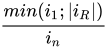
Δ Output : Δ Input
|
Input: Main Components
|
| Total
|
Gearsets
|
Brakes
|
Clutches
|
|
|
W4A
Ref. Object
|


|
Topic[b]
|


|


|


|


|
| Δ Number
|

|

|

|

|

|
| Relative Δ
|
Δ Output

|
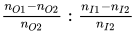
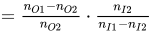
|
Δ Input

|

|

|

|
|
|
W4A
W4B 025[c]
|
4[d]
4[d]
|
Progress[b]
|
8
8
|
3[e]
3
|
3
3
|
2
2
|
| Δ Number
|
0
|
0
|
0
|
0
|
0
|
| Relative Δ
|
0.000

|
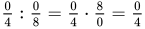
0.000[b]
|
0.000

|
0.000

|
0.000
|
0.000

|
|
|
W4A
ZF 4HP 22
|
4[d]
4[d]
|
Early
Market Position[b]
|
8
10
|
3[e]
3
|
3
4
|
2
3
|
| Δ Number
|
0
|
-2
|
0
|
-1
|
-1
|
| Relative Δ
|
0.000
|
0.000[b]

|
−0.200

|
0.000
|
−0.250

|
−0.333

|
|
|
W4A
ZF 4HP 18
|
4[d]
4[d]
|
Late
Market Position[b]
|
8
7
|
3[e]
2[e]
|
3
2
|
2
3
|
| Δ Number
|
0
|
1
|
1
|
1
|
-1
|
| Relative Δ
|
0.000
|
0.000[b]
|
0.143

|
0.500

|
0.500
|
−0.333
|
|
|
W4A
3-Speed[f]
|
4[d]
3[d]
|
Historical
Market Position[b]
|
8
7
|
3[e]
2
|
3
3
|
2
2
|
| Δ Number
|
1
|
1
|
1
|
0
|
0
|
| Relative Δ
|
0.333

|
2.333[b]

|
0.143
|
0.500
|
0.000
|
0.000
|
|
|
- ^ Progress increases cost-effectiveness and is reflected in the ratio of forward gears to main components.
It depends on the power flow:
- parallel: using the two degrees of freedom of planetary gearsets
- to increase the number of gears
- with unchanged number of components
- serial: in-line combined planetary gearsets without using the two degrees of freedom
- to increase the number of gears
- a corresponding increase in the number of components is unavoidable
- ^ a b c d e f g h i j Innovation Elasticity Classifies Progress And Market Position
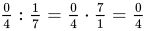
- Automobile manufacturers drive forward technical developments primarily in order to remain competitive or to achieve or defend technological leadership. This technical progress has therefore always been subject to economic constraints
- Only innovations whose relative additional benefit is greater than the relative additional resource input, i.e. whose economic elasticity is greater than 1, are considered for realization
- The required innovation elasticity of an automobile manufacturer depends on its expected return on investment. The basic assumption that the relative additional benefit must be at least twice as high as the relative additional resource input helps with orientation
- negative, if the output increases and the input decreases, is perfect
- 2 or above is good
- 1 or above is acceptable (red)
- below this is unsatisfactory (bold)
- ^ Direct Predecessor
- To reflect the progress of the specific model change
- ^ a b c d e f g h plus 1 reverse gear
- ^ a b c d e of which 2 gearsets are combined as a compound Ravigneaux gearset
- ^ Historical Reference Standard (Benchmark)
- 3-speed transmissions with torque converters have established the modern market for automatic transmissions and thus made it possible in the first place, as this design proved to be a particularly successful compromise between cost and performance
- It became the archetype and dominated the world market for around 3 decades, setting the standard for automatic transmissions. It was only when fuel consumption became the focus of interest that this design reached its limits, which is why it has now completely disappeared from the market
- What has remained is the orientation that it offers as a reference standard (point of reference, benchmark) for this market for determining progressiveness and thus the market position of all other, later designs
- All transmission variants consist of 7 main components
- Typical examples are
|
|
|
Gearset Concept W5A: Cost Effectiveness
The need of 2 housings[a] and 2 different controls[b] turn out the W5A 030 as the least economically designed automatic transmission ever manufactured for passenger cars. Obviously a transition solution: the direct successor, launched in 1996, requires 9 main components,[c] 1 housing and 1 control.[d]
Gearset Concept: Cost-Effectiveness[e]
With
Assessment
|
Output:
Gear
Ratios
|
Innovation
Elasticity[f]
Δ Output : Δ Input
|
Input: Main Components
|
| Total
|
Gearsets
|
Brakes
|
Clutches
|
|
|
W5A
Ref. Object
|
|
Topic[f]
|
|
|
|
|
| Δ Number
|
|
|
|
|
|
| Relative Δ
|
Δ Output
|
|
Δ Input
|
|
|
|
|
|
W5A
W4A[g]
|
5[h]
4[h]
|
Progress[f]
|
11
8
|
4[i]
3[i]
|
4
3
|
3
2
|
| Δ Number
|
1
|
3
|
1
|
1
|
1
|
| Relative Δ
|
0.250

|
0.667[f]
|
0.375

|
0.333
|
0.333
|
0.500
|
|
|
W5A
ZF 5HP 18
|
5[h]
5[h]
|
Early
Market Position[f]
|
11
10
|
4[i]
3[i]
|
4
3
|
3
4
|
| Δ Number
|
0
|
1
|
1
|
1
|
-1
|
| Relative Δ
|
0.000

|
0.000[f]

|
0.100

|
0.333
|
1.000

|
−0.250
|
|
|
W5A
ZF 5HP 30
|
5[h]
5[h]
|
Late
Market Position[f]
|
11
9
|
4[i]
3
|
4
3
|
3
3
|
| Δ Number
|
0
|
2
|
1
|
1
|
0
|
| Relative Δ
|
0.000
|
0.000[f]

|
0.222

|
0.333
|
0.333
|
0.000
|
|
|
W5A
3-Speed[j]
|
5[h]
3[h]
|
Historical
Market Position[f]
|
11
7
|
4[i]
2
|
4
3
|
3
2
|
| Δ Number
|
2
|
4
|
2
|
1
|
1
|
| Relative Δ
|
0.667

|
1.167[f]
|
0.571

|
1.000
|
0.333
|
0.500
|
|
|
- ^ regular bousing for gear 1 to 4 and reverse gear · supplemental housing for gear 5
- ^ hydraulic for gear 1 to 4 and reverse gear · electronic for gear 5
- ^ 3 simple planetary gearsets, 3 brakes, 3 clutches
- ^ electronic
- ^ Progress increases cost-effectiveness and is reflected in the ratio of forward gears to main components.
It depends on the power flow:
- parallel: using the two degrees of freedom of planetary gearsets
- to increase the number of gears
- with unchanged number of components
- serial: in-line combined planetary gearsets without using the two degrees of freedom
- to increase the number of gears
- a corresponding increase in the number of components is unavoidable
- ^ a b c d e f g h i j Innovation Elasticity Classifies Progress And Market Position
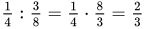
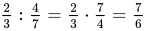
- Automobile manufacturers drive forward technical developments primarily in order to remain competitive or to achieve or defend technological leadership. This technical progress has therefore always been subject to economic constraints
- Only innovations whose relative additional benefit is greater than the relative additional resource input, i.e. whose economic elasticity is greater than 1, are considered for realization
- The required innovation elasticity of an automobile manufacturer depends on its expected return on investment. The basic assumption that the relative additional benefit must be at least twice as high as the relative additional resource input helps with orientation
- negative, if the output increases and the input decreases, is perfect
- 2 or above is good
- 1 or above is acceptable (red)
- below this is unsatisfactory (bold)
- ^ Direct Predecessor
- To reflect the progress of the specific model change
- ^ a b c d e f g h plus 1 reverse gear
- ^ a b c d e f of which 2 gearsets are combined as a compound Ravigneaux gearset
- ^ Historical Reference Standard (Benchmark)
- 3-speed transmissions with torque converters have established the modern market for automatic transmissions and thus made it possible in the first place, as this design proved to be a particularly successful compromise between cost and performance
- It became the archetype and dominated the world market for around 3 decades, setting the standard for automatic transmissions. It was only when fuel consumption became the focus of interest that this design reached its limits, which is why it has now completely disappeared from the market
- What has remained is the orientation that it offers as a reference standard (point of reference, benchmark) for this market for determining progressiveness and thus the market position of all other, later designs
- All transmission variants consist of 7 main components
- Typical examples are
|
|
|
Gearset Concept: Quality
The most obvious flaw of the gearset concept is the second gear, which is clearly too short, but this affected all Mercedes-Benz transmissions, especially automatic transmissions.[2] After Hans-Joachim Foerster, the originator of this flawed gear ratio, left the company in November 1982,[3] Mercedes-Benz began to address this problem. This led to the introduction of the W4A 040 II with modified gear ratios in 1985. With the 7G-Tronic transmission from 2003, they finally succeeded in completely resolving this issue.
Gear Ratio Analysis
In-Depth Analysis
With Assessment[a]
|
Planetary Gearset: Teeth[b]
|
Count
|
Nomi-
nal[c]
Effec-
tive[d]
|
Cen-
ter[e]
|
| Ravigneaux
|
Simple
|
Avg.[f]
|
|
|
Model
Type
|
Version
First Delivery
|
S1[g]
R1[h]
|
S2[i]
R2[j]
|
S3[k]
R3[l]
|
S4[m]
R4[n]
|
Brakes
Clutches
|
Ratio
Span
|
Gear
Step[o]
|
Gear
Ratio
|
|
R

|
|
1

|
2

|
3

|
4

|
5

|
| Step[o]
|
|
 [p] [p]
|
|

|
 [q] [q]
|

|

|

|
| Δ Step[r][s]
|
|
|
|
|

|

|

|
|
Shaft
Speed
|
|

|
|
|
|

|

|

|
Δ Shaft
Speed[t]
|
|

|
|

|

|

|

|

|
Specific
Torque[u]
|
|
 [v] [v]
|
|
 [v] [v]
|
 [v] [v]
|
 [v] [v]
|
 [v] [v]
|
 [v] [v]
|
Efficiency
 [u] [u]
|
|

|
|

|

|

|

|

|
|
|
W4A 040 I
722.3
|
40 kp⋅m (289 lb⋅ft)
1979[4][5]
|
34
50
|
50
78
|
34
78
|
|
3
2
|
3.6759
3.6759
|
1.9173
|
| 1.5433[o]
|
Gear
Ratio
|
|
−5.1388[p]

|
|
3.6759

|
2.4123
[o][s]

|
1.4359[o]

|
1.0000

|
|
| Step
|
|
1.3980[p]
|
|
1.0000
|
1.5238[o]
|
1.6800[o]
|
1.4359
|
|
| Δ Step[r]
|
|
|
|
|
0.9070[s]
|
1.1700
|
|
|
| Speed
|
|
-0.7153
|
|
1.0000
|
1.5238
|
2.5600
|
3.6759
|
|
| Δ Speed
|
|
0.7153
|
|
1.0000
|
0.5238
|
1.0362
|
1.1159
|
|
Specific
Torque[u]
|
|
–4.9659
–4.8805
|
|
3.6091
3.5758
|
2.3687
2.3471
|
1.4272
1.4228
|
1.0000
|
|
Efficiency
[u]
|
|
0.9664
0.9497
|
|
0.9818
0.9728
|
0.9819
0.9730
|
0.9939
0.9909
|
1.0000
|
|
|
|
W4A 020
722.4
|
20 kp⋅m (145 lb⋅ft)
1982[4][5]
|
26
42
|
42
78
|
38
78
|
|
3
2
|
4.2491
4.2491
|
2.0613
|
| 1.6197[o]
|
Gear
Ratio
|
|
−5.6692[p]

|
|
4.2491

|
2.4078[q]

|
1.4872

|
1.0000
|
|
| Step
|
|
1.3342[p]
|
|
1.0000
|
1.7647[q]
|
1.6190
|
1.4872
|
|
| Δ Step[r]
|
|
|
|
|
1.0900
|
1.0887
|
|
|
| Speed
|
|
-0.7153
|
|
1.0000
|
1.7647
|
2.8571
|
4.2491
|
|
| Δ Speed
|
|
0.7153
|
|
1.0000
|
0.7647
|
1.0924
|
1.3919
|
|
Specific
Torque[u]
|
|
–5.4811
–5.3882
|
|
4.1664
4.1253
|
2.3647
2.3434
|
1.4774
1.4726
|
1.0000
|
|
Efficiency
[u]
|
|
0.9668
0.9504
|
|
0.9805
0.9709
|
0.9821
0.9733
|
0.9934
0.9902
|
1.0000
|
|
|
|
W4A 040 II
722.3
|
40 kp⋅m (289 lb⋅ft)
1985[4]
|
26
46
|
46
78
|
34
78
|
|
3
2
|
3.8707
3.8707
|
1.9674
|
| 1.5701[o]
|
| Ratio
|
|
−5.5857[p]
|
|
3.8707
|
2.2475[q]
|
1.4359
|
1.0000
|
|
|
|
W4A 028
722.3
|
28 kp⋅m (203 lb⋅ft)
1990[4]
|
26
46
|
46
78
|
34
78
|
|
3
2
|
3.8707
|
1.9674
|
| 1.5701[o]
|
| Ratio
|
|
−5.5857[p]
|
|
3.8707
|
2.2475[q]
|
1.4359
|
1.0000
|
|
|
|
W5A 030
722.5
|
30 kp⋅m (217 lb⋅ft)
1990[4]
|
26
46
|
46
78
|
34
78
|
26
78
|
4
3
|
5.1609
5.1609
|
1.7038
|
| 1.5072[o]
|
Gear
Ratio
|
|
−5.5857[p]

|
|
3.8707

|
2.2475[q]

|
1.4359
|
1.0000
|
0.7500

|
| Step
|
|
1.4431[p]
|
|
1.0000
|
1.7222[q]
|
1.5652
|
1.4359
|
1.3333
|
| Δ Step[r]
|
|
|
|
|
1.1003
|
1.0901
|
1.0769
|
|
| Speed
|
|
-0.6930
|
|
1.0000
|
1.7222
|
2.6957
|
3.8707
|
5.1609
|
| Δ Speed
|
|
0.6930
|
|
1.0000
|
0.7222
|
0.9734
|
1.1750
|
1.2902
|
Specific
Torque[u]
|
|
–5.3977
–5.3049
|
|
3.7988
3.7631
|
2.2098
2.1911
|
1.4272
1.4228
|
1.0000
|
0.7462
0.7442
|
Efficiency
[u]
|
|
0.9664
0.9497
|
|
0.9814
0.9722
|
0.9832
0.9749
|
0.9939
0.9909
|
1.0000
|
0.9949
0.9923
|
|
|
| Actuated Shift Elements
|
| Brake A[w]
|
|
|
|
|
❶
|
|
|
|
| Brake B[x]
|
|
|
|
❶
|
❶
|
❶
|
|
|
| Brake R[y]
|
|
❶
|
|
|
|
|
|
|
| Brake S[z]
|
|
|
|
|
|
|
|
❶
|
| Clutch E[aa]
|
|
|
|
|
|
❶
|
❶
|
❶
|
| Clutch F[ab]
|
|
❶
|
|
❶
|
|
|
❶
|
❶
|
| Clutch S[ac]
|
|
❶
|
|
❶
|
❶
|
❶
|
❶
|
|
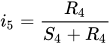
| Geometric Ratios
|
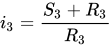
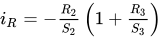
Ratio
R & 3
Ordinary[ad]
Elementary
Noted[ae]
|
|
|
|

|
|
|
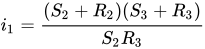
Ratio
1 & 4
Ordinary[ad]
Elementary
Noted[ae]
|
|

|

|
|
|
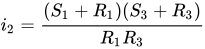
Ratio
2 & 5
Ordinary[ad]
Elementary
Noted[ae]
|
|
|

|

|
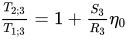
| Kinetic Ratios
|
Specific
Torque[u]
R & 3
|

|
|
|
|
Specific
Torque[u]
1 & 4
|

|

|
|
|
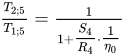
Specific
Torque[u]
2 & 5
|

|
|
|
|
|
|
|
|
Applications
W4A 040 I+II (Type 722.3)
1981–1985 W123
| Chassis code
|
Car model
|
Engine
code
|
Transmission
code
|
Notes
|
| 123.026
|
250
|
123.920
123.921
|
722.308
|
| 123.086
|
250 T
|
| 123.028
|
250 Lang
|
| 123.033
|
280 E
|
110.984
110.988
|
722.300
722.309
|
| 123.093
|
280 TE
|
722.309
|
| 123.053
|
280 CE
|
722.300
722.309
|
| 123.133
|
300 D Turbo
|
617.952
|
722.315 1982–1985
|
USA only
|
| 123.153
|
300 CD Turbo
|
| 123.193
|
300 TD Turbo
|
722.303 1981–1982
722.315 1982–1985
|
W4A 028 (Type 722.3)
W4A 020 (Type 722.4)
1982–1985 W123
| Chassis code
|
Car model
|
Engine
code
|
Transmission
code
|
Notes
|
| 123.220
|
200
|
102.920
102.939
|
722.406
|
| 123.280
|
200 T
|
| 123.223
|
230 E
|
102.980
|
722.401
|
| 123.283
|
230 TE
|
| 123.243
|
230 CE
|
| 123.120
|
200 D
|
615.940
|
722.407
|
| 123.123
|
240 D
|
616.912
|
722.404
|
| 123.183
|
240 TD
|
| 123.125
|
240 D Lang
|
| 123.130
|
300 D
|
617.912
|
722.405
|
| 123.190
|
300 TD
|
| 123.132
|
300 D Lang
|
| 123.133
|
300 D Turbo
|
617.952
|
722.416 1985
|
California only
|
| 123.153
|
300 CD Turbo
|
| 123.193
|
300 TD Turbo
|
W5A 030 (Type 722.5)
See also
References
- ^ Hans-Joachim Foerster · Automatic Transmissions · P. 453 German: Hans-Joachim Förster · Automatische Fahrzeuggetriebe · Berlin und Heidelberg 1991 · Print ISBN 978-3-642-84119-4 · eBook ISBN 978-3-642-84118-7 · S. 453: "Zur Fertigungsvereinfachung wird die vordere Gruppe jetzt von einem Ravigneaux-Satz gebildet, dem die zweite Gruppe unmittelbar folgt. Damit sind Hohlwellen und andere Verbindungsglocken, die sich in Planetengetrieben so ausgiebig finden, weitgend vermieden. Wo möglich, sind Blechform- oder Druckgussteile verwendet. Die kosteninsive Materialzerspanung beschränkt sich auf die Herstellung der Zahnräder, Wellen, Bolzen." Translated with DeepL.com (free version)
- ^ Gert Hack · Short Test Mercedes-Benz350 SE · [Ed.] Ferdinand Simoneit · auto motor & sport 8/1977 · P. 127: "The manual transmission plays a key role in the positive impression made by the small V8 engine in the large S-Class sedan. It simply suits the sporty performance characteristics of the engine better than the automatic transmission, although there is still room for improvement in terms of gear ratios. Second gear in particular seems a little too short with a range of only 90 km/h." German: Gert Hack · Kurztest: Mercedes-Benz 350 SE. [Hrsg.] Ferdinand Simoneit · auto motor & sport · Heft 8 1977 · S. 127: "An dem positiven Eindruck, den der kleine V8-Motor in der großen S-Limousine hinterlässt, ist das Schaltgetriebe maßgeblich beteiligt. Es passt ganz einfach besser zu der sportlichen Leistungscharakteristik des Motors als die Automatik, wobei hinsichtlich der Übersetzung durchaus noch Wünsche offenbleiben. Besonders der II. Gang erscheint mit seiner Reichweite von nur 90 km/h etwas zu kurz geraten." Translated with DeepL.com (free version)
- ^ Result And Outlook · commemorative publication for Prof. Dr. Hans-Joachim Foerster on the occasion of leaving as director from active duty at Daimler-Benz AG in November 1982 German: Ergebnis und Ausblick · Festschrift für Herrn Prof. Dr. Hans Joachim Förster zum Ausscheiden als Direktor aus dem aktiven Dienst der Daimler-Benz AG im November 1982 · Translated with DeepL.com (free version)
- ^ a b c d e Hans-Joachim Foerster · Automatic Transmissions · Pp. 171 & 192 German: Hans-Joachim Förster · Automatische Fahrzeuggetriebe · Berlin und Heidelberg 1991 · Print ISBN 978-3-642-84119-4 · eBook ISBN 978-3-642-84118-7 · S. 171 & 192
- ^ a b Mercedes 722.3 & 722.4 Technical Overview