mirour
Middle English
Alternative forms
- merour, merrour, myrour, myrrour; merrur, mirur (Yorkshire)
- meror, merowre, mirowr, mirrur, myrowre, myrure (Late Middle English)
- mero, merow, merowe (Late Middle English, Lincolnshire, Yorkshire)
Etymology
Borrowed from Old French mireor, from the verb mirer (“to look at”).
Forms with loss of final /r/ are probably from dissimilation occasioned by the previous /r/.
Pronunciation
- IPA(key): /miˈruːr/, /mɛˈruːr/
- IPA(key): /ˈmirur/, /ˈmɛrur/ (with stress shift)
Noun
mirour (plural mirours)
- A mirror, looking-glass, or other reflective surface.
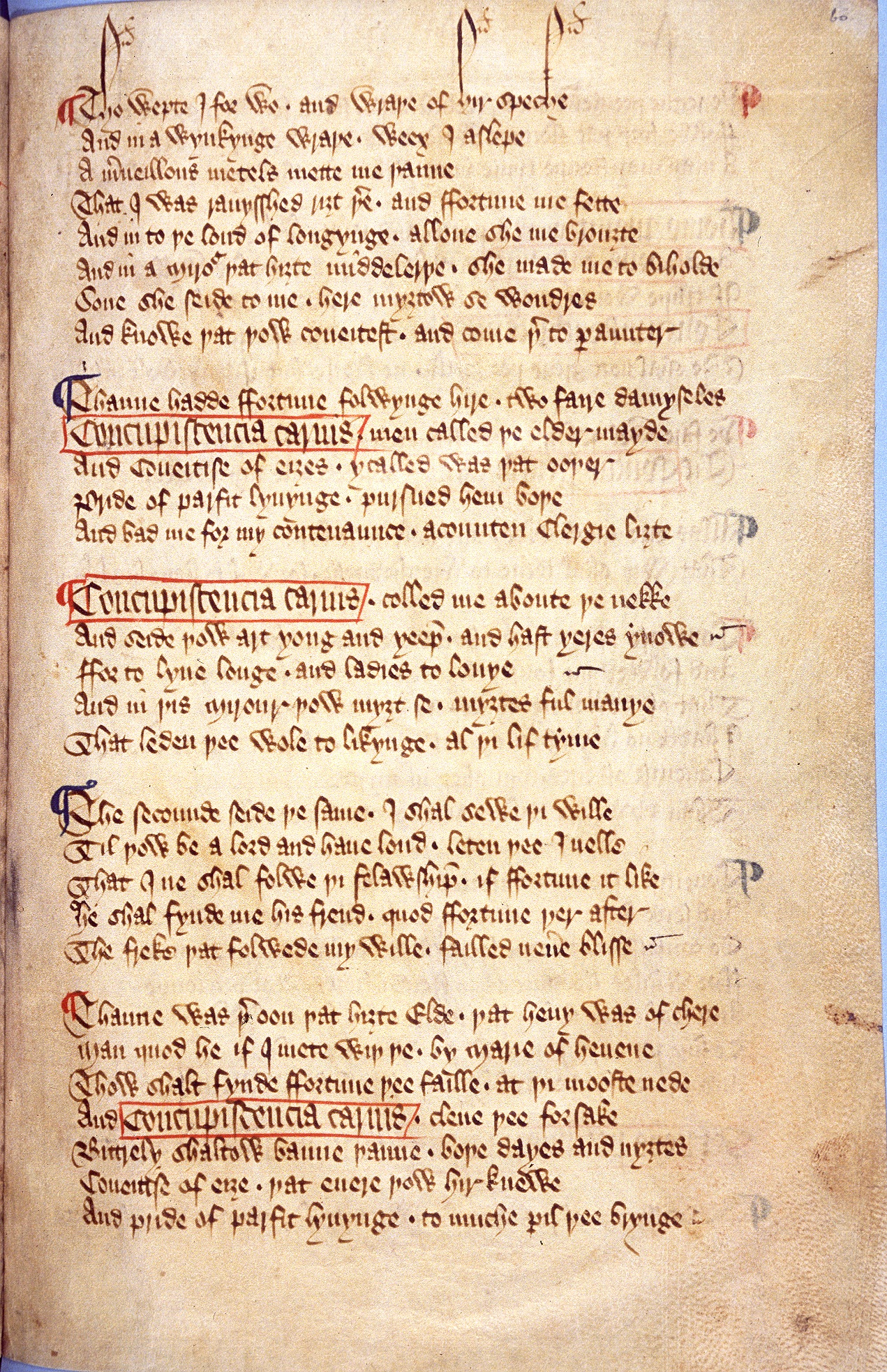
- c. 1378-9, [William Langland], “Paſſus undecım᷒”, in [Piers Plowman, A Treatise on Sin] (W, B-text), London, published c. 1400, →OCLC, folio 60, recto; republished as Thorlac Turville-Petre, Hoyt N. Duggan, editors, Cambridge, Trinity College, MS B.15.17 (The Piers Plowman Electronic Archive; 2), SEENET, 2014, →ISBN:
- And in to þe lond of longynge. allone she me brouȝte / And in a Miro᷑ þat hıȝte middelerþe. she made me to bıholde / Sone she seıde to me. here myȝtow se wondres […]
- And into the land of longing, she brought me by myself, / then she got me to stare at a mirror called Middle-earth. / Shortly she said to me, "Here you can see marvels […] "
- An exemplar or model of behaviour (of good or bad behaviour)
- Texts or writings used for advice or help.
- (figurative) God, his workings or evidence of them.
- (rare) A mental picture.
- (rare) A narrative or report; a description of past events.
Descendants
References
- “mirǒur, n.”, in MED Online, Ann Arbor, Mich.: University of Michigan, 2007, retrieved 15 November 2018.