mankynde
Middle English
Alternative forms
- man-kende, mankende, mankinde, man kynde
- mankynd, men-kynde, monkende (Late Middle English)
- man-kend, man-kinde, mankindde (Norfolk); mankind, man-kind, mans kind (Northern)
- mankunde (Southern); monkinde, monkunde, monkuynde, monkynd, monkynde (West Midland)
Etymology
From man (“man, human”) + kynde (“nature, kind”), possibly as an alteration of mankyn.
Pronunciation
- IPA(key): /ˌmanˈkiːnd(ə)/, /ˈmanˌkiːnd(ə)/
- IPA(key): /ˌmanˈkeːnd(ə)/, /ˈmanˌkeːnd(ə)/ (East Anglia, East Saxon, Kent)
- IPA(key): /ˌmɔnˈkyːnd(ə)/, /ˈmɔnˌkyːnd(ə)/ (West Midland)
Noun
mankynde (uncountable)
- Humankind, humanity; the human race.
- Synonym: mankyn
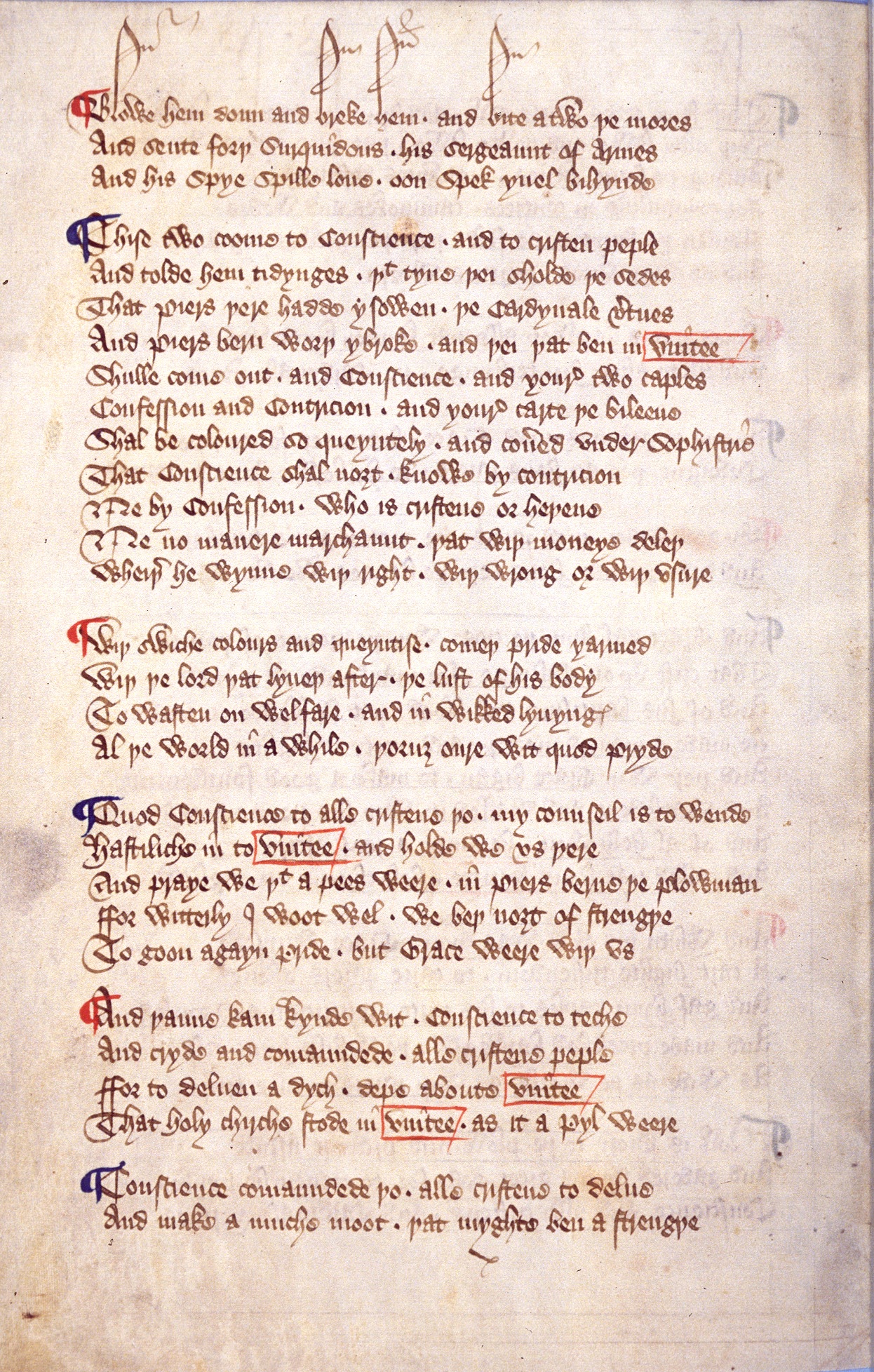
- c. 1378-9, [William Langland], “Paſſus xıx᷒ et explıcıt Dobet // et ımplıcıt Dobeſt”, in [Piers Plowman, A Treatise on Sin] (W, B-text), London, published c. 1400, →OCLC, folio 121, verso; republished as Thorlac Turville-Petre, Hoyt N. Duggan, editors, Cambridge, Trinity College, MS B.15.17 (The Piers Plowman Electronic Archive; 2), SEENET, 2014, →ISBN:
- ¶ And Grace gaf hym þe cros. wıþ þe croune of þoꝛnes / That crıſt vp on Caluarıe. foꝛ mankynde on pyned
- And Grace gave him the Cross with the Crown of Thorns, / that Christ suffered on for humanity up on Calvary.
- Human nature or form.
- Synonym: mankyn
- (rare) Men; the male gender or sex.
Usage notes
- mankyn is the more usual term for "mankind" in Early Middle English.
Descendants
References
- “man-kīnd(e, n.”, in MED Online, Ann Arbor, Mich.: University of Michigan, 2007.