creer
Asturian
Verb
creer
- alternative form of creyer
Further reading
- “creer”, in Diccionariu de la llingua asturiana [Dictionary of the Asturian Language] (in Asturian), 1ª edición, Academia de la Llingua Asturiana, 2000, →ISBN
Latin
Verb
creer
- first-person singular present passive subjunctive of creō
Old Galician-Portuguese
Etymology
Inherited from Latin crēdere, from Proto-Italic *krezdō, from Proto-Indo-European *ḱred dʰeh₁- (“to place one's heart, i.e. to trust, believe”), compound phrase of oblique case form of *ḱḗr (“heart”) and *dʰeh₁- (“to put, place, set”).
Pronunciation
- IPA(key): /kɾeˈeɾ/
- Rhymes: -eɾ
Verb
creer
- to believe
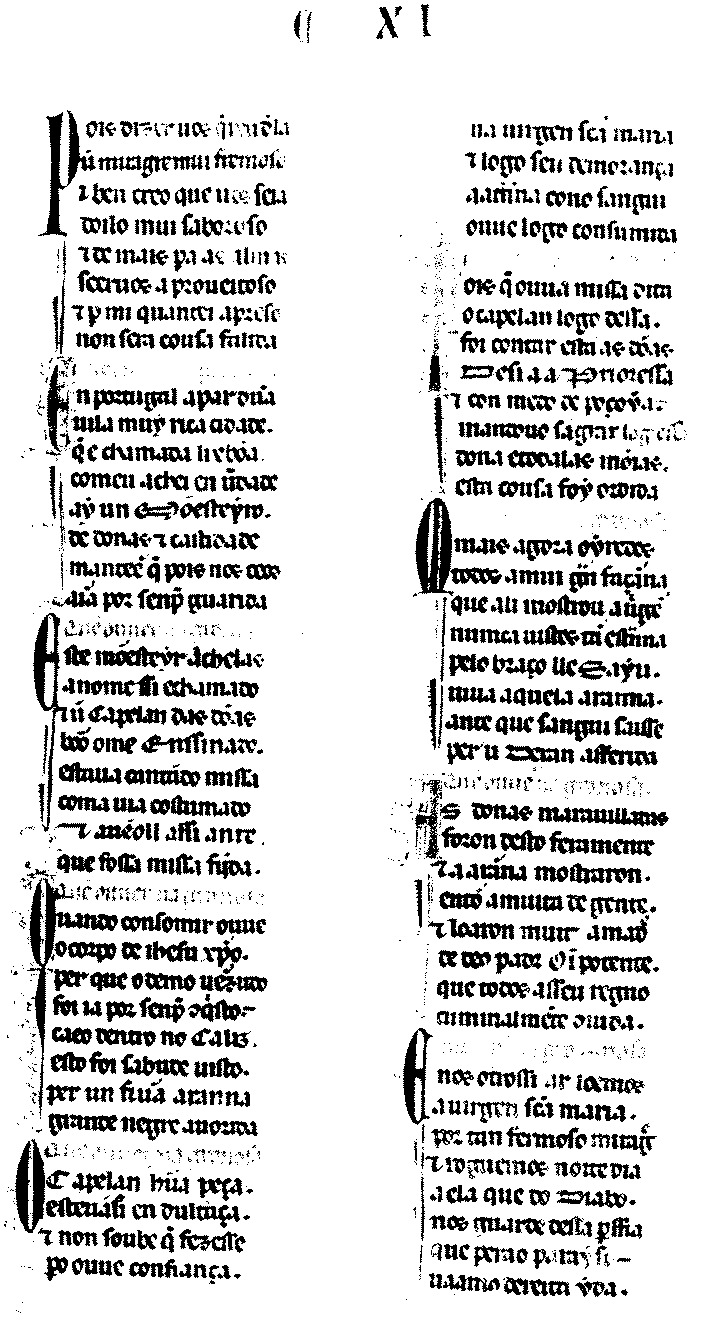
- a. 1284, Alfonso X of Castile, Cantigas de Santa Maria, Códice de los músicos, cantiga 181 (facsimile):
- ⁊ el creeu ſeu conſello
- And he took their advice.
- ⁊ el creeu ſeu conſello
Descendants
Further reading
Romanian
Noun
creer m (plural creeri)
- obsolete form of creier
Declension
| singular | plural | ||||
|---|---|---|---|---|---|
| indefinite | definite | indefinite | definite | ||
| nominative-accusative | creer | creerul | creeri | creerii | |
| genitive-dative | creer | creerului | creeri | creerilor | |
| vocative | creerule | creerilor | |||
References
- creer in Academia Română, Micul dicționar academic, ediția a II-a, Bucharest: Univers Enciclopedic, 2010. →ISBN
Spanish
Etymology
Inherited from Old Spanish creer,[1] from Latin crēdere, from Proto-Italic *krezðō, from Proto-Indo-European *ḱred dʰeh₁- (“to place one's heart, i.e. to trust, believe”), compound phrase of oblique case form of *ḱḗr (“heart”) and *dʰeh₁- (“to put, place, set”).
Pronunciation
- IPA(key): /kɾeˈeɾ/ [kɾeˈeɾ]
Audio (Colombia): (file) - Rhymes: -eɾ
- Syllabification: cre‧er
Verb
creer (first-person singular present creo, first-person singular preterite creí, past participle creído)
- (transitive) to believe
- Creé en vos mismo.
- Believe in yourself.
- (transitive) to think, to believe, to reckon, to be of the opinion
- to give credence to
- (reflexive, copulative) to think one is something
- Se cree Dios.
- (S)he thinks (s)he's God.
Usage notes
When it precedes the conjunction que and a clause, the affirmative form can only be used before the indicative mood, and the use of the subjunctive is grammatically incorrect. The subjunctive mood can be used after interrogative or negative sentences to express doubt. The use of the indicative mood in these cases is grammatically incorrect.
Conjugation
| infinitive | creer | ||||||
|---|---|---|---|---|---|---|---|
| gerund | creyendo | ||||||
| past participle | masculine | feminine | |||||
| singular | creído | creída | |||||
| plural | creídos | creídas | |||||
| singular | plural | ||||||
| 1st person | 2nd person | 3rd person | 1st person | 2nd person | 3rd person | ||
| indicative | yo | tú vos |
él/ella/ello usted |
nosotros nosotras |
vosotros vosotras |
ellos/ellas ustedes | |
| present | creo | creestú creésvos |
cree | creemos | creéis | creen | |
| imperfect | creía | creías | creía | creíamos | creíais | creían | |
| preterite | creí | creíste | creyó | creímos | creísteis | creyeron | |
| future | creeré | creerás | creerá | creeremos | creeréis | creerán | |
| conditional | creería | creerías | creería | creeríamos | creeríais | creerían | |
| subjunctive | yo | tú vos |
él/ella/ello usted |
nosotros nosotras |
vosotros vosotras |
ellos/ellas ustedes | |
| present | crea | creastú creásvos2 |
crea | creamos | creáis | crean | |
| imperfect (ra) |
creyera | creyeras | creyera | creyéramos | creyerais | creyeran | |
| imperfect (se) |
creyese | creyeses | creyese | creyésemos | creyeseis | creyesen | |
| future1 | creyere | creyeres | creyere | creyéremos | creyereis | creyeren | |
| imperative | — | tú vos |
usted | nosotros nosotras |
vosotros vosotras |
ustedes | |
| affirmative | creetú creévos |
crea | creamos | creed | crean | ||
| negative | no creas | no crea | no creamos | no creáis | no crean | ||
These forms are generated automatically and may not actually be used. Pronoun usage varies by region.
| singular | plural | ||||||
|---|---|---|---|---|---|---|---|
| 1st person | 2nd person | 3rd person | 1st person | 2nd person | 3rd person | ||
| with infinitive creer | dative | creerme | creerte | creerle, creerse | creernos | creeros | creerles, creerse |
| accusative | creerme | creerte | creerlo, creerla, creerse | creernos | creeros | creerlos, creerlas, creerse | |
| with gerund creyendo | dative | creyéndome | creyéndote | creyéndole, creyéndose | creyéndonos | creyéndoos | creyéndoles, creyéndose |
| accusative | creyéndome | creyéndote | creyéndolo, creyéndola, creyéndose | creyéndonos | creyéndoos | creyéndolos, creyéndolas, creyéndose | |
| with informal second-person singular tuteo imperative cree | dative | créeme | créete | créele | créenos | not used | créeles |
| accusative | créeme | créete | créelo, créela | créenos | not used | créelos, créelas | |
| with informal second-person singular voseo imperative creé | dative | creeme | creete | creele | creenos | not used | creeles |
| accusative | creeme | creete | creelo, creela | creenos | not used | creelos, creelas | |
| with formal second-person singular imperative crea | dative | créame | not used | créale, créase | créanos | not used | créales |
| accusative | créame | not used | créalo, créala, créase | créanos | not used | créalos, créalas | |
| with first-person plural imperative creamos | dative | not used | creámoste | creámosle | creámonos | creámoos | creámosles |
| accusative | not used | creámoste | creámoslo, creámosla | creámonos | creámoos | creámoslos, creámoslas | |
| with informal second-person plural imperative creed | dative | creedme | not used | creedle | creednos | creeos | creedles |
| accusative | creedme | not used | creedlo, creedla | creednos | creeos | creedlos, creedlas | |
| with formal second-person plural imperative crean | dative | créanme | not used | créanle | créannos | not used | créanles, créanse |
| accusative | créanme | not used | créanlo, créanla | créannos | not used | créanlos, créanlas, créanse | |
Related terms
- acreer
- credibilidad
- crédito
- creedor
- creencia
- creíble
- creído
- creyente
- descreer
- lo creas o no
- no creas
- no te creas
- ya lo creo (“indeed, you bet, you better believe it, you can say that again”)
References
- ^ Concepción Company Company (1985), “Los futuros en el español medieval, sus orígenes y su evolución [The future tense in Medieval Spanish, its origin and its evolution]”, in Nueva Revista de Filología Hispánica (NRFH)[1] (in Spanish), volume 34, number 1 (PDF), Mexico City: Centro de Estudios Lingüísticos y Literarios (CELL), El Colegio de México, published 1985, , →ISSN, →OCLC, retrieved 14 June 2019, page 105
Further reading
- “creer”, in Diccionario de la lengua española [Dictionary of the Spanish Language] (in Spanish), online version 23.8.1, Royal Spanish Academy [Spanish: Real Academia Española], 15 December 2025
- “creer”, in Diccionario de americanismos [Dictionary of Americanisms] (in Spanish), Association of Academies of the Spanish Language [Spanish: Asociación de Academias de la Lengua Española], 2010