beggere
Middle English
Alternative forms
Etymology
Either borrowed from Old French begart (from Middle Dutch beggaert) or formed anew from beggen + -ere (suffix forming agent nouns).
Pronunciation
- IPA(key): /ˈbɛɡər(ə)/
Noun
beggere (plural beggeres)
- A beggar (one who begs for alms)
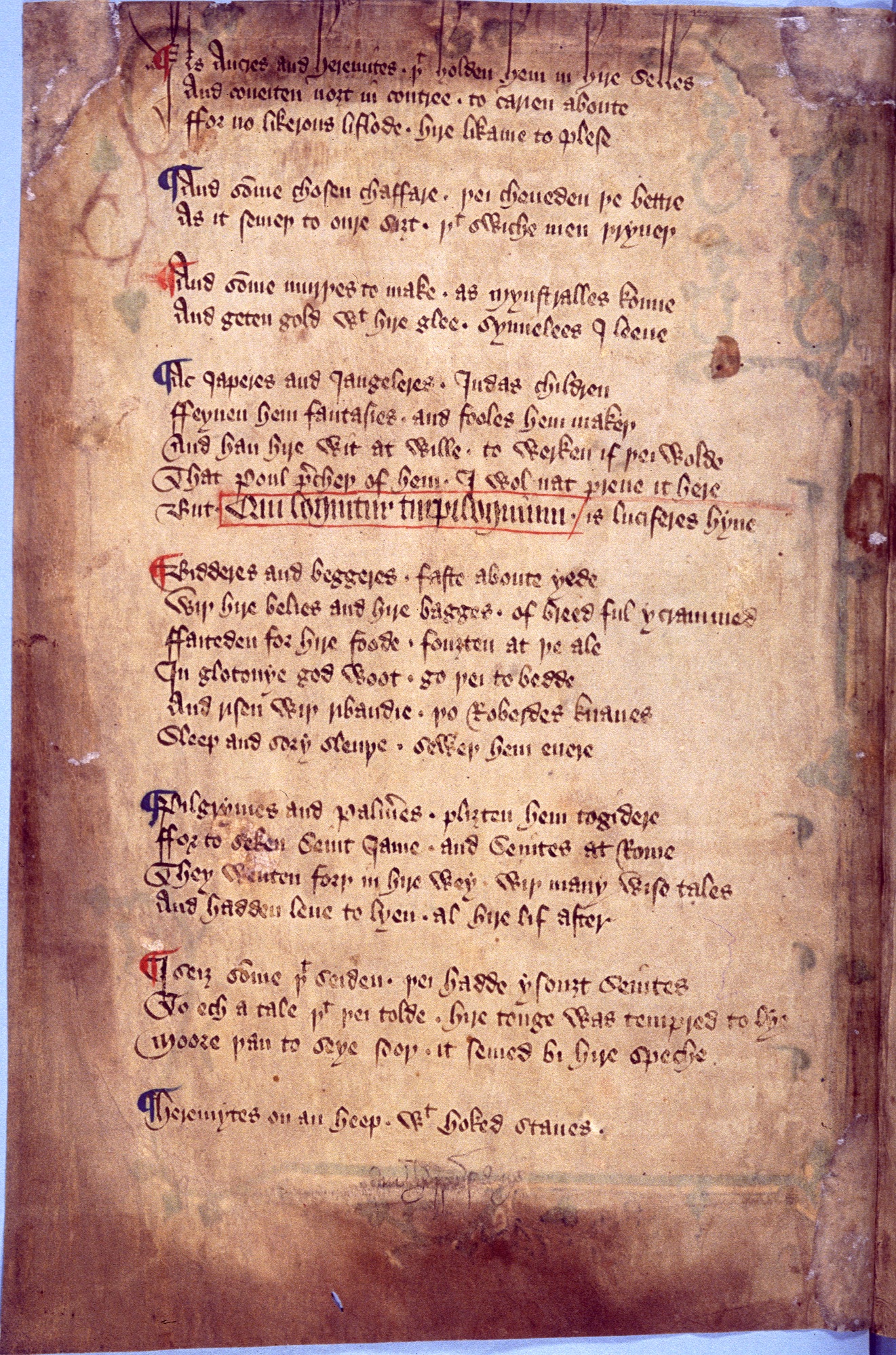
- c. 1378-9, [William Langland], “[Prologue]”, in [Piers Plowman, A Treatise on Sin] (W, B-text), London, published c. 1400, →OCLC, folio 1, verso; republished as Thorlac Turville-Petre, Hoyt N. Duggan, editors, Cambridge, Trinity College, MS B.15.17 (The Piers Plowman Electronic Archive; 2), SEENET, 2014, →ISBN:
- ¶ Bıdderes and beggeres. faſte aboute ẏede / Wıþ hıre belıes and hıre bagges. of breed ful ycrammed […]
- Panhandlers and beggars quickly moving about, / with their bellies and bags of bread crammed full, […]
- A poor person; one living in poverty.
- A mendicant; a friar reliant on alms.
- A villain; a despicable person.
- (rare) A petitioner; a supplicator.
Descendants
References
- “begger(e, n.”, in MED Online, Ann Arbor, Mich.: University of Michigan, 2007.