Caunterbury
Middle English
Alternative forms
- Canterbiri, Canterburi, Canterbury, Canturbery, Caunterbery, Caunterbiri, Caunturbyry, Caunterbiry, Caunterburi, Cawnterbery, Kanterburi, Kaunterburi, Kaunturbury
- Cauntelbury, Cauntilburye (with dissimilation of /r/ to /l/)
Etymology
From Old English Cantwarbyriġ, late form of Cantwara byriġ, dative and genitive of Cantwara burg.
The pronunciation with /au̯/ could just be analogy with variation between /au̯/ and /a/ in other words, but the influence of the lost /w/ in Old English Cantwara byriġ is also possible. Such a development is also seen in aunswere, variant of answere (“answer”); this is not a mere backspelling, as orthoepists commonly give pronunciations of answer with reflexes of /au̯/ in the Early Modern English period.[1][2]
Pronunciation
- IPA(key): /ˈkau̯ntərˌburiː/, /ˈkantərˌburiː/, /-ˌbɛriː/, /-ˌbiriː/
- IPA(key): /ˈkau̯ntəl-/, /ˈkantəl-/ (with dissimilation of /r/ to /l/)
Proper noun
Caunterbury
- Canterbury (a cathedral city in modern Kent, England)
- c. 1390, [William Langland], “Paſſus .vıȷ᷒. de dowel ⁊ explıƈ”, in Peres plouhman (X, C-text), southwest Worcestershire, published c. 1395, folio 78, recto; republished as MS. HM 143, San Marino, CA: Huntingdon Digital Library, p. 2011:
- In sauacıoun of mannes soule seynte Thomas of Cant͛bury / Amonges vkynde crıſtene ın holy churche was slawe […]
- While saving people's souls Saint Thomas of Canterbury / was killed amongst impious Christians in a holy church […]
- 1387–1400, [Geoffrey] Chaucer, “Here Bygynneth the Book of the Tales of Caunt́burẏ”, in The Tales of Caunt́bury (Hengwrt Chaucer; Peniarth Manuscript 392D), Aberystwyth, Ceredigion: National Library of Wales, published [c. 1400–1410], →OCLC, folio 2, recto:
- […] and specıallẏ from euerẏ shire' ende / Of Engelond to Caunterburẏ theẏ wende / The holẏ blıſful martır foꝛ to seke / That hem hath holpen whan þᵗ theẏ weere seeke […]
- […] and specially from every county's end / of England to Canterbury they went / to seek the holy blessed martyr / that had helped them when they were sick […]
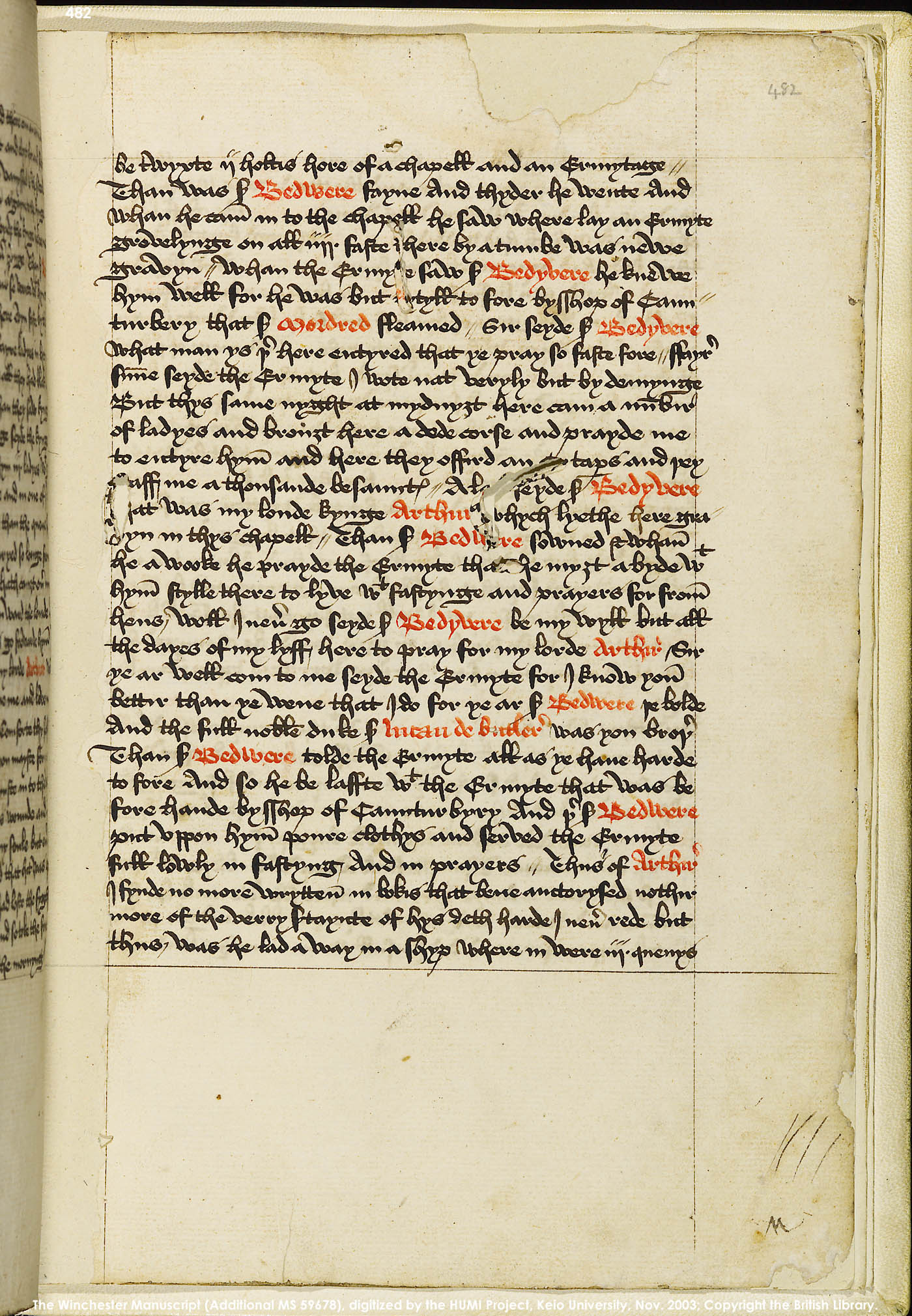
- 1470–1483 (date produced), Thom̃s Malleorre [i.e., Thomas Malory], “[Morte Arthur]”, in Le Morte Darthur (British Library Additional Manuscript 59678), [England: s.n.], folio 482, recto:
- Than ẜ Bedwere tolde the Ermyte all as ye haue harde tofore And ſo he be laffte wt the Ermyte that was before hande byſſhop of Caunturbyry.
- Then Sir Bedivere told the hermit everything that you've heard up to this point before he departed with the hermit, who was previously Bishop of Canterbury.
Descendants
- English: Canterbury (obsolete Cantelbury)
- → Middle Dutch: Cantelburch, Cantellenborch
- Dutch: Kantelburg, Kantelberg (obsolete)
- → Middle High German: Candelberc
- German: Kantelburg (obsolete)
- → Middle Welsh: Kawntlberi
References
- ^ Jespersen, Otto (1909), A Modern English Grammar on Historical Principles (Sammlung germanischer Elementar- und Handbücher; 9)[1], volume I: Sounds and Spellings, London: George Allen & Unwin, published 1961, § 3.97, page 109.
- ^ Dobson, E[ric] J. (1957), English pronunciation 1500-1700[2], second edition, volume II: Phonology, Oxford: Clarendon Press, published 1968, →OCLC, § 62, page 557.