Tan Mui Buay
| Personal information | ||||||||||||||||||||||||||||||||||||
|---|---|---|---|---|---|---|---|---|---|---|---|---|---|---|---|---|---|---|---|---|---|---|---|---|---|---|---|---|---|---|---|---|---|---|---|---|
| Born | 1955 (age 69–70) | |||||||||||||||||||||||||||||||||||
| Sport | ||||||||||||||||||||||||||||||||||||
| Sport | Wushu | |||||||||||||||||||||||||||||||||||
Event(s) | Taijiquan, Taijijian | |||||||||||||||||||||||||||||||||||
| Team | Singapore Wushu Team | |||||||||||||||||||||||||||||||||||
Medal record
| ||||||||||||||||||||||||||||||||||||
Tan Mui Buay (Chinese: 陈美郿; pinyin: Chénměiméi) is a retired competitive wushu taolu athlete and taijiquan practitioner and teacher from Singapore.
Career
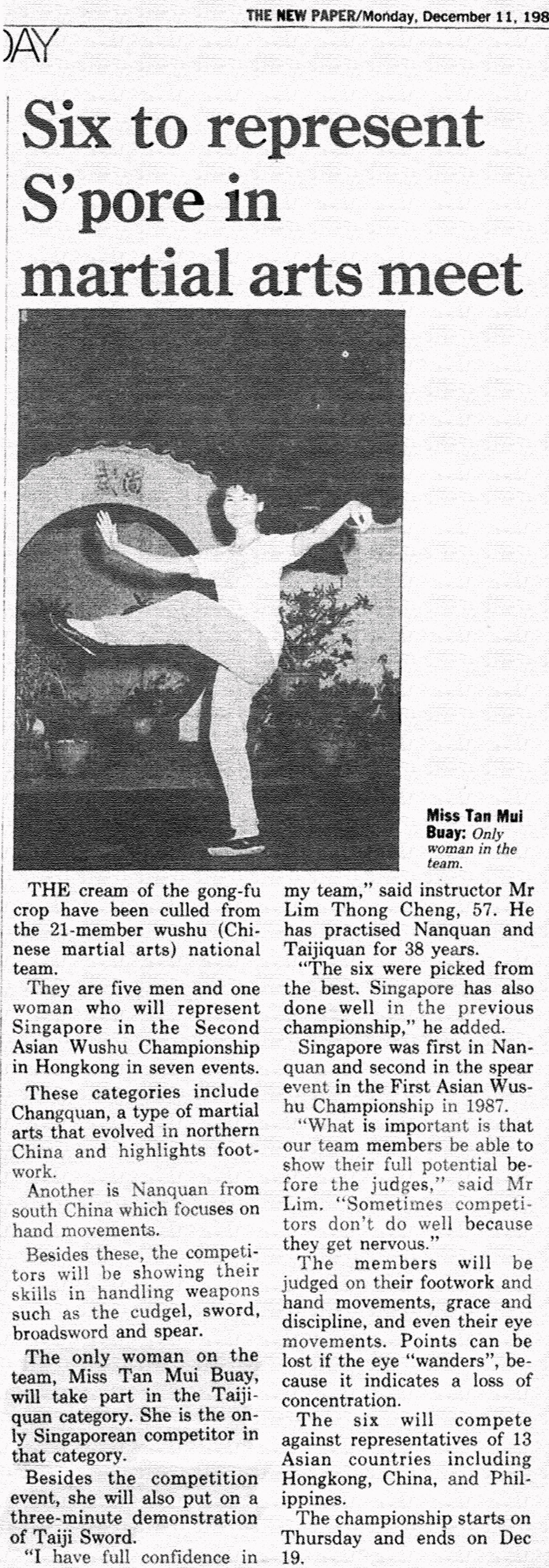
In 1986, Tan started taijiquan due to natural curiosity and made her international debut at the 1989 Asian Wushu Championships where she competed in taijiquan.[1] Two years later, Tan competed at the 1991 SEA Games and won the silver medal in taijiquan.[2]
In 1993, Tan competed in the 1993 SEA Games and won the gold medal in taijiquan.[3] The following year, Tan appeared at the 1994 Asian Games and won the bronze medal in women's taijiquan, one of the first medals for Singapore in wushu at the Asian Games.[4][5][6]
In 1996, Tan won two bronze medals in taijiquan and taijijian at the 1996 Asian Wushu Championships.[7][8] A year later, she won another bronze medal in taijiquan at the 1997 SEA Games.[9] Her last international competition was at the 1998 Asian Games where she finished 7th in women's taijiquan.[10][11]
During her competitive career Tan worked as a computer technician at Nanyang Polytechnic, and after her competitive wushu career began to teach taijiquan.[12]
See also
References
- ^ "Six to represent S'pore in martial arts meet". The New Paper. 12 November 1989. Retrieved 21 November 2024.
- ^ "results at southeast asian games". Xinhua General News Service. Manila. 30 November 1991. Retrieved 16 November 2024.
- ^ Sung, Grace (14 June 1993). "Singapore's four out of five in wushu". The Straits Times. National Library Board. p. 26. Retrieved 16 November 2024.
- ^ "Asiad results of Wushu, Women's Taijiquan -3-". Kyodo News. Hiroshima. Japan Economic Newswire. 14 October 1994. Retrieved 26 May 2021.
- ^ "第12回広島アジア競技大会《武術太極拳》競技成績一覧" [12th Hiroshima Asian Games "Wushu Taijiken" Competition Results List] (PDF). Japan Wushu Federation (in Japanese). 1994. Retrieved 26 May 2021.
- ^ Ho-Pareira, Shrilynn (15 October 1994). "Wushu adds two bronze medals". The Straits Times. Hiroshima. Retrieved 21 November 2024.
- ^ "'pore bags one gold, four bronzes". The Straits Times. National Library Board. 18 November 1996. p. 32. Retrieved 16 November 2014.
- ^ "Swordplay first". The New Paper. National Library Board. 30 October 1996. p. 46. Retrieved 16 November 2024.
- ^ "1997 SEA Games Results". Jakarta Post. 24 October 1997. Retrieved 16 September 2024.
- ^ "china takes women's taijiquan title". Bangkok. Xinhua News Agency. 18 December 1998. 1218381. Retrieved 29 May 2021.
- ^ "第13回バンコクアジア競技大会《武術太極拳》競技成績一覧" [13th Bangkok Asian Games "Wushu Taijiken" Competition Results List] (PDF). Japan Wushu Taijiquan Federation (in Japanese). 1998. Retrieved 29 May 2021.
- ^ "Our Founder". Xin Ying Wushu Training Centre. Retrieved 21 November 2024.