In mathematics, the Segre class is a characteristic class used in the study of cones, a generalization of vector bundles. For vector bundles the total Segre class is inverse to the total Chern class, and thus provides equivalent information; the advantage of the Segre class is that it generalizes to more general cones, while the Chern class does not.
The Segre class was introduced in the non-singular case by Beniamino Segre (1953).[1]
In the modern treatment of intersection theory in algebraic geometry, as developed e.g. in the definitive book of Fulton (1998), Segre classes play a fundamental role.[2]
Definition
Suppose that  is a cone over
  , that
  is the projection from the projective completion
  of to , and that
  is the anti-tautological line bundle on . Viewing the Chern class
  as a group endomorphism of the Chow group of , the total Segre class of is given by:
![{\displaystyle s(C)=q_{*}\left(\sum _{i\geq 0}c_{1}({\mathcal {O}}(1))^{i}[\mathbb {P} (C\oplus 1)]\right).}](./_assets_/eb734a37dd21ce173a46342d1cc64c92/0159c8a7048a6883134166de6088b7cb3545ee1d.svg)
The  th Segre class
  is simply the th graded piece of
  . If is of pure dimension
  over then this is given by:
![{\displaystyle s_{i}(C)=q_{*}\left(c_{1}({\mathcal {O}}(1))^{r+i}[\mathbb {P} (C\oplus 1)]\right).}](./_assets_/eb734a37dd21ce173a46342d1cc64c92/c4360819b6b08c5b2cb2811e0215a17c97d486f3.svg)
The reason for using rather than  is that this makes the total Segre class stable under addition of the trivial bundle
  .
.
If Z is a closed subscheme of an algebraic scheme X, then  denote the Segre class of the normal cone to
  .
.
Relation to Chern classes for vector bundles
For a holomorphic vector bundle  over a complex manifold
  a total Segre class
  is the inverse to the total Chern class
  , see e.g. Fulton (1998).[3]
Explicitly, for a total Chern class

one gets the total Segre class

where

Let  be Chern roots, i.e. formal eigenvalues of
  where
where  is a curvature of a connection on .
While the Chern class c(E) is written as

where  is an elementary symmetric polynomial of degree in variables ,
the Segre for the dual bundle  which has Chern roots
  is written as

Expanding the above expression in powers of  one can see that
  is represented by
a complete homogeneous symmetric polynomial of .
is represented by
a complete homogeneous symmetric polynomial of .
Properties
Here are some basic properties.
- For any cone C (e.g., a vector bundle),
 .[4]
.[4]
- For a cone C and a vector bundle E,
 [5]
[5]
- If E is a vector bundle, then[6]
 for
for  .
. is the identity operator.
 for another vector bundle F.
- If L is a line bundle, then
 , minus the first Chern class of L.[6]
- If E is a vector bundle of rank
 , then, for a line bundle L,
 [7]
[7]
A key property of a Segre class is birational invariance: this is contained in the following. Let  be a proper morphism between algebraic schemes such that
  is irreducible and each irreducible component of maps onto . Then, for each closed subscheme
  ,
,  and
and 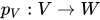 the restriction of
  ,
,
 [8]
[8]
Similarly, if  is a flat morphism of constant relative dimension between pure-dimensional algebraic schemes, then, for each closed subscheme ,
  and
and  the restriction of
  ,
,
 [9]
[9]
A basic example of birational invariance is provided by a blow-up. Let  be a blow-up along some closed subscheme Z. Since the exceptional divisor
  is an effective Cartier divisor and the normal cone (or normal bundle) to it is
  ,
,
![{\displaystyle {\begin{aligned}s(E,{\widetilde {X}})&=c({\mathcal {O}}_{E}(E))^{-1}[E]\\&=[E]-E\cdot [E]+E\cdot (E\cdot [E])+\cdots ,\end{aligned}}}](./_assets_/eb734a37dd21ce173a46342d1cc64c92/30f3cde80f79481933ebe592e8dedbe2d7488924.svg)
where we used the notation  .[10] Thus,

where  is given by
  .
.
Examples
Example 1
Let Z be a smooth curve that is a complete intersection of effective Cartier divisors  on a variety X. Assume the dimension of X is n + 1. Then the Segre class of the normal cone
  to is:[11]
![{\displaystyle s(C_{Z/X})=[Z]-\sum _{i=1}^{n}D_{i}\cdot [Z].}](./_assets_/eb734a37dd21ce173a46342d1cc64c92/6290d290c2721dc763a811e062b790df7311dc2c.svg)
Indeed, for example, if Z is regularly embedded into X, then, since 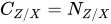 is the normal bundle and
 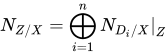 (see Normal cone#Properties), we have:
![{\displaystyle s(C_{Z/X})=c(N_{Z/X})^{-1}[Z]=\prod _{i=1}^{d}(1-c_{1}({\mathcal {O}}_{X}(D_{i})))[Z]=[Z]-\sum _{i=1}^{n}D_{i}\cdot [Z].}](./_assets_/eb734a37dd21ce173a46342d1cc64c92/8e67a25171334dfb958fbda7776599229a74546e.svg)
Example 2
The following is Example 3.2.22. of Fulton (1998).[2] It recovers some classical results from Schubert's book on enumerative geometry.
Viewing the dual projective space  as the Grassmann bundle
  parametrizing the 2-planes in
  , consider the tautological exact sequence

where  are the tautological sub and quotient bundles. With
  , the projective bundle
 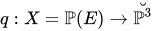 is the variety of conics in . With
  , we have
  and so, using Chern class#Computation formulae,

and thus

where  The coefficients in have the enumerative geometric meanings; for example, 92 is the number of conics meeting 8 general lines.
Example 3
Let X be a surface and  effective Cartier divisors on it. Let
  be the scheme-theoretic intersection of
  and
and  (viewing those divisors as closed subschemes). For simplicity, suppose
  meet only at a single point P with the same multiplicity m and that P is a smooth point of X. Then[12]
![{\displaystyle s(Z,X)=[D]+(m^{2}[P]-D\cdot [D]).}](./_assets_/eb734a37dd21ce173a46342d1cc64c92/c79b21037d2b25890db7fa1152a9d35a63586834.svg)
To see this, consider the blow-up of X along P and let  , the strict transform of Z. By the formula at #Properties,
![{\displaystyle s(Z,X)=g_{*}([{\widetilde {Z}}])-g_{*}({\widetilde {Z}}\cdot [{\widetilde {Z}}]).}](./_assets_/eb734a37dd21ce173a46342d1cc64c92/8051e5ac44c3da04313181630d9424401868a5aa.svg)
Since  where
where  , the formula above results.
Multiplicity along a subvariety
Let  be the local ring of a variety X at a closed subvariety V codimension n (for example, V can be a closed point). Then
  is a polynomial of degree n in t for large t; i.e., it can be written as
  the lower-degree terms and the integer
  is called the multiplicity of A.
The Segre class  of
of  encodes this multiplicity: the coefficient of
 ![{\displaystyle [V]}](./_assets_/eb734a37dd21ce173a46342d1cc64c92/3028d44ccfbe61947ac1c686584efe4d106505d3.svg) in is .[13]
in is .[13]
References
- ^ Segre 1953
- ^ a b Fulton 1998
- ^ Fulton 1998, p.50.
- ^ Fulton 1998, Example 4.1.1.
- ^
Fulton 1998, Example 4.1.5.
- ^ a b Fulton 1998, Proposition 3.1.
- ^ Fulton 1998, Example 3.1.1.
- ^ Fulton 1998, Proposition 4.2. (a)
- ^ Fulton 1998, Proposition 4.2. (b)
- ^ Fulton 1998, § 2.5.
- ^ Fulton 1998, Example 9.1.1.
- ^ Fulton 1998, Example 4.2.2.
- ^ Fulton 1998, Example 4.3.1.
Bibliography
- Fulton, William (1998), Intersection theory, Ergebnisse der Mathematik und ihrer Grenzgebiete. 3. Folge., vol. 2 (2nd ed.), Berlin, New York: Springer-Verlag, ISBN 978-3-540-62046-4, MR 1644323
- Segre, Beniamino (1953), "Nuovi metodi e resultati nella geometria sulle varietà algebriche", Ann. Mat. Pura Appl. (in Italian), 35 (4): 1–127, MR 0061420