Richard A. Peterson (aviator)
Richard Allen Peterson | |
|---|---|
Major Richard A Peterson of the 357th Fighter Group | |
| Nicknames | Pete, Bud |
| Born | February 26, 1923 Hancock, Minnesota, U.S. |
| Died | June 4, 2000 (aged 77) Minneapolis, Minnesota, U.S. |
| Buried | Lakewood Cemetery Minneapolis, Minnesota, U.S. |
| Allegiance | United States |
| Branch | United States Army Air Forces |
| Service years | 1942–1946 |
| Rank | Major |
| Unit | 364th Fighter Squadron, 357th Fighter Group |
| Conflicts | World War II |
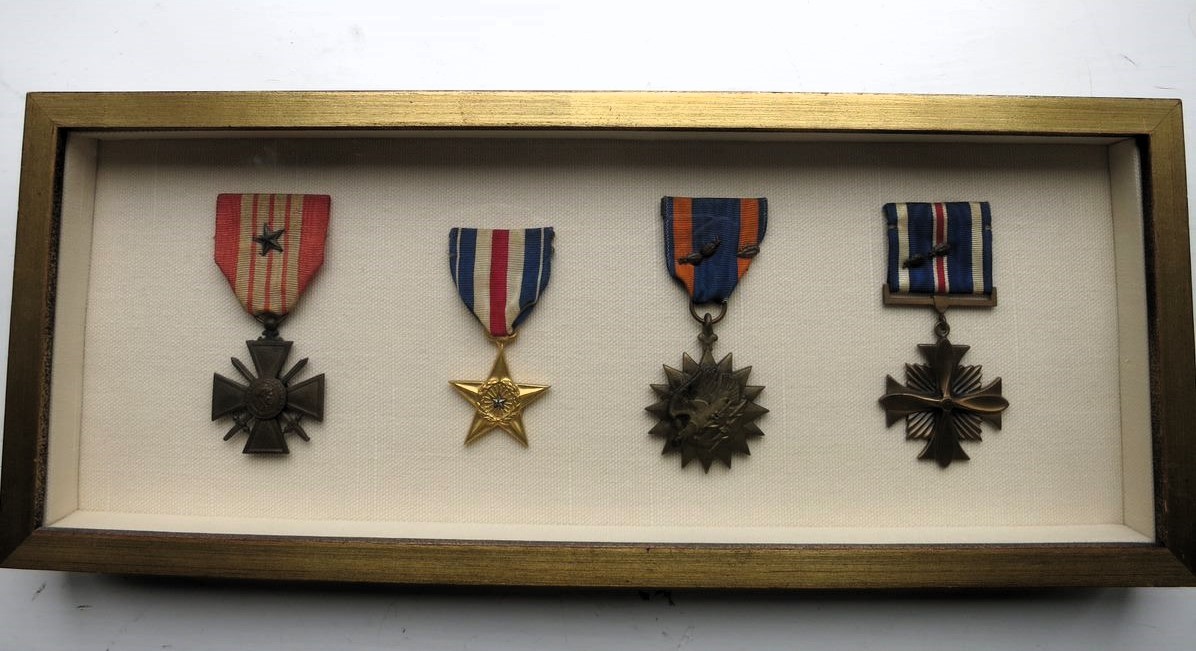
| Awards | Silver Star Distinguished Flying Cross (3) Air Medal (13) |
Richard Allen Peterson (February 26, 1923 – June 4, 2000) was a fighter ace and a major in the United States Army Air Forces. During World War II, he was the fourth highest scoring ace of 357th Fighter Group, with 15.5 aerial victories.[1][2][3]
Early life and education
Peterson was born in Hancock, Minnesota, and grew up in Alexandria, Minnesota. He graduated from Alexandria High School in 1940 and then attended the University of Minnesota.[1][4][5] From 1940 to 1941, he was part of the university's track team.[6]
World War II
On 30 March 1942, he enlisted in the Aviation Cadet Program of the United States Army Air Forces; in June 1942, he left the university to become an aviation cadet.[7]
After finishing flight training in March 1943, Peterson was assigned to the 364th Fighter Squadron of the 357th Fighter Group at Tonopah, Nevada, flying Bell P-39 Airacobras. On October 4, 1943, while flying a P-39 during a transfer flight from El Paso, Texas to Tucson, Arizona, he became disoriented and got separated from his squadron. Despite navigation issues, Peterson made a deadstick landing at El Chapo, Chihuahua, Mexico, resulting in his aircraft being damaged beyond repair; the P-39's landing also damaged some railcars. Mexican officials confiscated the P-39's ammunition despite an Army Air Forces officer showing up at the crash site upon Peterson's request. Peterson was later allowed to travel back to Nevada to rejoin his fighter group.[8][9]
In November 1943, the 357th Fighter Group was assigned to the European Theater of Operations, and was stationed at RAF Leiston in England—where the unit was now equipped with North American P-51 Mustangs. On March 6, 1944, he shot down a Focke-Wulf Fw 190 over Bordeaux, France, his first aerial victory. On March 16, he was credited with the shared destruction of a twin-engine Messerschmitt Bf 110, and on March 18, he shot down a Messerschmitt Bf 109 over Augsburg, Germany; his second aerial victory. By the end of May 1944, he shot down eight more enemy aircraft—including two shared destructions—bringing his total aerial victories to nine and earning him the title of flying ace. On July 1, he shot down two Bf 109s south of Saint-Quentin, France; later the same month, he returned to the United States for shore leave.[10][11]
In October 1944, he returned to the 357th Figher Group, and on October 6, he shot down a Fw 190 over Berlin, Germany; the next day, he shot down a Bf 109 over Jena, Germany. On November 2, he shot down a Bf 109 north of Merseburg, Germany. His fifteenth and final aerial victory was on November 11, when he shot down a Bf 109 over an airfield in Neuhausen, Germany.[12][11] Peterson had 15.5 air victories and destroyed 3.5 aircraft on the ground while flying 150 missions.[13][11] His P-51 Mustang aircraft were named Hurry Home Honey after his wife's letter closing.[14][2] On one of the missions, he witnessed a Bf 109 shooting at American B-17 bomber crews in parachutes after being shot down. Peterson attacked the Bf 109 and forced the German pilot to bail out of the aircraft. He shot and killed him as he descended on his parachute.[15] Peterson recalled that some of his unit were nervous that this would invite a retaliatory response from the Luftwaffe, "but they had to be there to know what I was seeing," Peterson said, adding that "those guys were helpless, the bomber crews going down".[15] Peterson earned numerous awards and decorations during his career.[16][5]
Post-war
Peterson and his wife Elaine had three children and numerous grandchildren.[6] After World War II, he left military service in 1946, and returned to the University of Minnesota; obtaining a degree in architecture in 1949, subsequently entering the field of architecture. In 2000, he was inducted into the Minnesota Aviation Hall of Fame.[17][18][19][1]
He died of cancer on June 4, 2000, at the age of 77 and was buried at Lakewood Cemetery in Minneapolis.[6][1]
Aerial victory credits
| Chronicle of aerial victories | |||||
|---|---|---|---|---|---|
| Date | # | Type | Location | Aircraft flown | Unit Assigned |
| March 6, 1944 | 1 | Focke-Wulf Fw 190 | Bordeaux, France | P-51B Mustang | 364 FS, 357 FG |
| March 16, 1944 | 0.5 | Messerschmitt Bf 110 | Ulm, Germany | P-51B | 364 FS, 357 FG |
| March 18, 1944 | 1 | Messerschmitt Bf 109 | Augsburg, Germany | P-51B | 364 FS, 357 FG |
| April 11, 1944 | 1 | Bf 109 | Magdeburg, Germany | P-51B | 364 FS, 357 FG |
| April 24, 1944 | 1 | Bf 109 | Munich, Germany | P-51B | 364 FS, 357 FG |
| April 30, 1944 | 2 | Fw 190 | Auxerre, France | P-51B | 364 FS, 357 FG |
| May 12, 1944 | 0.5 | Fw 190 | Frankfurt, Germany | P-51B | 364 FS, 357 FG |
| May 13, 1944 | 1.5 | Messerschmitt Me 410 | Grünberg, Germany | P-51B | 364 FS, 357 FG |
| May 28, 1944 | 1 | Bf 109 | Magdeburg, Germany | P-51B | 364 FS, 357 FG |
| July 1, 1944 | 2 | Bf 109 | Saint-Quentin, France | P-51D Mustang | 364 FS, 357 FG |
| October 6, 1944 | 1 | Fw 190 | Berlin, Germany | P-51D | 364 FS, 357 FG |
| October 7, 1944 | 1 | Bf 109 | Jena, Germany | P-51D | 364 FS, 357 FG |
| November 2, 1944 | 1 | Fw 190 | Merseburg, Germany | P-51D | 364 FS, 357 FG |
| November 11, 1944 | 1 | Bf 109 | Neuhausen, Germany | P-51D | 364 FS, 357 FG |
- SOURCES: Air Force Historical Study 85: USAF Credits for the Destruction of Enemy Aircraft, World War II
Awards and decorations
| Army Air Forces Pilot Badge |
| Silver Star[20] | |
| Distinguished Flying Cross with two bronze oak leaf clusters[20] | |
| Air Medal with two silver and two bronze oak leaf clusters[20] | |
| American Campaign Medal | |
| European-African-Middle Eastern Campaign Medal with silver campaign star | |
| World War II Victory Medal | |
| Croix de Guerre with bronze star (France)[20] |
Army Presidential Unit Citation
See also
References
- ^ a b c d William Hess. America's Top Eighth Air Force Aces in Their Own Words. Zenith Imprint. pp. 143–. ISBN 978-1-61060-702-5.
- ^ a b Chris Bucholtz (20 December 2012). Mustang Aces of the 357th Fighter Group. Bloomsbury Publishing. pp. 37–. ISBN 978-1-78200-872-9.
- ^ Martin W. Bowman (2006). Echoes of England: The 8th Air Force in World War Two. Tempus. ISBN 978-0-7524-3738-5.
- ^ "Richard Peterson - Recipient -". valor.militarytimes.com. Retrieved 2023-05-19.
- ^ a b "Richard A. (Bud) Peterson". Alexandria Education Foundation. Retrieved 2023-05-19.
- ^ a b c "Obituary: Richard A. Peterson (Aged 77)". Star Tribune (Newspapers.com). 2000-06-07. Retrieved 2024-07-14.
- ^ "Access to Archival Databases (AAD)". National Archives. Retrieved 2023-12-12.
- ^ Olmsted, Merle C. "See Them Tumbling Down". To Fly and Fight. Retrieved 2023-12-13.
- ^ Flories, Santiago A. (2019). Mexicans at War: Mexican Military Aviation in the Second World War, 1941–1945. Helion Limited. ISBN 9781913118396. Retrieved 2023-12-13.
- ^ "Air Force Historical Study 85: USAF Credits for the Destruction of Enemy Aircraft, World War II" (PDF). 1978. p. 150. Retrieved December 13, 2023.
- ^ a b c "Richard Peterson (Victory Table)". To Fly and Fight. Retrieved December 13, 2023.
- ^ Peterson, Richard. "Combat Report (6 October 1944)". WWII Aircraft Performance. Archived from the original on December 13, 2023. Retrieved November 5, 2025.
- ^ Jerry Scutts (20 November 2012). Mustang Aces of the Eighth Air Force. Bloomsbury Publishing. pp. 174–. ISBN 978-1-78200-675-6.
- ^ "P-51 Mustang (Drawing) "Hurry Home Honey"". United States Air Force (af.mil). Retrieved 2025-11-05.
- ^ a b Wings - Target: Berlin. Retrieved 2025-11-13 – via YouTube. (At 27:30.) At this time frame in this documentary, features Peterson describing the incident of shooting and killing a German pilot while he was parachuting, after the German had shot at parachuting American bomber crewmen.
- ^ "Richard Peterson". Hall of Valor: Medal of Honor, Silver Star, U.S. Military Awards. Retrieved 2025-10-31.
- ^ "Richard A. "Bud" Peterson - - Minnesota Aviation Hall of Fame Inductee". Retrieved 2023-05-10.
- ^ "Elaine B. Peterson". Star Tribune. 2015-08-16. Retrieved 2023-12-13.
- ^ "Richard A. (Bud) Peterson". Alexandria Education Foundation. Retrieved 2023-05-10.
- ^ a b c d "Picture of Richard Peterson's award rack". To Fly and Fight. Retrieved 2025-11-01.


External links
- "Richard A. "Bud" Peterson 1923 - 2000". Minnesota Aviation Hall of Fame. Retrieved 2018-06-27.
- "Richard A Peterson". American Air Museum in Britain. Retrieved 2018-06-27.