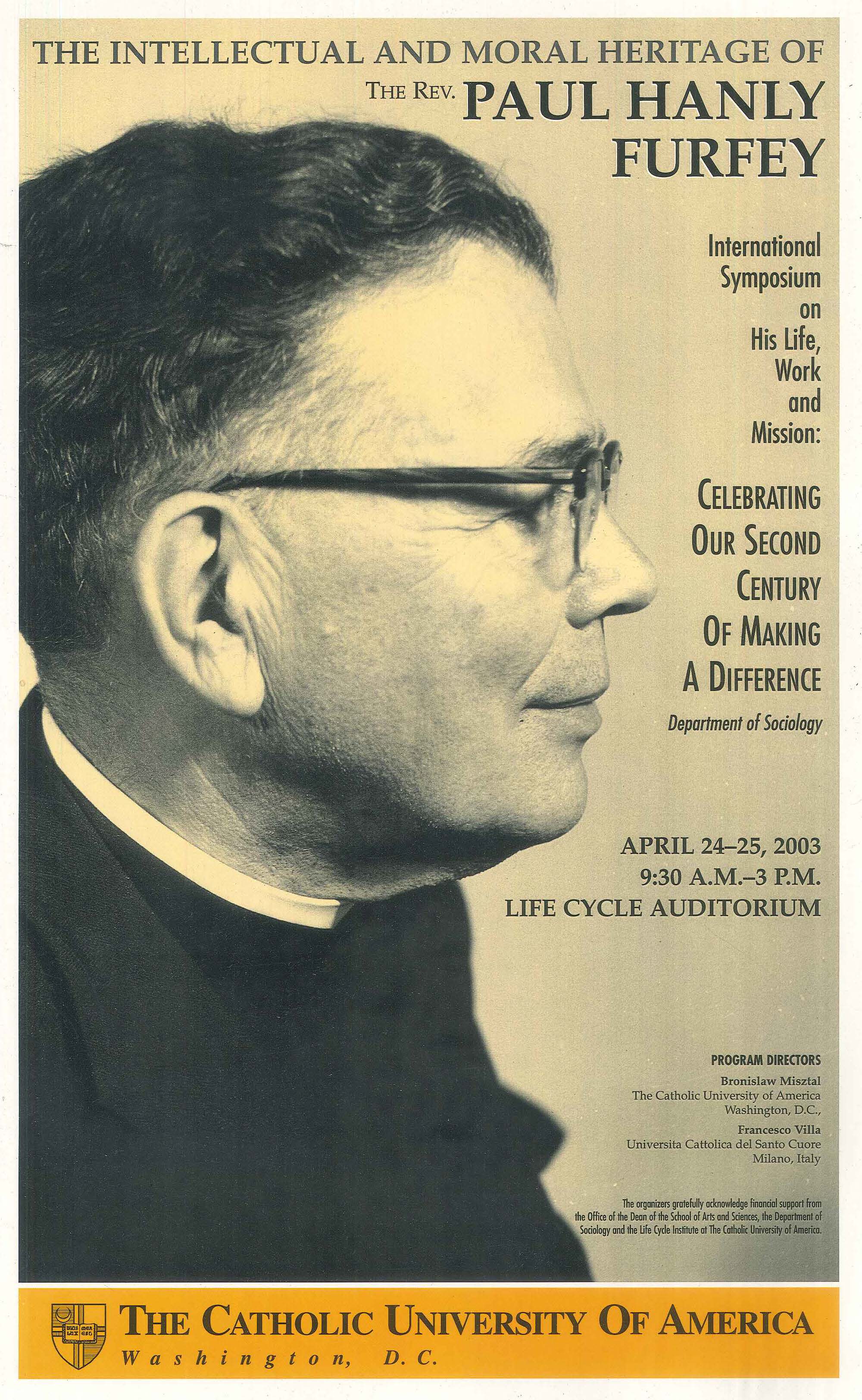
Paul Hanly Furfey
Rev. Monsignor Paul Hanly Furfey | |
|---|---|
| Personal life | |
| Born | June 30, 1896 Cambridge, Massachusetts |
| Died | June 12, 1992 (aged 95) |
| Religious life | |
| Religion | Roman Catholicism |
Paul Hanly Furfey (1896 – 1992) was an American Roman Catholic priest and sociologist, whom his biographer, Nicholas K. Rademacher, called "one of U.S. Catholicism’s greatest champions of peace and social justice."[1][2] He was spiritual advisor to Servant of God Catherine de Hueck Doherty, founder of the Madonna House Apostolate and Friendship House, until she left Harlem and returned to Canada, and they remained frequent correspondents.[3] He introduced Doherty to Servant of God Dorothy Day and Peter Maurin.[4] Thomas Merton considered him a strong early spiritual influence who caused him to more deeply consider the path he eventually took, entering the Trappist monastery.[4] The Association for the Sociology of Religion gives the Furfey lecture annually in his honor, and credits him with coining the term "metasociology" in a 1953 book.[5][6]
Early life and education
Furfey was born on June 30, 1896, to Margaret Hanly Connell Furfey and James A. Furfey in Cambridge, Massachusetts.[7] After Catholic elementary and secondary education in Cambridge, he earned an A.B. (bachelor of arts) from Boston College in 1917. He studied psychology at Catholic University of America as a Knights of Columbus fellow, and then transferred, earning his master's degree from St. Mary's Seminary and University in 1918.[8] He counted priest and psychologist-psychiatrist Thomas Verner Moore as one of his great influences. He was ordained to the priesthood of the Archdiocese of Baltimore in 1922 and began his doctoral work in sociology at Catholic University, graduating in 1926.[9] He studied medicine in Germany on a sabbatical, where Rademacher writes that he witnessed the "increasingly desperate" and "polarized" political landscape there just before the start of WWII, from 1931 to 1932.[1]
Moderate Catholic social thought advocates charity... but balks at social equality. It advocates world peace but takes no action that would greatly offend the militarists. It talks about the living wage, but becomes very cautious in discussing specific strikes. It discusses social justice, but fawns on wealthy [people] and politicians.
Career
He described himself as a radical, calling out everyday citizens who tolerate slavery, genocide, and the bombing of noncombatants as "respectable murderers."[10][11] He was influenced by the Catholic-left religious communities such as the Bowery's Catholic Worker, founded by his friends Dorothy Day and Peter Maurin, Harlem's Friendship House, founded by his spiritual directee Catherine Doherty, and the settlement house movement.[12] As chair of sociology at Catholic University for 32 years, from 1934 to 1966, he became what Santa Clara professor of spirituality Bruce H. Lescher calls "one of the leading spokespersons of the Catholic left."[9] In 2003 Catholic University held a symposium, "The Intellectual and Moral Heritage of the Rev. Paul Hanly Furfey."[13]
Community houses for social justice in Washington, DC
In 1936, with sociologist Gladys Sellew and department colleague Mary Elizabeth Walsh, he cofounded Il Poverello House at 2119 10th Street NW.[14] The name of the house came from St. Francis of Assisi, who was known as "Il Poverello," the little poor man.[15] There they demonstrated that they could live on 15 cents a day, the rough equivalent of $3 in the 2020s.[16] Emanuel A. Romero, a prominent Black Catholic author advocating interracial justice wrote in detail of the house, describing it as coming "as close to the heart of Catholic interracial work as anything I know."[14] Furfey was also closely involved with two other such houses, Fides House, where Catholic University nursing students joined the mix of sociologists living with low-income residents of the Shaw neighborhood, and Emmaus House in the university's own Brookland neighborhood, both of which drew the attention of Eleanor Roosevelt.[17][18]
References
- ^ a b Rademacher, Nicholas K. (2017). Paul Hanly Furfey: Priest, Scientist, Social Reformer. Catholic Practice in North America. New York, NY: Fordham University Press. ISBN 978-0-8232-7679-0.
- ^ Shepherd, William J.; Barga, Mike; Moore, Raymond; Sakolsky, Josh; Turrini, Joseph M.; Rawson, Carter (1996–2011). "An inventory of the Paul Hanly Furfey Papers". Special Collections of the University Libraries at The Catholic University of America.
- ^ Doherty, Catherine de Hueck; Furfey, Paul Hanly. "Msgr. Paul Hanly Furfey Papers: Baroness Catherine de Hueck Doherty, 1951-1974". The Catholic University of America, Libraries.
- ^ a b Pycior, Julie Leininger (2000). "We Are All Called to Be Saints: Thomas Merton, Dorothy Day and Friendship House" (PDF). The Merton Annual (13): 53.
- ^ "Introduction to the Paul Hanley Furfey Lecture". Sociology of Religion. 43 (1): iv. 1982. doi:10.1093/socrel/43.1.iv.
- ^ Furfey, Paul Hanly (1953). The Scope and Method of Sociology: A Metasociological Treatise. New York: Harper & Brothers. pp. xi.
- ^ "Massachusetts, State Vital Records, 1638-1927", FamilySearch (https://www.familysearch.org/ark:/61903/1:1:FXX8-NM6 : Fri Jul 25 15:42:18 UTC 2025), Entry for Paul H. Furfey and James A., 1896.
- ^ Barga, Michael (March 4, 2013). "Monsignor Paul Hanly Furfey". Social Welfare History Project: Virginia Commonwealth University Libraries.
- ^ a b Lescher, Bruce H. (1996). "Paul Hanly Furfey: Insights from a Spiritual Pilgrimage". Records of the American Catholic Historical Society of Philadelphia. 107 (3/4): 40. JSTOR 44210210 – via JSTOR.
- ^ Furfey, Paul Hanly. "From Catholic Liberalism to Catholic Radicalism". The American Ecclesiastical Review (166): 678–686.
- ^ Furfey, Paul Hanly (1966). The Respectable Murderers: Social Evil and Christian Conscience. New York: Herder and Herder, Fordham reprint.
- ^ "Msgr. Paul Hanly Furfey Papers: Baroness Catherine De Hueck-Doherty, 1951-1970: Box 6, Folder 31". American Catholic History Archives. Catholic University of America – via JSTOR.
- ^ Misztal, Bronislaw; Villa, Francesco (April 24–25, 2003). "The Intellectual and Moral Heritage of the Rev. Paul Hanly Furfey". Department of Sociology, The Catholic University of America.
- ^ a b Romero, Emanuel A. (August 1, 1940). "The Little Poor House". The Interracial Review. XIII (8): 122–24 – via Digital Georgetown.
- ^ Himes, Kenneth R. (December 1, 1981). "St. Francis of Assisi: The Little Poor Man". Sojourners. Retrieved December 13, 2025.
- ^ Sellew, Gladys (1938). A Deviant Social Situation, a Court. PhD Dissertation. Washington, DC: Catholic University of America.
- ^ Paris, Jenell (January 1, 2000). "Fides Means Faith: A Catholic Neighborhood House in Lower Northwest Washington, D.C." Sociology Educator Scholarship: 12. Also published in Washington History 11(2000):2:24-45.
{{cite journal}}: CS1 maint: postscript (link) - ^ Shepherd, William J. (October 12, 2017). "The Archivist's Nook: 'Supernatural Sociologist' – Paul Hanly Furfey". Catholic University of America, University Libraries.