Oclemena × blakei
| Oclemena × blakei | |
|---|---|
| Scientific classification | |
| Kingdom: | Plantae |
| Clade: | Tracheophytes |
| Clade: | Angiosperms |
| Clade: | Eudicots |
| Clade: | Asterids |
| Order: | Asterales |
| Family: | Asteraceae |
| Genus: | Oclemena |
| Species: | O. × blakei
|
| Binomial name | |
| Oclemena × blakei | |
| Synonyms[2] | |
|
Homotypic synonyms
Heterotypic synonyms
| |
Oclemena × blakei, commonly known as Blake's aster, is a hybrid of flowering plant in the aster family Asteraceae. It is native to northeastern North America. Its parent species are Oclemena acuminata and Oclemena nemoralis.
Description
The hybrid Oclemena × blakei is intermediate in appearance between its parent species. It is distinguished from its parents primarily by its leaves:[3][4][5][6]
| Oclemena acuminata | Oclemena × blakei (O. acuminata × O. nemoralis) |
Oclemena nemoralis | |
|---|---|---|---|
| Number of leaves below the inflorescence | 10–22 Clustered and larger at the summit of the stem |
20–45 | 40–75 Uniformly sized and distributed |
| Width of leaf blades | 15–60 mm wide | 5–24 mm wide | 2–12 mm wide |
| Leaf margins | Prominently toothed with flat margins | Small teeth | Entire or nearly so, often with revolute margins |
| Flower heads | 5–46 | 2–35 | 1–15 |
| Ray flowers | White or tinged with pink | White to pink | Pink to purple, seldom white |
| Habitat | Forests | Overlapping habitat of parents | Bogs, fens, mossy lake shores |
Oclemena × blakei is sometimes confused with Eurybia radula. The latter has pale blue-violet ray flowers and 4–5 rows of phyllaries (bracts) with rounded tips,[7] whereas the former has white to pink ray flowers and 1–2 rows of phyllaries with pointed tips.
Taxonomy
Oclemena × blakei was first described as Aster nemoralis var. blakei by the American botanist Thomas Conrad Porter in 1894.[9] Porter named the variety in honor of the botanist who collected its type specimen in Gilmanton, New Hampshire 30 years earlier.[10] In 1920, the American botanist Homer Doliver House concluded that Aster nemoralis var. blakei Porter "should more properly be regarded as a hybrid" of Aster acuminatus and Aster nemoralis.[11][12] The resulting hybrid name Aster × blakei (Porter) House remained in use for the rest of the 20th century. In 1995, the American botanist Guy L. Nesom published the name Oclemena acuminata × Oclemena nemoralis.[1] As of December 2025, the hybrid name Oclemena × blakei (Porter) G.L.Nesom is widely accepted.[2][13][14][15]
In the Report of the State Botanist of 1893, Charles Horton Peck described a variety of Aster nemoralis collected in northern Herkimer County, New York along with the typical variety. As described by Peck,[16] the new variety was much larger than Aster nemoralis with a longer stem, more flower heads, and larger leaves. As of December 2025, the name Aster nemoralis var. major Peck is considered to be a synonym of Oclemena × blakei.[17]
Distribution and habitat
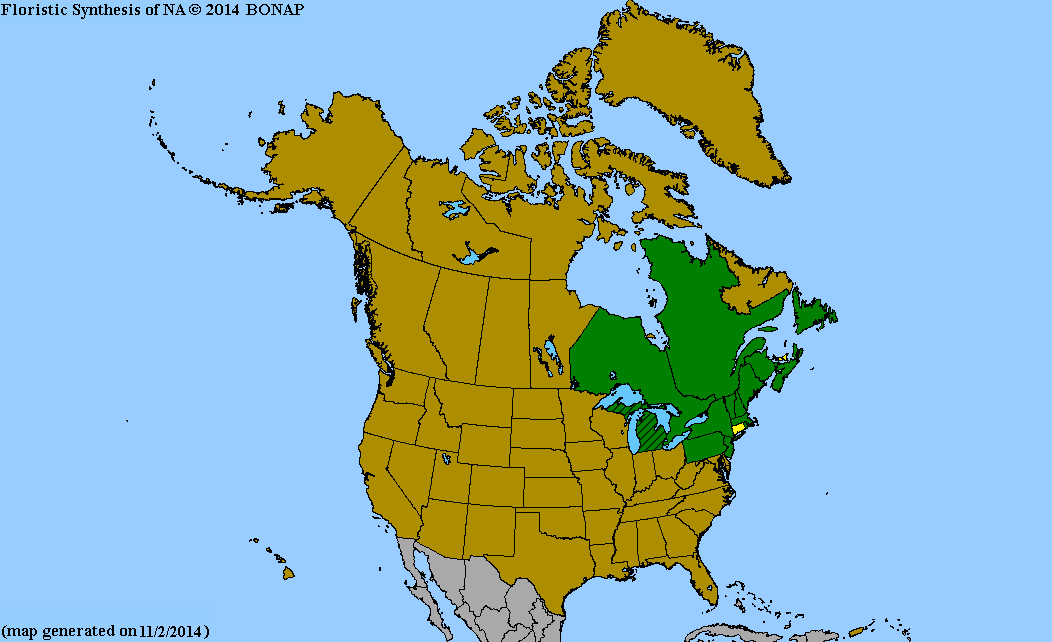
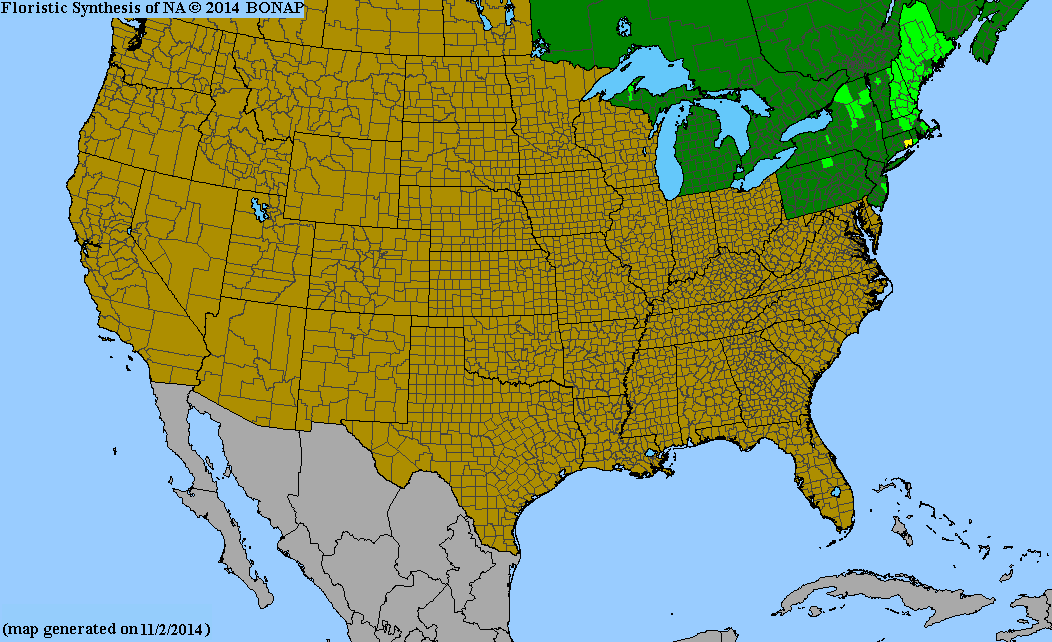
Oclemena × blakei is native to eastern Canada and northeastern United States:[2][18]
- Canada: New Brunswick, Newfoundland, Nova Scotia, Ontario, Prince Edward Island, Quebec
- United States: Connecticut, Maine, Massachusetts, New Hampshire, New Jersey, New York, Rhode Island, Vermont
There are unconfirmed reports that the hybrid occurs in Michigan and Pennsylvania as well.[19][20]
Conservation
As of December 2025, Oclemena × blakei is not globally ranked by NatureServe.[21] It is secure (S5) in Nova Scotia and critically imperiled (S1) in Connecticut but no other state-level ranks are listed.
References
- ^ a b "Oclemena × blakei (Porter) G.L.Nesom". International Plant Names Index (IPNI). Royal Botanic Gardens, Kew; Harvard University Herbaria & Libraries; Australian National Botanic Gardens. Retrieved 4 December 2025.
- ^ a b c "Oclemena × blakei (Porter) G.L.Nesom". Plants of the World Online. Royal Botanic Gardens, Kew. Retrieved 4 December 2025.
- ^ Brouillet & Simon (1981), Table 1.
- ^ Brouillet, Luc (2006). "Oclemena". In Flora of North America Editorial Committee (ed.). Flora of North America North of Mexico (FNA). Vol. 20. New York and Oxford: Oxford University Press. Retrieved 5 December 2025 – via eFloras.org, Missouri Botanical Garden, St. Louis, MO & Harvard University Herbaria, Cambridge, MA.
- ^ Haines (2011), p. 420.
- ^ "Oclemena". Go Botany. Native Plant Trust. Retrieved 5 December 2025.
- ^ Brouillet, Luc (2006). "Eurybia radula". In Flora of North America Editorial Committee (ed.). Flora of North America North of Mexico (FNA). Vol. 20. New York and Oxford: Oxford University Press. Retrieved 5 December 2025 – via eFloras.org, Missouri Botanical Garden, St. Louis, MO & Harvard University Herbaria, Cambridge, MA.
- ^ Britton & Brown (1913), p. 432, Fig. 4351.
- ^ "Aster nemoralis var. blakei Porter". International Plant Names Index (IPNI). Royal Botanic Gardens, Kew; Harvard University Herbaria & Libraries; Australian National Botanic Gardens. Retrieved 4 December 2025.
- ^ Porter (1894).
- ^ "Aster blakei (Porter) House". International Plant Names Index (IPNI). Royal Botanic Gardens, Kew; Harvard University Herbaria & Libraries; Australian National Botanic Gardens. Retrieved 18 December 2025.
- ^ House (1920), p. 241.
- ^ "Oclemena × blakei (Porter) G.L.Nesom". WFO Plant List. Retrieved 4 December 2025.
- ^ NRCS. "Oclemena ×blakei". PLANTS Database. United States Department of Agriculture (USDA). Retrieved 6 December 2025.
- ^ "Oclemena × blakei (Porter) G.L.Nesom". Database of Canadian Vascular Plants. Retrieved 6 December 2025.
- ^ Peck (1894), p. 155.
- ^ "Aster nemoralis var. major Peck". Plants of the World Online. Royal Botanic Gardens, Kew. Retrieved 18 December 2025.
- ^ Brouillet, Luc (2006). "Oclemena × blakei". In Flora of North America Editorial Committee (ed.). Flora of North America North of Mexico (FNA). Vol. 20. New York and Oxford: Oxford University Press. Retrieved 6 December 2025 – via eFloras.org, Missouri Botanical Garden, St. Louis, MO & Harvard University Herbaria, Cambridge, MA.
- ^ Kartesz, John T. (2014). "Oclemena X blakei". State-level distribution map from the North American Plant Atlas (NAPA). Biota of North America Program (BONAP). Retrieved 6 December 2025.
- ^ Kartesz, John T. (2014). "Oclemena X blakei". County-level distribution map from the North American Plant Atlas (NAPA). Biota of North America Program (BONAP). Retrieved 6 December 2025.
- ^ NatureServe (5 December 2025). "Oclemena × blakei". NatureServe Explorer. Arlington, Virginia. Retrieved 9 December 2025.
Bibliography
- Britton, Nathaniel Lord; Brown, Addison (1913). An illustrated flora of the northern United States, Canada and the British possessions (2nd ed.). New York: Charles Scribner's Sons. Retrieved 13 December 2025.
- Brouillet, L.; Simon, J.-P. (1981). "An ecogeographical analysis of the distribution of Aster acuminatus Michx. and A. nemoralis Aiton (Asteraceae: Astereae)". Rhodora. 83: 521–550. JSTOR 23311067. Retrieved 8 December 2025.
- Haines, Arthur (2011). New England Wild Flower Society's Flora Novae Angliae: A Manual for the Identification of Native and Naturalized Higher Vascular Plants of New England. Illustrated by Elizabeth Farnsworth and Gordon Morrison. Yale University Press. ISBN 978-0-300-17154-9.
- House, Homer D. (1920). "Notes on local floras VI". Bull. New York State Mus. Nat. Hist. 219–220: 238–246. Retrieved 4 December 2025.
- Peck, Charles H. (1894). "Report of the State Botanist 1893". Rep. (Annual) Regents Univ. State New York New York State Mus. 47: 129–174. Retrieved 18 December 2025.
- Porter, Thomas C. (1894). "Varieties of Solidago and Aster". Bull. Torrey Bot. Club. 21 (7): 310–311. Retrieved 4 December 2025.
External links
- Reznicek, A. A.; Voss, E. G.; Walters, B. S. (February 2011). "Oclemena nemoralis (Aiton) Greene". Michigan Flora Online. University of Michigan. Retrieved 6 December 2025.
- Nesom, G. L. (2001). "An anomalous population of Aster (Asteraceae: Astereae) sensu lato in Michigan". SIDA, Contributions to Botany. 19 (3): 625–632. JSTOR 41967889.
- "Oclemena × blakei (Porter) G.L.Nesom". Global Compositae Database. Compositae Working Group (CWG). 2025. Retrieved 10 December 2025.