Mechanized Infantry Regiment "Castilla" No. 16
| Mechanized Infantry Regiment «Castilla» No. 16 | |
|---|---|
Coat of arms of the regiment as an armored unit (since 2015) | |
| Active | Since April 1793 Since 2015 in its current configuration |
| Country | Spain |
| Allegiance | Spain |
| Branch | Spanish Army |
| Type | Multi-role |
| Role | Mechanized |
| Garrison/HQ | Sancha Brava Barracks on the outskirts of Badajoz and later at General Menacho Base in Bótoa, approximately 20 km from Badajoz |
| Nickname | "The Hero" |
| Patron | Immaculate Conception |
| Decorations | Laureate Cross of Saint Ferdinand |
| Insignia | |
| Identification symbol | |
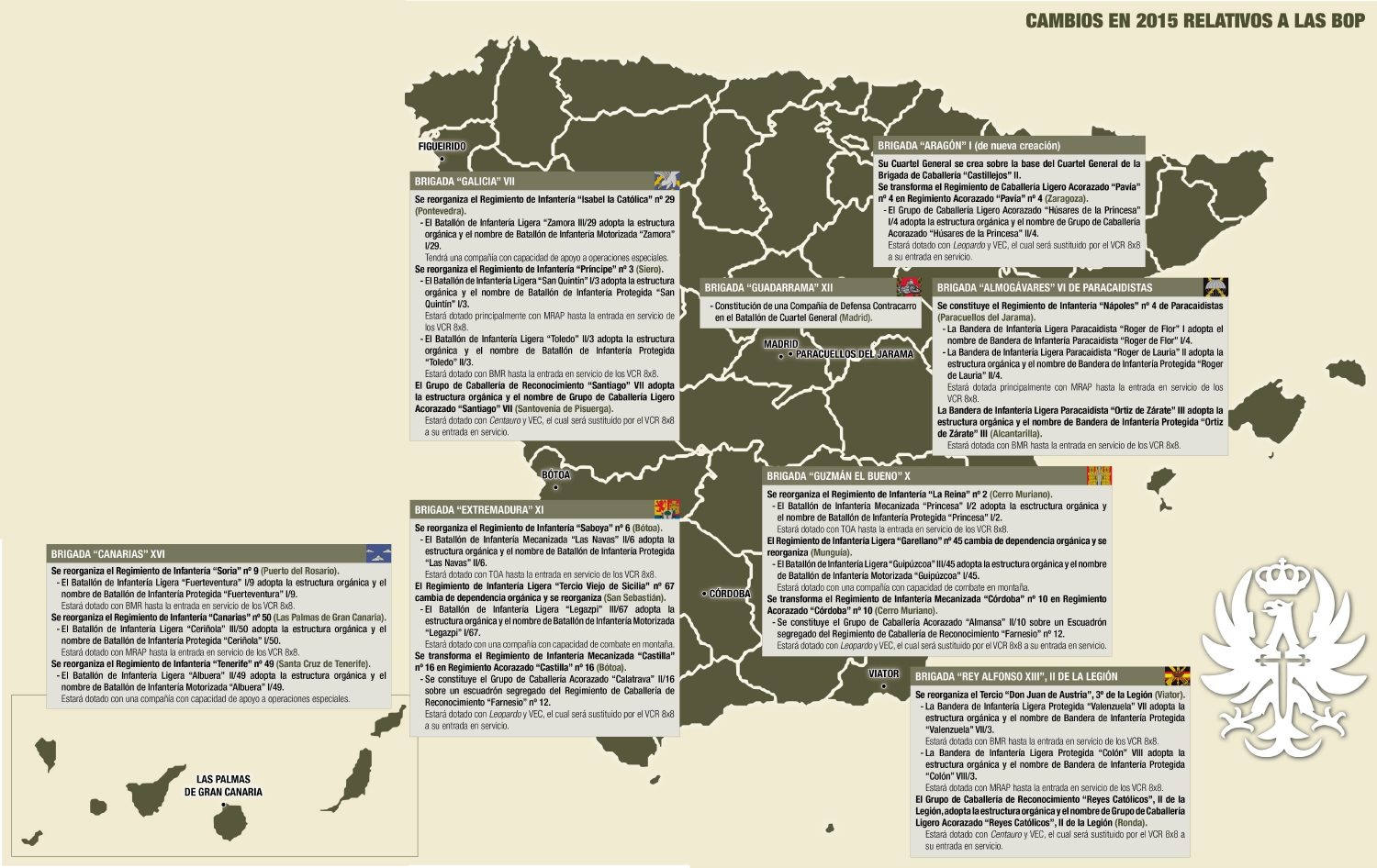
The Mechanized Infantry Regiment "Castilla" No. 16 is currently a versatile unit of the Spanish Army, traditionally integrated into the infantry. Since 2015, with the introduction of multi-role organic brigades, it was designated as the Armored Regiment "Castilla" No. 16.[1] It has been known as "Mechanized Infantry" since 1966, when the first tanks arrived at its Sancha Brava barracks. Until that time, the unit was designated as the 16th Infantry Regiment "Castilla". Years later, in 1975, the limitations of the barracks and, in particular, the training and firing range became evident, necessitating restrictions on the direction and range of projectiles.[2] This led to considerations for relocating the unit to a larger facility that could also accommodate other units, transforming it into a base housing multiple regiments and logistical and support units.[3] This plan was realized with the construction of the General Menacho Base near the village of Bótoa, approximately 20 km from Badajoz, where the regiment has been stationed since 1999.
During its time at the Sancha Brava Barracks, the regiment experienced significant historical moments, some challenging and others rewarding. Among the challenges was the difficult situation surrounding the coup attempt on February 23, 1981. Days earlier, most of the regiment's tanks were on maneuvers in Cerro Muriano, Córdoba, and were ordered to return to their Badajoz barracks before the maneuvers concluded. Upon arrival at Sancha Brava, all personnel were placed on alert, and tanks and other vehicles were refueled and armed. The regiment remained loyal to the Constitution and continued its operations with complete normalcy.
The first tanks assigned to the regiment were the American M47 Patton, M41 Walker Bulldog, and APCs (armoured personnel carriers) in their M577 command variants and M113 for troop transport and other functions. In 1983, the AMX-30E (the Spanish version of the French AMX-30) arrived, followed by the M60 Patton, the German Leopard 2A4 in the mid-1990s, and finally the Spanish Leopard 2E. Regarding its activities, the regiment has participated in various humanitarian and peacekeeping missions in El Salvador, six deployments in Bosnia-Herzegovina, one in Yugoslavia, two in Kosovo, one in Iraq, one in Indonesia, and three in Lebanon.[4]
Coat of arms and decorations
The coat of arms of the Armored Regiment "Castilla" No. 16 features a gold castle, embattled, with three towers and adorned with sable on a gules field, with the Laureate Cross of Saint Ferdinand hanging from the lower point, accompanied by armorial pieces; the castle symbolizes the region of its namesake. The regiment bears the nickname "The Hero", earned for its heroism against the French during the second siege of Zaragoza, particularly in the bayonet assault at Torrero hill and the defense of the Convent of Jesus on December 21, 1808.[5] According to Infantry Captain Antonio Gil Álvaro in 1893,[6] "this nickname is due to the regiment's actions during the second siege of Zaragoza." The Supreme Junta, then based in Cádiz, decreed that these forces be called "Meritorious of the Homeland" for their "heroic and eminent service."
Seven decorations for distinguished heroic actions hang from the lower part of the coat of arms. From left to right, they are as follows:[7]
- Cross of the First Army or of Catalonia. It consists of four triangular arms enameled in turquoise blue. In the center is a circular shield with a royal crown on a red field, and below, the stripes of Catalonia on gold. The inscription reads "Defender of my King and the Principality." On the reverse, the number "1" appears. The ribbon is white with red edges. This is in accordance with the Royal Order of March 31, 1815.[8][9]
- Cross of the Third Army. It features a mountain with an inscription around it that reads "Victor from the Strait to the Pyrenees." On the reverse, the number "3" refers to the ordinal number of the army, on a green field. It has a crimson crown linking it to a ribbon of white and green diamonds. The Royal Order of concession is, like the previous one, dated March 31, 1815.[10][11]
- Cross of Zaragoza in its First and Second Sieges. Created on the same date as the previous ones for the troops that endured both sieges, with the intent that they wear only one distinction cross. It is similar to the other two but with notable differences resulting from combining them into a single piece. The arms are red and white by halves; the central oval, featuring the Virgin of the Pillar, is blue with lilies between the arms, a mural crown on the upper arm, and a laurel crown on the lower one. It bears a royal crown and hangs from a ribbon with a central blue stripe and two yellow and two red fillets on each side. On the reverse, over blue, it reads: "The King to the defenders of Zaragoza in its 1st and 2nd Sieges." The Royal Order granting it has different dates according to specialized authors: March 25, 1817, according to Calvó Pascual, and May 13, 1817, according to Gravalos-Calvo Pérez.[12][13]
- Cross of the First Siege of Bilbao. This decoration was awarded to the regiment by Queen Regent Isabella II on July 6, 1835, to honor the defenders of the city during its "first siege." The officers' decoration is gold, while the troops' is silver. It consists of four equal arms enameled in white, with a gold center and ends finished in gold globes. In the center, an oval shape displays the bust of Queen Isabella II on a red background, with the inscription on a blue enamel circle: "Isabella II, Homeland and Liberty." Between the arms are two lions and two gold castles, and above the upper vertical arm is a laurel crown linked to a red ribbon with two blue stripes. On the reverse are the arms of Bilbao and, around it, on blue, the inscription: "Siege of Bilbao, June 1835."[14][15]
- Cross of Mendigorría. This cross was awarded to the regiment by Royal Order of September 23, 1835, issued by Queen Regent Isabella II of Spain. It consists of five white enameled blades linked by a laurel border. Over this is another laurel crown linked to a red ribbon. In the center, the inscription "Y2" appears on red, and around it, on blue, the motto "Reward for Valor." On the reverse, in another circle, the inscription reads: "The Queen to her defenders" in horizontal lines, and on a blue crown surrounding it: "Mendigorría July 16, 1835."[16][15]
- Cross of the Third Siege of Bilbao. Similar to the previous one, but the colors of the arms and the ribbon are alternated, and the shape of the arms is slightly different. Between the arms are two cannons, while three bombs cross the interstices. In the center, "Saved Bilbao" and a gold castle on a red background. On the reverse, the inscription reads: "In its Third Siege," and in the center, a broken bridge over the river. The laurel crown linking it to the ribbon contains no pieces inside. The decree granting this decoration is the same as the previous one.[17]
- Cross of Merit for the Homeland. This decoration never received official recognition. However, it is included due to the numerous examples found in museums and private collections and the mystery surrounding it. The brief history of this questionable decoration is as follows: In 1809, the Cádiz Cortes declared some regiments, including the "Bourbon Infantry Regiment," as "Meritorious of the Homeland." This honor continued during the reigns of Ferdinand VII, Isabella II, the Provisional Government of 1868–1871, Amadeo I, the First Spanish Republic, and Alfonso XII, before falling into disuse, possibly due to overuse. The decoration resembles the previous two: five blue enameled arms over a circle resembling a wall, with a smaller central circle bearing an inscription. The ribbon is blue with two red stripes. Typically, it reads "Meritorious to the Homeland" or "… of the Homeland" on the obverse and reverse, though some examples feature the effigy of Isabella II or have a ribbon reading "Homeland and Loyalty," while others lack enamel and are stamped in poor-quality metal. Evidence that this decoration was merely a fantasy of those who used it is found in the Official Bulletin of the Captaincy General of Cuba, year IX, number 51, which publishes a resolution dated September 13, 1870, stating: "Manuel González González, a volunteer from the Havana Battalion, requested authorization to use the Cross of Merit for the Homeland, claiming that in that city, Army Chiefs and Officers use it. The Captain General has resolved to dismiss this request, as such a Cross does not officially exist, and its use is prohibited by various royal provisions, the most recent being August 26, 1867, so Your Excellency will ensure that such abuse ceases immediately…". The origin of its use is unknown, but due to its similarity to the previous models, it is placed here.[18][19][20]
History
Background
The unit's origins date back to 1793, when the XIII Duke of the Infantado, Pedro de Alcántara Álvarez de Toledo y Salm-Salm, who would become its first colonel, submitted a request to create the regiment to King Charles IV on April 3, 1793. The king approved the request on April 15 of the same year. Its initial designation was the "Castilla Volunteers Regiment," as notified by the Minister of War on April 25, 1793, expressing the king's wish for this name. At its founding, the regiment consisted of three battalions, each with four fusilier companies. Years later, in 1883, while the Castilla No. 16 was stationed in Leganés, a Royal Order of December 10, 1883, assigned the regiment to Badajoz. The Castilla No. 16 departed on December 16 and took six days to organize the transfer by railway. Upon arriving in Badajoz, it occupied the San Francisco el Grande Barracks,[21] which was vacant after the dissolution of the Covadonga Regiment No. 41, which had previously occupied it.[22]
From December 17, 1883, the Castilla Infantry Regiment No. 16 became tied to the city of Badajoz for over a century, during which many generations of Extremadurans, particularly from Badajoz, were trained in its ranks (at that time, recruits were assigned to the nearest regiments).[23] This marked the origin of the 16th Infantry Regiment "Castilla", which, in 1966, with the arrival of tanks, was renamed the "Mechanized Infantry Regiment Castilla No. 16" and had as its first commander, from February 17, 1966, Lieutenant Colonel Rovira Recio.
Sancha Brava Barracks
The first barracks of the "Mechanized Infantry Regiment Castilla No. 16" was Sancha Brava, located about 4 km from the city of Badajoz. Until the change in designation due to the incorporation of tanks, it was occupied by its predecessor, the 16th Infantry Regiment "Castilla", from which all mechanical and logistical assets, as well as officers, non-commissioned officers, and troops, were drawn.[24]
Its first commander from February 17, 1966, was Lieutenant Colonel Adolfo Rovira Recio.[25] On November 17, Colonel Fidel Cátera Román took command of the regiment, appointed by Circular Order of October 28, published in Official Gazette No. 245. He received command from Lieutenant Colonel Adolfo Rovira Recio, who was relinquishing command due to his promotion to colonel.
In 1967, the regiment received its first 16 M47 Patton tanks from the Sagunto Cavalry Regiment, distributed among the battalion’s various companies. The American M-47 tank, manufactured since 1951, was first operated in the Spanish Army by the Armoured Division No. 1 "Brunete". The M-47 had the following characteristics: an engine with 810 cv equivalent to approximately 800 HP, a maximum speed of 48 km/h, a range of 128 km, and armament consisting of a 90 mm cannon, a 12.70 mm machine gun, and two 7.62 mm machine guns.[26]
In the first quarter of 1967, another thirteen M-47 tanks arrived, and in April, the regiment deployed to Cerro Muriano, Córdoba, to participate in Operation Saeta, conducted by the XXI Mechanized Infantry Brigade under General Pedro Merry Gordon, involving a live-fire offensive. In October of that year, additional mechanized equipment arrived: Thirty-four all-terrain vehicles with all-wheel drive came from the Córdoba Automobile Base, and thirteen M-47 tanks, as well as a crane truck for maintenance, came from the Segovia Mixed Base of Tractors and Tanks.[27]
By late 1967, the demolition of the old San Francisco Barracks began, where a cypress tree known as the "Castilla Sentinel" still stood, its condition deteriorating due to lack of irrigation and pruning. A unanimous request from civil society, led by the local newspaper Hoy and spearheaded by journalist Antonio García Orio Zabala—a former provisional sergeant of the first battalion of "Castilla No. 16"—resulted in General Pedro Merry Gordon authorizing a company of sappers from the "Engineer Battalion" to uproot the cypress and transplant it to the Sancha Brava Barracks, where it was placed to the right of the chapel.[28]
"La Hispanidad" Battalion
On November 10, 1968, a significant event occurred in the regiment: Extremadura and the Institute of Hispanic Culture paid tribute to the Spanish Army, symbolized on this occasion by the Mechanized Infantry Regiment Castilla No. 16. The event was used to bless and present a banner offered by the Badajoz City Council to the regiment. At 11 a.m., the Captain General of the II Military Region, Manuel Chamorro Martínez, arrived. After attending Holy Mass, the standard-bearers marched to their positions in front of the formation. Following a speech by the colonel, the fusilier company fired a volley, and while the national anthem played, the flag and standards were retired to their designated room. A parade of the forces followed, with the M-47 tank battalion, each tank named after an Extremaduran conquistador, closing the event. This battalion was thus named the "La Hispanidad Battalion." Representatives from the towns attended the event, presenting silver plaques with the names of the conquistadors born in their towns, along with the number of the sponsored tank, the town’s coat of arms, and a medal of the town’s patron saint, whose names were already displayed on the tanks’ prows.[29]
| Conquistador’s Name | Place of Origin | Sponsored Tank Number | Achievements |
|---|---|---|---|
| Pedro Alvarado | Badajoz | No. 111 | Conquistador of Guatemala[31] |
| Andrés de Tapia de Alvarado | Badajoz | No. 123 | Conquistador in Mexico[32] |
| Luis de Moscoso Alvarado | Badajoz | No. 212 | Leader of the expedition to Florida after Hernando de Soto’s death[33] |
| Arias Tinoco | Badajoz | No. 215 | Conquistador of Florida, commanding the ship Santa Bárbara[34] |
| Romo de Cardeñosa | Badajoz | No. 233 | Conquistador of Florida, commanding the ship San Antón[35] |
| Juan Núñez de Prado | Badajoz | No. 225 | Conquistador in Tucumán[36] |
| Hernán Sánchez de Badajoz | Badajoz | No. 315 | Conquistador of Peru[37] |
| Alonso Rangel | Aceuchal | No. 134 | Conquistador in Costa Rica[38] |
| Vasco Núñez de Balboa | Jerez de los Caballeros | No. 200 | Discoverer of the Pacific Ocean[39] |
| Hernando Méndez de Soto | Jerez de los Caballeros | No. 211 | Conquistador of Florida[40] |
| Nuño de Tovar | Jerez de los Caballeros | No. 213 | Conquistador of Florida, commanding the ship Magdalena[41] |
| Jaime de Maraver | Jerez de los Caballeros | No. 224 | Conquistador of New Spain[42][43] |
| Pedro de Valdivia | Castuera | No. 100 | Conquistador of Chile[44] |
| Hernán Cortés | Medellín | No. 001 (unit commander’s tank) | Conquistador of Mexico[45] |
| Alonso de Mendoza | Medellín | No. 115 | Conquistador in Peru[46] |
| Gonzalo de Sandoval | Medellín | No. 124 | Captain in the conquest of Mexico[47][48] |
| Rodrigo de Paz | Medellín | No. 132 | Conquistador in Mexico[49] |
| Alonso de Alvarado Montoya | Zafra | No. 321 | Conquistador in Guatemala, Mexico, and Peru. Captain General in Potosí and La Plata[50] |
| Juan Coles | Zafra | No. 201 | Conquistador in Florida and chronicler[51] |
| Benito Hurtado | Garrovillas de Cáceres | No. 112 | Conquistador in Castilla de Oro and Nicaragua[52] |
| Gallego de Andrade | Burguillos del Cerro | No. 012 | Conquistador in Mexico, husband of Isabel de Moctezuma[53] |
| Diego García de Paredes | Barcarrota | No. 214 | Conquistador of Florida, commanding the ship San Juan[54] |
| Juan Ruiz de Arce | Alburquerque | No. 301 | Conquistador in Peru and chronicler[55] |
| Jorge de Alvarado | Lobón | No. 323 | Conquistador of Mexico and Guatemala[56] |
| Diego de Alvarado | Lobón | No. 334 | Conquistador in Mexico, Guatemala, and Chile[57] |
| Juan Cano de Saavedra | Cáceres | No. 011 | Captain in the conquest of Mexico[58] |
| García Holguín | Cáceres | No. 014 | Conquistador in Mexico[59] |
| Vasco Porcallo de Figueroa | Cáceres | No. 222 | Conquistador in Florida, Cuba, and Santo Domingo[60] |
| Francisco de Sande | Cáceres | No. 234 | Founder of the Camarines Province of Nueva Cáceres and Governor of the Philippines[61] |
| Lorenzo de Aldama | Cáceres | No. 002 | Conquistador in Peru and Governor of Popayán[62] |
| Lorenzo de Ulloa | Cáceres | No. 331 | Conquistador in Peru, Jamaica, and Honduras[63] |
| Carrillo de Obando | Cáceres | No. 332 | Governor of Muso de Palma, Colombia[64] |
| Pedro Corbacho | Cáceres | No. 335 | Navigator with Columbus on the first voyage to the Indies[65] |
| Francisco Pizarro | Trujillo | No. 300 | Conquistador of Peru[66] |
| Francisco de Orellana | Trujillo | No. 121 | Discoverer of the Amazon River[67] |
| Juan de Chaves | Trujillo | No. 101 | Conquistador in Mexico and Honduras[68] |
| Diego de Sanabria | Trujillo | No. 113 | Adelantado of the Río de la Plata[69] |
| Diego García de Paredes | Trujillo | No. 221 | Conquistador in Venezuela, where he founded the city of Trujillo[70] |
| Ñuflo de Chaves | Trujillo | No. 235 | Founder of Santa Cruz de la Sierra and conquistador in Paraguay[71] |
| Francisco de las Casas | Trujillo | No. 135 | Founder of the city of Trujillo in Honduras[72] |
| Pedro Alonso de Hinojosa | Trujillo | No. 333 | Conquistador in Peru and captain general of Lagasca’s army[73] |
| Gonzalo de Ocampo | Trujillo | No. 324 | Conquistador in Santo Domingo and Pánuco[74] |
| Hernando de Trejo | Trujillo | No. 325 | Conquistador in Argentina[75] |
| Gonzalo Pizarro | Trujillo | No. 131 | Leader of the expedition to the Land of Cinnamon[76] |
| Alonso de Sotomayor | Trujillo | No. 231 | Governor and captain general in Chile[77] |
| Diego Alfonso de Camargo | Plasencia | No. 122 | Conquistador in Mexico and Jamaica[78] |
| Juan de Carvajal | Plasencia | n.º 133 | Conquistador in Paraguay.[79] |
| Cristóbal Flores | Valencia de Alcántara | n.º 125 | Conquistador in Mexico.[80] |
| Gonzalo de Silvestre | Herrera de Alcántara | n.º 222 | Conquistador in La Florida.[81] |
| Nicolás de Ovando | Brozas | n.º 311 | First Governor of the Indies.[82] |
| Diego de Santa Cruz | Guadalupe | n.º 312 | Conquistador in Peru.[83][84] |
| Martín Cabañas | Logrosán | n.º 313 | Conquistador in Peru.[85] |
| Juan de la Plaza | Hervás | n.º 314 | Conquistador in Peru.[86] |
| Pedro Alonso | Aldeacentenera | n.º 003 | Conquistador in Peru.[87][88] |
| Antonio Villarroel | Alcántara | n.º 332 | Conquistador in Peru, Cuba, and Mexico. Discoverer of the Potosí mines.[89][90] |
Operations and activities until the end of the 20th century
From 1970 to 1980
From April 4 to 9, 1970, as part of the "General Training and Instruction Program," the regiment participated in tactical exercises named Operation Zújar, alongside other forces from Mérida, such as the GACA and GLOG XXI, and from Córdoba, in addition to the Castilla n.º 16 and BMING XXI from Badajoz. In May, it took part in maneuvers called Operation Brigadier in Arcos de la Frontera, where live fire was conducted with all standard weapons, including tanks. Between May and October, up to ten "Officer Patrols" were carried out, which were guerrilla warfare exercises in the areas of Olivenza and Alconchel. The regiment underwent ten inspections of various kinds and participated in external events such as Holy Week, Corpus Christi, and a tribute to the patron saint, the Immaculate Conception, at the church of the same name in central Badajoz, among others. The year 1971 proceeded similarly, with guerrilla warfare exercises conducted in the El Pedroso area in the Province of Seville. That year, the regiment received two significant visits: on February 17, the Captain General of the II Military Region, Julio Coloma Gallego, inspected the regiment, and in June, the Minister of the Army, General Juan Castañón de Mena, visited. On both occasions, the regiment's commanders were commended for "the martial bearing, presentation, and condition of the regiment."[91]
In 1972, the regiment continued its garrison duties and participated in various tactical exercises, notably Operation Lanza, conducted in Cerro Muriano (Córdoba) alongside other units of the "Guzmán el Bueno" Division from April 7 to 12. By 1973, the regiment had 54 M47 Patton tanks, 26 trucks, and 52 all-wheel-drive vehicles that replaced outdated models. Regarding weaponry, the most notable addition was 50 12.7 mm machine guns. In February and March, a "Training and Knowledge Course for the M113-A1" was held, including water-crossing exercises at the Piedra Aguda reservoir, as the delivery of these armored personnel carriers was scheduled two months later, which occurred as planned. In June, 49 M113-A1s were received, and by late November, navigation exercises were conducted on the Guadiana River near Badajoz. In September, the regiment participated in the "Hornachos-73" maneuvers, with French and Portuguese military observers present. After the exercises, the participating units paraded before the Minister of the Army, General Francisco Coloma Gallegos, and the then Prince of Spain, Juan Carlos I.[92]
In 1974, several deficiencies became evident, particularly the limited size of the training and firing range for practicing with the available equipment and weapons. The most significant maneuvers were Operation Diana-74 in Talarrubias, involving the entire regiment, and "Otoño-74" in Algeciras. More modern APC units, models M-577-A1 and M-125-A1, were received. In 1975, General Franco died, and Juan Carlos I was named King of Spain. Meanwhile, the Kingdom of Morocco organized the Green March to penetrate the Spanish Sahara and pressure the Spanish government to negotiate the transfer of the territory to the African nation. The Peace Agreement of Madrid ended Spain's presence in the region, avoiding a war that, according to Gutiérrez Mellado, "would not have been winnable."[93]
In 1976, the regiment left its base three times: once to Chinchilla (Albacete) for the "Montearagón 76" exercise, and twice to Cerro Muriano. It also conducted maneuvers in Alburquerque for the "Gévora 76" exercise and near the Virgin of Botoa hermitage for the "Zapatón 76" exercise. Several M-47 tanks were decommissioned that year and replaced with modified M-47Es that ran on diesel.[94] In the following years, the regiment continued its regular training and maneuver exercises, but the terrorist attacks by ETA began to take a toll on the armed forces. Following the assassination of General Ortín Gil on January 3, 1980, the Castilla n.º 16 tank battalion, like other garrisons, deployed its forces onto the streets of Badajoz, following a route through Valverde road, Europa Avenue, Ramón y Cajal Avenue, San Roque, Madrid road, and back to the "Sancha Brava" barracks.[95]
From 1981 to the relocation to General Menacho Base
On February 23, 1981, a coup d'état took place. Days earlier, the tank battalion was conducting maneuvers in Cerro Muriano and received orders to return immediately to their barracks, arriving the following day. Thus, on the day of the assault on the Congress, the regiment was fully stationed at its usual Sancha Brava barracks. Around midnight on February 23, all commanders were summoned, and all vehicles were refueled and armed. However, the King's message at around 3 a.m. alleviated the tension and uncertainty.[96]
In 1982, the Minister of Defence, Alberto Oliart, visited on February 5. In 1983, the regiment celebrated the centenary of its arrival in Badajoz, and the M47 Patton tanks were replaced with the AMX-30E (Spanish version of the French AMX-30), which had superior performance, featuring a Hispano-Suiza 680 hp engine, a maximum speed of 65 km/h, a range of about 500 km, and was armed with a 105 mm cannon, a 12.7 mm machine gun, and a 7.62 mm machine gun. Another milestone was the presentation of a new banner to the regiment by the Badajoz City Council, featuring the constitutional coat of arms. The previous banner was donated to the Museum of the Army but was later returned to the city council for safekeeping. Between June and September, the regiment participated in the "Castelar-83" and "Pedrera-83" maneuvers in San Gregorio and Chinchilla, respectively, as well as the "Crisex-83" maneuvers in Huelva. In 1985, Gustavo Urrutia García, Captain General of the I Military Region, visited, and that year, the Brigade XI, headquartered on Fernando Calzadilla Avenue next to the Gravelinas Military Residence, relocated to the fields of Bótoa, about 22 km from Badajoz, where all smaller units of the brigade eventually converged, with the RIMZ Castilla n.º 16 being the last to join the General Menacho Base.[97]
The following years were marked by continued training both within and outside the barracks. In 1987, the regiment participated in the "Alfa-2" and "Beta" maneuvers in the San Gregorio fields in Zaragoza. On June 1, the regiment celebrated its 194th anniversary, attended by senior Spanish and Portuguese military officials. In mid-October, a section exchange with the British Army took place as part of the "Hispano-British Activities." In 1988, the regiment moved to the San Lorenzo maneuver field for the "Aragón-88" tactical exercises. In 1989, the "Beta-101," "Beta-107," and "Beta-109" maneuvers were conducted. The next two years followed a routine of discipline and daily work. In 1991, Operation Escudo was carried out to guard the dams of the García Sola Reservoir and Cíjara Reservoir in the Guadiana River Basin. In April, the "Águila 2/91" exercises were held in Chinchilla (Albacete), and in November, the "Puisemilla-91" maneuvers took place.[98]
In 1992, the Fifth Centenary of the Discovery of America was celebrated, and Operation Alfa-Foxtrot was conducted to protect specific sections of the Spanish High-Speed Rail route between Madrid and Seville. The regiment also participated in a new type of exercise called "ENEAS." The most significant event of that year was the visit of His Majesty King Juan Carlos I to the barracks in May. In 1993, the AMX-30E tanks were replaced with the American M60 A3 TTS, which were larger and more powerful, with a 750 hp engine, and 310 units were delivered to Spain. That year, to celebrate the Compostela Holy Year, a relay march was organized from the headquarters of Brigades XI and XII and the division itself to Santiago de Compostela, named "Corazeiro-93," covering nearly 800 km in four days. Regarding weaponry, a significant change was the replacement of the old Cetme C assault rifle with the lighter and more precise Cetme L. In 1994, under the United Nations mandate to contribute troops to the pacification of the former Yugoslavia, the Castilla n.º 16 deployed to Bosnia-Herzegovina on March 22 and to Croatia via a direct flight from the Talavera la Real Air Base in Badajoz. The rest of the regiment participated with Italian and American troops in the combined "Dinamic-Impact 94" exercise in the Vivaro area of the Province of Pordenone, Italy, and in the "Beta-106" tactical exercises.[99]
The year 1995 was significant for equipment upgrades, as the first Leopard 2 A4 tanks were received to replace the M60 tanks, with replacements continuing in 1996 and 1997. In 1997, troops were sent on peacekeeping missions to the former Yugoslavia, and those stationed in Bosnia-Herzegovina returned in 1998. That year, part of the regiment traveled to France and Germany to participate in the "Pegasus-98" exercises.[100]
Reasons for the relocation to General Menacho Base
As early as 1974, the shortcomings of the Sancha Brava barracks became evident, particularly regarding the shooting and maneuver range. The firing range did not allow the use of grenade launchers except with training grenades. For firing with a 60 mm mortar, only the first charge could be used, with a maximum range of 300 m. When using a 120 mm mortar, it had to be fitted with a reduced 60 mm sub-caliber. Since all military units in the Badajoz garrison used this range, the regiment's companies could only use it once a month. The training field also showed deficiencies, as its limited size restricted tactical exercises to the subgroup or company level, necessitating repetition due to the constrained terrain.[101]
In 1975, an accident occurred in which a civilian was injured by a ricochet of shrapnel in the opposite direction of the usual firing "backstop." As a result, the Civil Governor appointed an investigative and advisory commission on the future use of the firing range. The commission's conclusions were:
- Firing was permitted only in the northernmost part of the range.
- The maximum firing distance was not to exceed 50 m.
- Automatic firing with individual weapons was prohibited; shots had to be fired one at a time.
- Collective weapons had to have a "rigid mount."
- The use of the 12.7 mm machine gun was banned.
These restrictions highlighted the unsuitability of the site for conducting maneuvers and exercises with the new weaponry available.[102]
Another argument for a new location was the dispersion of the smaller units comprising the Mechanized Infantry Brigade "Extremadura" XI (BRIMZ Extremadura XI), which had its headquarters in what later became the Gravelinas Military Residence in central Badajoz, in addition to any strictly confidential and internal reasons the government of the time might have had. The headquarters of the Mechanized Infantry Brigade "Extremadura" XI was the first to relocate to the General Menacho Base in 1985, in Bótoa, about 20 km from Badajoz. Over the next 15 years, all smaller units of the "Brigade XI" gradually relocated to Bótoa. The "RIMZ Castilla n.º 16" was the last to join the new base in 1999.[103]
Establishment at the General Menacho Base
On June 30, 1999, the final "Sancha Brava Barracks Order" was published, consisting of a single article that began as follows:
On the eve of the regiment's relocation to the General Menacho Base (Bótoa), we take another step today by publishing the last "order" of our Sancha Brava Barracks.
I wish to take this opportunity to reiterate that once again, Castilla is being put to the test. I am confident that, as always, we will fulfill our duty without fail...
Ultimately, all this without losing, but rather proudly maintaining, our identity and pride as Soldiers of Castilla.
— Your Colonel Mollá.[104]
The relocation was carried out in three phases: on July 1, the "BIMZ Alcántara" moved; on September 1, the "BICC Mérida" followed; and by October 1, the entire regiment was at the General Menacho Base in Bótoa. That same year, the tank battalion paraded in Madrid on National Day of Spain and immediately proceeded to conduct the "Bótoa-99" exercises. The year 2000 began with the regiment fully settled and acclimated to the new base. In June, it traveled to the familiar San Gregorio maneuver field in Zaragoza to participate in the "Ejea 2000" and "Cierzo 2000" exercises (named after the northwest wind that frequently blows through the Ebro Valley). The name Cierzo was given to the end-of-course tactical exercises at the General Military Academy, attended by various army units where cadet ensigns in their final year, soon to become lieutenants, practiced command. Delayed by a few days due to the deployment of two battalions to Zaragoza, the regiment celebrated its 207th anniversary. In March 2001, two battalions traveled to the same Zaragoza maneuver field for training and firing exercises. That year, taking advantage of the facilities at the General Menacho Base maneuver field, four "ALFA-2" type exercises were conducted. In July, the regiment celebrated the 208th anniversary of its founding. Once established in its new barracks and adapted to the operational differences between a single-regiment barracks and a base shared with multiple units under a general's command, the regiment's military life continued with complete normalcy.[105]
Armament received in 2015
As part of the combat equipment renewal plan, the Leopard 2-A4 tanks were replaced with the more modern Leopard 2E, partially manufactured and fully assembled in Spain, which were incorporated into the regiment on March 22, 2015. Its main mechanical and firepower characteristics are:
- Manufactured by General Dynamics in Seville.
- Crewed by four personnel.
- Its primary weapon is a 155x55 mm cannon.
- The secondary armament includes two 7.62-mm caliber MG machine guns, one coaxial with the cannon and the other for immediate anti-aircraft defense.
- Equipped with 16 smoke grenade launchers for evasion and concealment from the enemy.
- Its combat weight is 62 tons.
- Its maximum speed is 68 km/h.
- Its engine power is 1500 hp.
- Features a more advanced optical and electronic system than its predecessor, the Leopard 2 A4.[106]
-
Right side view.
-
Side view with turret rotated 90º.
-
Tank "Francisco de Sande," 3/4 right view with driver in the turret.
-
Front view with cannon aligned with the tank.
-
Left side view with cannon aligned with the tank.
Peacekeeping missions
The regiment participated in numerous peacekeeping missions between 1993 and 2012, with the most significant listed below:
- El Salvador. Three of the five officers in Spain's advisory group were from the regiment and served in El Salvador throughout 1993. Their mission, called "United Nations Observers in El Salvador" (ONUSAL), established by a United Nations resolution, was to monitor the Chapultepec Peace Accords, which involved disarming the guerrilla to end the civil war through negotiations between the government and the Farabundo Martí National Liberation Front (FMLN).[107]
- Bosnia and Herzegovina. Córdoba Tactical Group (AGT Córdoba) (SPAGT). This group was not based on the "Rapid Action Forces" as previous missions had been. From March to October 1994, a company from the "RIMZ Castilla n.º 16," commanded by Captain Martín Francisco Expósito Alonso, was deployed in Bosnia and Herzegovina. The unit, named "2nd Castilla Company," was part of the "Princesa Battalion" of the "AGT Córdoba," led by Colonel Pedro Luis Braña under the UN UNPROFOR. Their mission was to ensure compliance with the ceasefire between Bosnian Muslims and Bosnian Croats. Their operational areas were Mostar and Dračevo, and they escorted approximately 2,400 convoys.[108]
- Bosnia and Herzegovina. Extremadura Tactical Group (AGT Extremadura) (SPAGT). The "RIMZ Castilla n.º 16" was designated the "Base Unit" to form the "AGT Extremadura," with a similar mission to previous ones, specifically focused on keeping access routes to Sarajevo open for supplies. They were deployed from October 1994 to May 1995 under the command of Colonel Francisco García-Almenta Dobón. Approximately 250 regiment personnel participated, operating in Mostar, Medjugorje, and Dračevo.[109]
- Yugoslavia. Spanish Brigade V (SPABRI V). From May to December 1997, 29 officers and non-commissioned officers and 76 soldiers from the "RIMZ Castilla n.º 16" were stationed at the "General Menacho Base" to form part of the "Spanish Brigade V" (SPABRI V) for peacekeeping missions, particularly during municipal and legislative elections in the former Yugoslavia. This mission included an "Electronic Warfare Unit."[110]
- Bosnia and Herzegovina. Spanish Brigade VIII (SPABRI VIII). From August to December 1998, personnel from the "RIMZ Castilla n.º 16" participated in peacekeeping missions in Bosnia and Herzegovina as part of the "Spanish Brigade VIII" (SPABRI VIII). Their primary mission was to monitor elections to ensure they proceeded smoothly and to provide security in the settlements of Stolac.[111]
- Bosnia and Herzegovina. Spanish Operational Organization XII (SPAGT XII). From December 1999 to April 2000, several members of the "RIMZ Castilla n.º 16," led by Colonel Mollá, were deployed to oversee compliance with peace agreements and assist in the resettlement of refugees. They also helped create a secure environment that allowed the second local elections to proceed without incident.[112]
- Bosnia and Herzegovina. Spanish Operational Organization XIV (SPAGT XIV). A section of the "RIMZ Castilla n.º 16," commanded by Lieutenant Antonio Jiménez, participated from July to December 2000 in verifying compliance with the Dayton Accords in Bosnia and Herzegovina, supporting the resettlement of refugees, the refurbishment of schools and clinics, and taking part in demining the terrain.[113]
- Bosnia and Herzegovina. Spanish Operational Organization XVI (SPAGT XVI). From May to December 2001, the "RIMZ Castilla n.º 16" was designated the "Main Unit" to form the "Spanish Operational Organization SPAGT XVI." It contributed a battalion named "Badajoz Battalion" with 245 personnel out of a total of 769. They continued monitoring compliance with the Dayton Accords, refurbished workshops and schools, provided medical services to over 1,200 people, and delivered more than 1,000 cubic meters of drinking water. Their operational areas were the cities of Trebinje and Mostar.[114]
- Kosovo. Spanish Tactical Group X (KSPAGT X). Most members of this group belonged to the "BRIMZ Extremadura XI." The mission lasted from September 2003 to April 2004, led by Colonel Martín Aragonés of the "RIMZ Castilla n.º 16," and focused on maintaining the peace process in Kosovo alongside the Kosovo Force (KFOR). The group was based in Doboj East.[115]
- Iraq. Hispano-Polish Multinational Brigade Plus Ultra II. Based on the "BRIMZ Extremadura XI," this brigade was deployed from December 2003 to April 2004. Colonel Asarta, head of the "RIMZ Castilla n.º 16," served as the brigade's second-in-command. The RIMZ Castilla n.º 16 was integrated into the Staff and Logistics units and contributed a rifle company.[116]
- Indonesia. Solidarity Response Operation. Soldier Miguel Carroza Gallardo from the RIMZ Castilla n.º 16 participated as a volunteer medic from January to March 2005 in the Solidarity Response Operation, traveling on the ship Galicia from Alicante to Banda Aceh, the area most affected by the December 26, 2004 tsunami.[117]
- Kosovo. Spanish Tactical Group XV (KSPAGT XV). From January to July 2006, the "RIMZ Castilla n.º 16" was once again designated the "Base Unit" under Colonel Nicolás de Bari Millán Cruz to form the KSPAGT XV. The regiment contributed over 300 personnel, including officers and troops.[118]
- Lebanon. Free Hidalgo IV Operation. From November 2007 to March 2008, the regiment, alongside the Light Armored Cavalry Regiment "Numancia n.º 9," participated in the Operation Free Hidalgo Brigade IV to enforce United Nations Security Council resolutions in the area. Their base was the Spanish "Miguel de Cervantes" base near Marjayoun.[119]
- Lebanon. Free Hidalgo X Operation. The "RIMZ Castilla n.º 16" was part of the "Eastern Multinational Brigade" with personnel from countries such as India, Indonesia, and Nepal in the Free Hidalgo X Operation from December 2009 to April 2010. Several officers, non-commissioned officers, and troops participated in "Command, Management, and Logistics" roles to maintain peace along the Lebanon-Israel border, with the headquarters in An-Naqoura, southern Lebanon.[120]
- Lebanon. Free Hidalgo XV Operation. For the third time, the regiment was deployed to Lebanon from September 2011 for five months as part of the "Multinational Brigade" named Free Hidalgo XV, performing the same border protection duties along the Lebanon-Israel border near the Litani River mouth. The operation included military personnel from Indonesia, Malaysia, India, Nepal, Serbia, and El Salvador.[121]
- Lebanon. Free Hidalgo XX Operation. Starting November 12, 2013, the transition between the Free Hidalgo XIX and Free Hidalgo XX contingents took place, with the Mechanized Infantry Brigade (BRIMZ) Extremadura XI continuing until May 2014 with tasks assigned by the United Nations under "Resolution 1701." This contingent included sixteen men and women from the "RIMZ Castilla n.º 16" performing "Command and Logistics Support" roles.[122] On March 19, 2014, soldier Carlos Martínez Gutiérrez from the Mechanized Infantry Brigade Extremadura XI died in the line of duty at Hammoud Hospital in Sidon (Lebanon), where he had been admitted since March 12.[123]
Commanders of the regiment
The commanders of the regiment since it became a "mechanized unit" in 1966 are as follows:[124]
| 1966 - Fidel Cátedra Román | 1970 - Gervasio Martín Cotano | 1972 - Juan Camacho Collazo | 1976 - Leandro Blanco González | 1980 - José Cruz Requejo | 1980 - Pedro Vallespín González-Valdés | 1981 - Carlos Torres Espiga | 1984 - Hermenegildo García Briones |
| 1985 - Celestino Sanz Hurtado de Mendoza | 1987 - Tomás Quecedo González | 1989 - José Gallego del Pueyo | 1991 - Oliverio Celemín Peña | 1993 - Francisco M. García Almenta Dobón | 1995 - Juan José Antolín Heriz | 1997 - José Manuel Mollá Ayuso | |
| 1999 - Alfonso Guillén Regodón | 2001 - Luis Martín Aragonés | 2003 - Alberto Asarta Cuevas | 2005 - Nicolás de Bari Millán Cruz | 2007 - Santiago Cubas Roig | 2009 - Jerónimo de Gregorio y Monmeneu | 2011 - Pedro José Cabanach Villa | |
| 2013 - José Rivas Moriana |
Anthem of the regiment
The regiment's anthem was composed by Bonifacio Gil in 1924. The original score is preserved in the museum of the RIMZ Castilla No. 16 in Bótoa (Badajoz). Bonifacio Gil began his military career as a drummer in the "La Lealtad" regiment in Burgos, later served as a first-class musician in the "Zamora Regiment" in Ferrol, and successfully passed the competitive examination to become a director of military bands, achieving the top rank. He eventually attained the rank of commander and director of music. He was assigned to the regiment from 1924 to 1947. During this period, he devoted himself to compiling Extremaduran folklore, and the Badajoz Provincial Council published his work titled Cancionero popular de Extremadura in two volumes. He also served as the director of the Badajoz Music Conservatory.[125] The lyrics were written by Captain José Castillo. The anthem is as follows:
| I am a soldier of the 16th Castilla Regiment
I must appear content and joyful |
Happy to be a soldier
in a homeland of freedoms freedoms won with blood shed to the cry of "Long live Spain!" |
Attack, attack
attack with valor know how to win or die |
| For honor and manliness
the Spanish soldier must preserve his history more than his life or glory |
Our motto is to always be faithful.
I promise to shout with energy, knowing how to win or die. CASTILLA was always like that. |
Lyrics by Captain José Castillo Music by Bonifacio Gil |
Name change of the regiment
By order of the Official Bulletin of the Ministry of Defence on July 2, 2015, the Mechanized Infantry Regiment Castilla n.º 16 lost the "Mechanized Infantry" designation and was renamed the Armored Regiment Castilla n.º 16, while retaining the name "Castilla" from its founding in 1793, continuing to be part of the Extremadura XI Brigade as it had been until that time.[126]
See also
References
- ^ "Organic Reform of the Spanish Army (2015)". Archived from the original on March 5, 2017. Retrieved April 4, 2017.
- ^ García Ramos (2001, pp. 525–526)
- ^ García Ramos (2001, pp. 543–545)
- ^ García Ramos (2001, multiple pages)
- ^ García Ramos (2001, pp. 41, 42, 45, and 46)
- ^ Gil Álvaro, Antonio (1893). Glosas de la Infantería Española [Glosses of the Spanish Infantry]. Madrid. p. 117.
- ^ Gravalos González & Calvo Pérez (1988, pp. multiple pages)
- ^ Torrijos 1831. "Asociación Histórico-Cultural Torrijos 1831 de Alhaurín de la Torre, Málaga". Archived from the original on August 1, 2013. Retrieved July 9, 2013.
- ^ Gravalos González & Calvo Pérez (1988, pp. 52 text and 305 image)
- ^ Gravalos, Calvo. "Cruz de distinción del Tercer Ejército". Archived from the original on July 1, 2013. Retrieved July 9, 2013.
- ^ Gravalos González & Calvo Pérez (1988, pp. 52 text and 306 image)
- ^ City of Zaragoza (April 4, 2010). "Los sitios de Zaragoza". Archived from the original on July 1, 2013. Retrieved July 9, 2013.
- ^ Gravalos González & Calvo Pérez (1988, pp. 67 text and 315 image)
- ^ Carmen Sanz Díaz (September 2011). "Museo del Romanticismo. September 2011" (PDF). Archived from the original (PDF) on July 1, 2013. Retrieved July 10, 2013.
- ^ a b Gravalos González & Calvo Pérez (1988, pp. 116 text and 334 image)
- ^ Antonio Prieto Barrio (April 1, 2010). "Colecciones militares". Archived from the original on July 1, 2013. Retrieved July 10, 2013.
- ^ Gravalos González & Calvo Pérez (1988, pp. 118 text and 334 image)
- ^ Ramiro Moliner Campos (September 2010). "Museo de historia militar de Castellón" (PDF). Archived from the original (PDF) on July 25, 2013. Retrieved July 25, 2013.
- ^ Antonio Prieto Barrio (April 1, 2010). "Grupos de medallas". Archived from the original on July 25, 2013. Retrieved July 25, 2013.
- ^ Gravalos González & Calvo Pérez (1988, pp. 111 text and 332 image)
- ^ Álvaro Meléndez (January 22, 2011). "Extremadura militar" (in Spanish). Archived from the original on May 24, 2013. Retrieved May 24, 2013.
San Francisco Barracks, Badajoz
- ^ Juanvi (November 1, 2007). "Historial del Regimiento Covadonga". Archived from the original on September 17, 2013. Retrieved September 17, 2013.
- ^ García Ramos (2001, p. 184)
- ^ Ministry of Defense. "Mechanized Brigade "EXTREMADURA" XI". Archived from the original on June 29, 2013. Retrieved May 24, 2013.
- ^ Official Bulletin of the Spanish Army. Captaincy General of the Region. November 25, 1965. pp. Section 4, Document No. 47, 910.
- ^ García Ramos (2001, pp. 491–493)
- ^ García Ramos (2001, pp. 495–499)
- ^ García Orio Zabala, Antonio (January 13, 1968). "The Proud Sentinel". Hoy.
- ^ García Ramos (2001, pp. 495–510)
- ^ García Ramos (2001, pp. 502–507)
- ^ Gutiérrez Escudero, Antonio (1988). Pedro de Alvarado: el conquistador del país de los quetzales. Anaya. ISBN 978-84-207-3137-7. Archived from the original on August 6, 2015. Retrieved August 6, 2015.
- ^ Jorge Gurría Lacroix. "Andrés de Vargas y la Caotlicue" (PDF). Archived from the original (PDF) on June 25, 2013. Retrieved June 25, 2013.
- ^ Rubio Mañé, Jorge Ignacio (1983). El virreinato: Expansión y defensa; 1ª parte. El virreinato: Expansión y defensa. México. FCE. UNAM. ISBN 978-968-16-1355-6. Archived from the original on August 6, 2015. Retrieved August 6, 2015.
- ^ Garcilaso de la Vega (1829). "La Florida del Inca". Archived from the original on June 25, 2013. Retrieved June 25, 2013.
- ^ Garcilaso de la Vega (1803). "Historia de La Florida". Archived from the original on June 25, 2013. Retrieved June 25, 2013.
Vol 4, p. 278
- ^ ECYT-AR. "La enciclopedia de ciencias y tecnologías en Argentina". Archived from the original on June 25, 2013. Retrieved June 25, 2013.
Expedición de Núñez de Prado
- ^ ArteHistoria. "Sánchez de Badajoz, Hernán". La página del arte y la cultura en español. Archived from the original on June 25, 2013. Retrieved June 25, 2013.
- ^ Adolfo Barredo de Valenzuela (1996). Nobiliario de Extremadura. Ediciones Hidalguia. ISBN 978-84-89851-35-1. Archived from the original on June 25, 2013. Retrieved June 25, 2013.
Rangel
- ^ Altolaguirre y Duvale, Ángel de (1914). "Vasco Núñez de Balboa". Real Academia de la Historia. Archived from the original on August 6, 2015. Retrieved August 6, 2015.
- ^ Institución Cultural "El Brocense." (1991). Homenaje a Hernando de Soto, en el 450 aniversario del descubrimiento de la Florida. Institución Cultural "El Brocense.". ISBN 978-84-86854-34-8. Archived from the original on August 6, 2015. Retrieved August 6, 2015.
- ^ UNEX. "Jerez de los Caballeros". Archived from the original on June 25, 2013. Retrieved June 25, 2013.
- ^ Unex. "Jerez de los Caballeros: La Ciudad de las Torres". Archived from the original on September 19, 2013. Retrieved September 19, 2013.
Other Jerez natives, captains, and paladins in the explorations of the Indies
- ^ de Salazar y Acha, Jaime (2001). Estudio histórico sobre una familia extremeña, los Sánchez Arjona. Real Academia Matritense de Heráldica y Genealogía. ISBN 978-84-88833-01-3. Archived from the original on August 6, 2015. Retrieved August 6, 2015.
- ^ Historia Cultural (2012). "Historia Universal". Archived from the original on June 26, 2013. Retrieved June 26, 2013.
Biography of Pedro de Valdivia
- ^ López de Gomara, Francisco (1979). Historia General de las Indias y vida de Hernán Cortés. Biblioteca Ayacucho. ISBN 978-84-660-0019-2. Archived from the original on August 6, 2015. Retrieved August 6, 2015.
- ^ Díaz del Castillo, Bernal (1837–1884). "Historia verdadera de la conquista de la Nueva España". Librería de Rosa. Archived from the original on August 6, 2015. Retrieved August 6, 2015.
- ^ La web de las biografías- MLS. "Sandoval, Gonzalo de". Archived from the original on June 26, 2013. Retrieved June 26, 2013.
- ^ Bernal Díaz del Castillo (1796). "Historia verdadera de la conquista de la Nueva España". Archived from the original on June 28, 2013. Retrieved June 28, 2013.
- ^ Bernal Díaz del Castillo (31 August 2010). Historia Verdadera de la Conquista de la Nueva España II. Linkgua Ediciones, S.L. ISBN 978-84-9953-906-5. Archived from the original on June 27, 2013. Retrieved June 27, 2013.
pp 204, 205, 278
- ^ "Biografía del mariscal D. Alonso de Alvarado". Archived from the original on June 27, 2013. Retrieved June 27, 2013.
- ^ de Mora y Garrido, Carmen y Antonio (2008). Garrido Aranda (ed.). Nuevas lecturas de La Florida Inca [New Readings of La Florida del Inca]. Parecos y Australes. pp. multiple. ISBN 978-84-8489-357-8.
- ^ Aram, Bethany (2007). Leyenda negra y leyendas doradas en la conquista de América [Black Legend and Golden Legends in the Conquest of America]. Fundación Jorge Juan. p. 188. ISBN 9788496467675.
- ^ Navarro, Sánchez Korrol, Marisa y Virginia (2004). Mujeres en América latina y el Caribe [Women in Latin America and the Caribbean]. Narcea S.A. de Ediciones. pp. 90–92. ISBN 84-277-1459-9.
- ^ Moreno Godino (1869). "Florencio". Archived from the original on June 27, 2013. Retrieved June 27, 2013.
- ^ Junta de Castilla y León. "Artehistoria". La página del arte y la cultura en Español. Archived from the original on September 17, 2013. Retrieved September 17, 2013.
Ruiz de Arce, Juan
- ^ Juarros, Domingo (1808). Compendio de la historia de la ciudad de Guatemala, Volumen 1 [Compendium of the History of Guatemala City, Volume 1]. pp. multiple.
- ^ de Cieza de León, Pedro (1985). Obras Completas [Complete Works]. CSIC. pp. Volume 2, numbers 2-3. ISBN 84-00-05932-8.
- ^ Bisabuelos.com. "Cano-Moctezuma bisabuelos". Archived from the original on June 28, 2013. Retrieved June 28, 2013.
- ^ Pérez Montejo. "Holguín ciudad de los parques". Archived from the original on September 17, 2013. Retrieved September 17, 2013.
Francisco García de Holguín
- ^ EcuRed. "Vasco Porcallo de Figueroa". Archived from the original on June 28, 2013. Retrieved June 28, 2013.
- ^ Rubio Merino, Pedro (1992). Andalucia y América en el Siglo XVI. Publicación conmemorativa del V centenario. Consejo Superior de Investigaciones Científicas. ISBN 978-84-00-05664-3. Archived from the original on August 6, 2015. Retrieved August 6, 2015.
- ^ Dr. José Antonio del Busto Duthurburu. "Historia marítima del Perú en el siglo XVI". Archived from the original on March 4, 2016. Retrieved June 28, 2013.
- ^ Álvaro Jara. "Fuentes para la historia del trabajo en el Reino de Chile". Archived from the original on June 28, 2013. Retrieved June 28, 2013.
- ^ Peralta Barrera (January 1, 1998). El País de los Muzos. Academia Boyacense de Historia. ISBN 978-958-95732-5-9. Archived from the original on September 17, 2013. Retrieved September 17, 2013.
carrillo obando
- ^ Benítez Floriano, Santos (September 17, 2014). "Discovery of America". El Periódico Extremadura. El Periódico Extremadura. Archived from the original on August 6, 2015. Retrieved August 6, 2015.
- ^ González Ochoa, José María (2002). Francisco Pizarro (Trujillo, 1478--Lima, 1541). Volume 22 of Flashback (Madrid, Spain). Acento Editorial. ISBN 978-84-483-0669-4. Archived from the original on August 6, 2015. Retrieved August 6, 2015.
- ^ Antonio Ramos Rubio. "Francisco de Orellana, descubridor del Amazonas". Archived from the original on September 3, 2013. Retrieved July 1, 2013.
Biography of Francisco de Orellana
- ^ Navarro del Castillo, Vicente (1978). Manuel Trinidad Martín (ed.). La epopeya de la raza extremeña a indias [The Epic of the Extremaduran Race in the Indies]. Biblioteca virtual extremeña. pp. multiple. ISBN 84-400-5359-2.
- ^ Alonso de Cadenas y Barredo de Valenzuela, Ampelio y Adolfo (2002). Nobiliario de Extremadura [Nobility of Extremadura]. Instituto Salazar y Castro. pp. Volume VII, pp. 47, 48, 49. ISBN 84-89851-39-5.
- ^ Diego Cortecero. "En España tuvimos un Sansón". Archived from the original on June 14, 2013. Retrieved July 1, 2013.
- ^ López Martínez, Mario (2004). Conquistadores Extremeños. Ediciones Lancia. ISBN 978-84-8177-095-7. Archived from the original on August 6, 2015. Retrieved August 6, 2015.
- ^ "Trujillo, un hermoso rincón de Honduras". June 12, 2012. Archived from the original on February 2, 2014. Retrieved September 17, 2013.
Trujillo, a beautiful corner of Honduras
- ^ J. A. Ramos Rubio. "Conociendo Trujillo". Archived from the original on July 26, 2018. Retrieved July 2, 2013.
Pedro Alonso de Hinojosa
- ^ Ramos Rubio, J. A. "Conociendo Trujillo". Archived from the original on July 26, 2018. Retrieved July 2, 2013.
Gonzalo de Ocampo
- ^ Ramos Rubio, J. A. "Conociendo Trujillo". Archived from the original on July 26, 2018. Retrieved July 2, 2013.
Hernando de Trejo
- ^ Ascensio Segura, Manuel (2004). Gonzalo Pizarro. Universidad Ricardo Palma, Editorial Universitaria. ISBN 978-9972-885-65-5. Archived from the original on August 6, 2015. Retrieved August 6, 2015.
- ^ Toribio Medina, José (1897). "Biblioteca Hispano-Chilena". Biblioteca hispano-chilena (1523-1817). Impreso y grabado en casa del autor. Archived from the original on August 6, 2015. Retrieved August 6, 2015.
- ^ Vicente Navarro del Castillo (1978). "La epopeya de la raza extremeña a Indias". Archived from the original on March 6, 2014. Retrieved September 17, 2013.
- ^ Navarro del Castillo, Vicente (1978). "La epopeya de la raza extremeña a Indias". Archived from the original on 6 March 2014. Retrieved 2 July 2013.
- ^ Tlalnepantla-Archivo Histórico Gustavo Baz Prada. "Compendio de la colonia de Tlalnepantla". Archived from the original on 15 May 2013. Retrieved 2 July 2013.
Los amos encomenderos
- ^ Fernández Vial, Ignacio; Fernández Morente, Guadalupe (12 September 2009). "Gonzalo Silvestre: uno de los primeros exploradores de los Estados Unidos". ABC. Retrieved 2 July 2013.
- ^ www.biografiasyvidas.com. "Biografías y vidas". Archived from the original on 8 March 2016. Retrieved 2 July 2013.
Nicolás de Ovando
- ^ "The Genealogy of Mexico". Archived from the original on 15 April 2023. Retrieved 2 July 2013.
Cortés R to T
- ^ Mayorga Nogal, Marcos. "Conquistadores oriundos de Extremadura". p. 211. Archived from the original on 15 April 2023. Retrieved 17 September 2013.
- ^ Navarro del Castillo, Vicente (1978). La epopeya de la raza extremeña a indias [The epic of the Extremaduran race in the Indies]. El autor. pp. multiple. ISBN 84-400-5359-2.
- ^ Universidad de Salamanca. "Diarium". Archived from the original on 15 April 2023. Retrieved 2 July 2013.
Hervás como es
- ^ Barredo de Valenzuela y Arrojo, Adolfo; Alonso de Cadenas y López, Ampelio (1996). Nobiliario de Extremadura. Revista Hidalguía, tomo I. Instituto Salazar y Castro. ISBN 978-84-87204-94-4. Archived from the original on 15 April 2023. Retrieved 6 August 2015.
- ^ Barredo de Valenzuela, Adolfo; Alonso-Cadenas López, Ampelio (1996). Nobiliario de Extremadura [Nobility of Extremadura]. Vol. 1 (A-B). Ediciones Hidalguía. p. 64. ISBN 9788487204944.
- ^ Díaz y Pérez, Nicolás (2005) [1875]. Historia de Talavera la Real [History of Talavera la Real]. Maxtor. pp. Appendix 9, p. 145. ISBN 84-9761-208-6.
- ^ Canzado, Corzo y Gómez (18 January 2008). "Crónicas de Talavera". Archived from the original on 15 April 2023. Retrieved 2 July 2013.
La villa imperial del Potosí
- ^ García Ramos (2001, pp. 511–514)
- ^ García Ramos (2001, pp. 515–517)
- ^ Picatoste (1983, p. 44)
- ^ García Ramos (2001, pp. 526–527)
- ^ García Ramos (2001, pp. 530–533)
- ^ García Ramos (2001, p. 533)
- ^ García Ramos (2001, pp. 542–543)
- ^ García Ramos (2001, pp. 558–561)
- ^ García Ramos (2001, pp. 568–573)
- ^ García Ramos (2001, pp. 575–581)
- ^ García Ramos (2001, pp. 518–519)
- ^ García Ramos (2001, pp. 525–526)
- ^ García Ramos (2001, p. 543)
- ^ García Ramos (2001, pp. 580–584)
- ^ García Ramos (2001, pp. 586–588)
- ^ Silva Martínez, Juan Fernando (10 June 2015). Diario del Regimiento.
- ^ Ministry of Defence (2012). "International Missions in El Salvador". Spanish Army. Archived from the original on 15 April 2023. Retrieved 1 August 2013.
- ^ Ministry of Defence (2012). "International Missions in Bosnia". Spanish Army. Archived from the original on 15 April 2023. Retrieved 1 August 2013.
- ^ Ministry of Defence (2012). "SPAGT Extremadura". International Peace Missions. Archived from the original on 15 April 2023. Retrieved 2 August 2013.
- ^ Ministry of Defence (2012). "SPABRI V". International Peace Missions. Archived from the original on 15 April 2023. Retrieved 2 August 2013.
- ^ Ministry of Defence (2012). "SPABRI VIII". International Peace Missions. Archived from the original on 15 April 2023. Retrieved 2 August 2013.
- ^ Ministry of Defence (2012). "SPAGT XI". International Peace Missions. Archived from the original on 15 April 2023. Retrieved 2 August 2013.
- ^ Ministry of Defence (2012). "SPAGT XIV". International Peace Missions. Archived from the original on 15 April 2023. Retrieved 2 August 2013.
- ^ Ministry of Defence (2012). "SPAGT". International Peace Missions. Archived from the original on 15 April 2023. Retrieved 2 August 2013.
- ^ Ministry of Defence (2012). "International Missions in Kosovo - KSPAGT X". Spanish Army. Archived from the original on 19 September 2015. Retrieved 1 August 2013.
- ^ Ministry of Defence (2012). "International Missions in Iraq". Spanish Army. Archived from the original on 15 April 2023. Retrieved 1 August 2013.
- ^ Ministry of Defence (2012). "International Missions in Indonesia". Spanish Army. Archived from the original on 15 April 2023. Retrieved 1 August 2013.
- ^ Ministry of Defence (2012). "International Missions in Kosovo - KSPAGT XV". Spanish Army. Archived from the original on 2 February 2014. Retrieved 1 August 2013.
- ^ Ministry of Defence (2012). "International Missions in Lebanon - Libre Hidalgo IV". Spanish Army. Archived from the original on 15 April 2023. Retrieved 1 August 2013.
- ^ Ministry of Defence (2013). "International Missions in Lebanon - Libre Hidalgo X". Spanish Army. Archived from the original on 15 April 2023. Retrieved 1 August 2013.
- ^ Ministry of Defence (2013). "International Missions in Lebanon - Libre Hidalgo XV". Spanish Army. Archived from the original on 15 April 2023. Retrieved 1 August 2013.
- ^ Ministry of Defence (21 November 2013). "Relevo de Mando de la Brigada Multinacional del Sector Este de UNIFIL y del Contingente español Libre Hidalgo XIX". Archived from the original on 2 February 2014. Retrieved 17 January 2014.
- ^ Ministry of Defence (20 March 2014). "Fallece un soldado en el Líbano". Archived from the original on 15 April 2023. Retrieved 23 March 2014.
- ^ García Ramos (2001, pp. 22, 23, 24, and 25)
- ^ Revista Española de Defensa. 2001. pp. 59–60.
- ^ Boletín Oficial del Ministerio de Defensa (3 July 2015). "Cambio de nombre de Unidades". Boletín Oficial del Estado (127): Sec. I. Pág. 15321.

Bibliography
- Carroza Luengo, Miguel (2011). "Volume No. 4". Diarios y archivos [Diaries and Archives]. Badajoz: Miguel Carroza. pp. multiple.
- de Cieza de León, Pedro (2011). "Volume No. III". Obras completas [Complete Works] (1st ed.). Madrid: Consejo Superior de Investigaciones Científicas (CSIC). pp. multiple. ISBN 9788400061159.
- García Ramos, Antonio (1987). Regimiento de Infantería Mecanizada Castilla núm. 16 [Mechanized Infantry Regiment Castilla No. 16] (1st ed.). Badajoz: RIMZ Castilla n.º 16. p. 214. OCLC 434907804.
- García Ramos, Antonio; et al. (2001). Memoria de una epopeya [Memory of an Epic] (1st ed.). Badajoz: RIMZ Castilla n.º 16. p. 630. OCLC 433018623.
- García Aranda, Antonio (2001). Nuevas lecturas de La Florida del Inca [New Readings of The Inca's Florida] (1st ed.). Madrid: Iberoamericana. p. 327. ISBN 9788484893578.
- Gravalos González, Luis; Calvo Pérez, José Luis (1988). Condecoraciones militares españolas [Spanish Military Decorations] (1st ed.). San Martín. p. 400. ISBN 84-7140-266-1.
- Picatoste, Jesús (1983). Gutiérrez Mellado, un soldado de España [Gutiérrez Mellado, a Soldier of Spain] (2nd ed.). Argos Vergara. p. 174. ISBN 84-717-85331. OCLC 10145743.
- Tuñón de Lara, Manuel (1980). "Volume No. 12". Historia de España [History of Spain]. Barcelona: Labor. ISBN 9788481830491. OCLC 489566292.