Lambek–Moser theorem
The Lambek–Moser theorem is a mathematical description of partitions of the natural numbers into two complementary sets. For instance, it applies to the partition of numbers into even and odd, or into prime and non-prime (one and the composite numbers). There are two parts to the Lambek–Moser theorem. One part states that any two non-decreasing integer functions that are inverse, in a certain sense, can be used to split the natural numbers into two complementary subsets, and the other part states that every complementary partition can be constructed in this way. When a formula is known for the th natural number in a set, the Lambek–Moser theorem can be used to obtain a formula for the th number not in the set.

The Lambek–Moser theorem belongs to combinatorial number theory. It is named for Joachim Lambek and Leo Moser, who published it in 1954,[1] and should be distinguished from an unrelated theorem of Lambek and Moser, later strengthened by Roy Wild, on the number of primitive Pythagorean triples.[2] It extends Rayleigh's theorem, which describes complementary pairs of Beatty sequences, the sequences of rounded multiples of irrational numbers.
From functions to partitions
The graphs of any two inverse functions on the positive real numbers are reflections of each other across the diagonal line .[3] For integer functions, it is possible to define an analogue of the inverse function, and a curve analogous to the graph of a function, called in this article a histogram,[4] for which the same reflection property holds. In more detail, let be any function from positive integers to non-negative integers that is both non-decreasing (each value in the sequence is at least as large as the preceding value) and unbounded (it eventually increases past any fixed value). Define the histogram of to be a piecewise-linear curve through the points , , and for each positive integer . The horizontal segments of the histogram graph the function on real numbers that rounds its argument up to the next integer, mapping to , while the vertical segments connect the horizontal segments into a single continuous curve.[5] Define a non-decreasing and unbounded integer function that is as close as possible to the inverse in the sense that, for all positive integers , Equivalently, may be defined as the number of values for which . It follows from either of these definitions that .[6] Then, like a pair of inverse functions, the two functions and have histograms that are mirror images of each other across the diagonal line .[5]





From these two functions and , define two more functions and , from positive integers to positive integers, by


Then the first part of the Lambek–Moser theorem states that each positive integer occurs exactly once among the values of either or . That is, the values obtained from and the values obtained from form two complementary sets of positive integers. More strongly, each of these two functions maps its argument to the th member of its set in the partition.[6]
As an example of the construction of a partition from a function, let , the function that squares its argument. Then its inverse is the square root function, whose closest integer approximation (in the sense used for the Lambek–Moser theorem) is . These two functions give and For the values of are the pronic numbers





- 2, 6, 12, 20, 30, 42, 56, 72, 90, 110, ...
while the values of are
- 1, 3, 4, 5, 7, 8, 9, 10, 11, 13, 14, ....
These two sequences are complementary: each positive integer belongs to exactly one of them.[5] The Lambek–Moser theorem states that this phenomenon is not specific to the pronic numbers, but rather it arises for any choice of with the appropriate properties.[6]
From partitions to functions
The second part of the Lambek–Moser theorem states that this construction of partitions from inverse functions is universal, in the sense that it can explain any partition of the positive integers into two infinite parts. If and are any two complementary increasing sequences of integers, one may construct a pair of functions and from which this partition may be derived using the Lambek–Moser theorem. To do so, define and .[6]


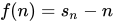

One of the simplest examples to which this could be applied is the partition of positive integers into even and odd numbers. The functions and should give the th even or odd number, respectively, so and . From these are derived the two functions and . They form an inverse pair, and the partition generated via the Lambek–Moser theorem from this pair is just the partition of the positive integers into even and odd numbers. Another integer partition, into evil numbers and odious numbers (by the parity of the binary representation) uses almost the same functions, adjusted by the values of the Thue–Morse sequence.[8]




Limit formula
In the same work in which they proved the Lambek–Moser theorem, Lambek and Moser provided a method of going directly from , the function giving the th member of a set of positive integers, to , the function giving the th non-member, without going through and . Let denote the number of values of for which ; this is an approximation to the inverse function of , but (because it uses in place of ) offset by one from the type of inverse used to define from . Then, for any , is the limit of the sequence meaning that, after a certain point, all successive values in this sequence become equal to each other, and the resulting value is .[9]


Lambek and Moser used the prime numbers as an example, following earlier work by Viggo Brun and D. H. Lehmer.[10] If is the prime-counting function (the number of primes less than or equal to ), then the th non-prime (1 or a composite number) is given by the limit of the sequence[9]

For some sequences of integers, the corresponding limit converges in a fixed number of steps, regardless of . When this happens, a direct formula for the complementary sequence is possible. In particular, the th positive integer that is not a th power can be obtained from the limiting formula as[11]

History and proofs
The theorem was discovered by Leo Moser and Joachim Lambek, who published it in 1954. Moser and Lambek cite the previous work of Samuel Beatty on Beatty sequences as their inspiration, and also cite the work of Viggo Brun and D. H. Lehmer from the early 1930s on methods related to their limiting formula for .[1]
Edsger W. Dijkstra has provided a visual "proof" of the result (scare quotes as given by Dijkstra),[12] and later a more rigorous proof based on algorithmic reasoning.[13] The first of these two proofs represents an integer partition geometrically, as an arrangement of rectangles in the plane. These rectangles have dimensions (unit width) for numbers that belong to the first set of the partition, and (unit height) for numbers in the second set. They are placed so that the bottom left corner of each rectangle lies on the diagonal line , and so that they together cover the integer squares of the half-plane above this line. The first rectangle, a unit square, is placed with its top right corner at the origin. The rectangles are then added one by one in order by their areas; each vertical rectangle is added to the left of the previous rectangles, with its bottom left corner on this diagonal line, while each horizontal rectangle is added above the previous rectangles, again with its bottom left corner on this diagonal line. Then the functions and of the theorem can be read off from this packing as the heights that the th vertical rectangle rises above the -axis or its bottom edge, respectively. Similarly, the functions and can be read off as the amount that the th horizontal rectangle extends to the right of the -axis or its left edge, respectively. Conversely, any two functions and or and meeting the conditions of the theorem give rise to a rectangle packing of this type, from which the values of and can be seen to be a partition of the integers.[12]


Yuval Ginosar has provided an intuitive proof based on an analogy of two athletes running in opposite directions, at varying speeds, around a circular racetrack. Each time one of the athletes crosses a fixed mark on the track, they report the number of times they have met the other athlete (counting the start of the race as a meeting). Because they cross paths a countable number of times, the mark can be placed at a point on the track where they never meet. Then, between each two consecutive times that the athletes meet, they will together cover each point on the track once, so during this time exactly one of them will cross the mark and report their number of meetings. Therefore, the sets of numbers reported by each athlete form a partition of the positive integers. From this setup Ginosar derives the remaining properties of the Lambek–Moser theorem.[14]
Related results
For non-negative integers
A variation of the theorem applies to partitions of the non-negative integers, rather than to partitions of the positive integers. For this variation, every partition corresponds to a Galois connection of the ordered non-negative integers to themselves. This is a pair of non-decreasing functions with the property that, for all and , if and only if . The corresponding functions and are defined slightly less symmetrically by and . For functions defined in this way, the values of and (for non-negative arguments, rather than positive arguments) form a partition of the non-negative integers, and every partition can be constructed in this way.[15]


Rayleigh's theorem
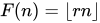
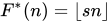
Rayleigh's theorem states that for two positive irrational numbers and , both greater than one, with , the two sequences and for , obtained by rounding down to an integer the multiples of and , are complementary. It can be seen as an instance of the Lambek–Moser theorem with and . The condition that and be greater than one implies that these two functions are non-decreasing; the derived functions are and . The sequences of values of and forming the derived partition are known as Beatty sequences, after Samuel Beatty's 1926 rediscovery of Rayleigh's theorem.[16]





See also
- Hofstadter Figure-Figure sequences, another pair of complementary sequences to which the Lambek–Moser theorem can be applied
Notes
- ^ a b Lambek & Moser 1954.
- ^ Wild 1955.
- ^ Boas 1985.
- ^ There appears to be no consistent name for these curves in the literature on the Lambek–Moser theorem. Both Dijkstra (1980) and Garry (1997) draw these curves and note their reflection property but do not distinguish the curves from the functions they graph nor give them a separate name. A histogram is a type of bar chart for a discrete sequence of data values; the curves called histograms here resemble the histograms of the sequence of function values in this sense.
- ^ a b c Garry 1997.
- ^ a b c d Lambek & Moser 1954; Honsberger 1970, pp. 95–96; Fraenkel 1977.
- ^ Angel 1964.
- ^ Allouche & Dekking 2019.
- ^ a b Lambek & Moser 1954; Roberts 1992.
- ^ Brun 1931; Lehmer 1932.
- ^ Honsberger 1970, pp. 97–100; Dos Reis & Silberger 1990; Roberts 1992.
- ^ a b Dijkstra 1980.
- ^ Dijkstra 1982.
- ^ Ginosar 2014.
- ^ Lambek 1994.
- ^ Rayleigh 1894; Beatty 1926; Honsberger 1970, pp. 93–95; Chamberland 2017.
References
- Allouche, Jean-Paul; Dekking, F. Michel (2019), "Generalized Beatty sequences and complementary triples", Moscow Journal of Combinatorics and Number Theory, 8 (4): 325–341, arXiv:1809.03424, doi:10.2140/moscow.2019.8.325, MR 4026541, S2CID 119176190
- Angel, Myer (1964), "Partitions of the natural numbers", Canadian Mathematical Bulletin, 7 (2): 219–236, doi:10.4153/CMB-1964-020-1, MR 0161826, S2CID 123729929
- Beatty, Samuel (1926), "Problem 3173", The American Mathematical Monthly, 33 (3): 159, doi:10.2307/2300153, JSTOR 2300153; Solutions by Beatty, A. Ostrowski, J. Hyslop, and A. C. Aitken, vol. 34 (1927), pp. 159–160, JSTOR 2298716
- Boas, Ralph P. (January 1985), "Inverse functions", The College Mathematics Journal, 16 (1): 42–47, doi:10.1080/07468342.1985.11972848, JSTOR 2686627
- Brun, Viggo (1931), "Rechenregel zur Bildung der -ten Primzahl" [Calculating rules to build the th prime], Norsk Matematisk Tidsskrift (in Norwegian), 13: 73–79, Zbl 0003.14902, as cited by Lambek & Moser 1954
- Chamberland, Marc (2017), "Beatty sequences", Single Digits: In Praise of Small Numbers, Princeton University Press, pp. 32–33, ISBN 978-0-691-17569-0
- Dijkstra, Edsger W. (1980), On a theorem by Lambek and Moser (PDF), Report EWD753, University of Texas
- Dijkstra, Edsger W. (1982), "Lambek and Moser revisited", in Broy, Manfred; Schmidt, Gunther (eds.), Theoretical Foundations of Programming Methodology: Lecture Notes of an International Summer School, directed by F. L. Bauer, E. W. Dijkstra and C. A. R. Hoare, NATO Advanced Study Institutes Series, Series C – Mathematical and Physical Sciences, vol. 91, D. Reidel Publishing Co., pp. 19–23, doi:10.1007/978-94-009-7893-5_2, ISBN 978-90-277-1462-6, Zbl 0533.40001
- Dos Reis, A. J.; Silberger, D. M. (1990), "Generating nonpowers by formula", Mathematics Magazine, 63 (1): 53–55, doi:10.1080/0025570X.1990.11977485, JSTOR 2691513, MR 1042938
- Fraenkel, Aviezri S. (1977), "Complementary systems of integers", The American Mathematical Monthly, 84 (2): 114–115, doi:10.2307/2319931, JSTOR 2319931, MR 0429815
- Garry, Y. K. K. (1997), "Inverse sequences and complementary sequences" (PDF), Mathematical Excalibur, 3 (4): 2
- Ginosar, Yuval (2014), "On the Lambek–Moser theorem", Integers, 14: A09:1–A09:4, arXiv:1207.5633
- Honsberger, Ross (1970), "Essay 12: Complementary sequences", Ingenuity in Mathematics, New Mathematical Library, vol. 23, New York: Random House, Inc., pp. 93–110, ISBN 0-394-70923-3, MR 3155264
- Lambek, Joachim (1994), "Some Galois connections in elementary number theory", Journal of Number Theory, 47 (3): 371–377, doi:10.1006/jnth.1994.1043, MR 1278405
- Lambek, Joachim; Moser, Leo (August–September 1954), "Inverse and complementary sequences of natural numbers", The American Mathematical Monthly, 61 (7): 454–458, doi:10.1080/00029890.1954.11988496, JSTOR 2308078
- Lehmer, D. H. (1932), "An inversive algorithm", Bulletin of the American Mathematical Society, 38 (10): 693–694, doi:10.1090/S0002-9904-1932-05496-9, MR 1562488
- John William Strutt, Baron Rayleigh (1894), The Theory of Sound, vol. 1 (2nd ed.), Macmillan, p. 123
- Roberts, Joe (1992), Lure of the Integers, MAA Spectrum, Washington, DC: Mathematical Association of America, p. 11, doi:10.2307/40148160, ISBN 0-88385-502-X, JSTOR 40148160, MR 1189138
- Wild, Roy E. (1955), "On the number of primitive Pythagorean triangles with area less than n", Pacific Journal of Mathematics, 5: 85–91, doi:10.2140/pjm.1955.5.85, MR 0067912