L'Huilier's theorem is a theorem on a triangle in Euclidean geometry proved by the Swiss mathematician Simon Antoine Jean L'Huilier in 1809.
Theorem
L'Huilier's theorem—Let  be the radius of the incircle of a triangle and
  be the radii of the three excircles. Then
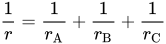
holds.[1][2]
Proof
Let  be the area of a triangle and
  be the lengths of the three sides. The reciprocal of the radius of the incircle is
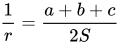
and the reciprocal of the radii of the excircles are
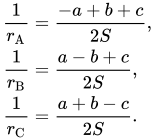
Therefore, the sum of the reciprocals are

Extension
Although L'Huilier's theorem is a result on the Euclidean plane (two dimension), it can be extended to  -dimensional Euclidean space.
Let  be an -simplex (triangle in two-dimension and tetrahedron in three-dimension). The inscribed sphere can be defined as the sphere whose center is the point in the interior of that has equal distance to each face of ; let
  be its radius. Similarly, an escribed sphere can be defined as the sphere whose center is the point in the region to the opposite side of only one of the faces and has equal distance to each face. Because has
  faces, let these radii be
  . Then

holds.[3] The proof uses linear algebra.
In his book, L'Huilier (1809) also suggested

Since
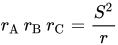
holds,[4] by multiplying to L'Huilier's theorem
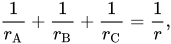
we obtain

where  is half of the circumference of the triangle.[5][6]
Notes
- ^ L'Huilier (1809), pp. 223-224.
- ^ Mackay (1893), Equation (24).
- ^ Toda (2014), Theorem 4.1.
- ^ Mackay (1893), Equation (3).
- ^ L'Huilier (1809), p. 224.
- ^ Mackay (1893), Equation (15).
References
- L'Huilier, Simon (1809). Elémens d'analyse géométrique et d'analyse algébrique, appliquées à la recherche des lieux géométriques. A Paris: chez J. J. Paschoud; à Genève: chez le même libraire. pp. 223–224. doi:10.3931/e-rara-4330.
- Mackay, J. S. (1893). "Formulae connected with the radii of the incircle and the excircles of a triangle". Proceedings of the Edinburgh Mathematical Society. 12: 86–105. doi:10.1017/S0013091500001711.
- Toda, Alexis Akira (2014). "Radii of the inscribed and escribed spheres of a simplex" (PDF). International Journal of Geometry. 3 (2): 5–13.