In the calculus of finite differences, the indefinite sum operator (also known as the antidifference operator), denoted by  or
or  ,[1][2] is the linear operator that is the inverse of the forward difference operator
  . It relates to the forward difference operator as the indefinite integral relates to the derivative. Thus,[3]
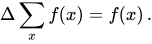
More explicitly, if  , then

The solution is not unique; it is determined only up to an additive periodic function with period 1. Therefore, each indefinite sum represents a family of functions.
Fundamental theorem of the calculus of finite differences
Indefinite sums can be used to calculate definite sums with the formula:[4]

Alternative usage
The inverse forward difference operator, , extends the summation up to  :
:

Some authors analytically extend summation for which the upper limit is the argument without a shift:[5][6][7]

In this case, a closed-form expression  for the sum is a solution of

which is called the telescoping equation.[8] It is the inverse of the backward difference operator  ,
,  :
:

It is related to the forward antidifference operator using the fundamental theorem of the calculus of finite differences.
Uniqueness
The functional equation  does not have a unique solution. If
  is a particular solution, then for any function
  satisfying
  (i.e., any 1-periodic function), the function
  is also a solution. Therefore, the indefinite sum operator defines a family of functions differing by an arbitrary 1-periodic component, .
To select the unique canonical solution up to an additive constant  (instead of up to the additive 1-periodic function ) one must impose additional constraints.
Complex analysis (Exponential type)
Suppose  is analytic in a vertical strip containing the real axis, and let
  be an analytic solution of
  in that strip. To ensure uniqueness, we require to be of minimal growth, specifically to be of exponential type less than
  in the imaginary direction. That is, there exist constants
  and
and  such that
as
such that
as  .[9][10]
Now let  and
and  be two analytic solutions satisfying this growth condition. Their difference
  is then analytic, 1‑periodic (i.e.,
  ), and inherits the same exponential type less than .
A fundamental result in complex analysis states that a non‑constant 1‑periodic entire function must have exponential type at least . This follows from its Fourier series expansion: if  is non‑constant, its Fourier series contains a term
  with
with  , which has type
  . Since has type strictly less than , it cannot contain any such term and therefore must be constant.
Consequently, under this minimal growth condition, any two solutions differ by at most a constant. Hence is unique up to an additive constant .
Relationship to Indefinite products
The indefinite product operator, denoted by  , is the multiplicative analogue of the indefinite sum. If
 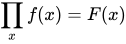 , then:

Its common discrete analog is  . The two operators are related by:


Expansions and Definitions
The Laplace summation formula is a formal asymptotic expansion (generally convergent only for polynomials) of the inverse forward difference  :[11][12]

- where
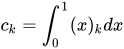 are the Cauchy numbers of the first kind.
 is the falling factorial.
Newton series
The inverse forward difference operator, , can be expressed formally (generally convergent only for polynomials) by its Newton series expansion:

- Given that
 can be represented by its Maclaurin Series expansion, the Taylor series about
  , it is sometimes possible to represent the indefinite sum using Bernoulli polynomials because
 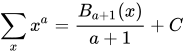 :
:

Müller-Schleicher Axiomatic definition
If is analytic on the right half-plane and satisfies the decay condition 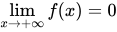 , the analytic continuation of
 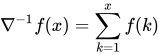 is given by:[5]

This formula is derived from axioms presented in the paper based on fractional sums, which uniquely extends the definition of the summation to complex limits. The decay condition represents the simplest case of the general asymptotic requirements for the function .
The Euler–Maclaurin formula extends :[6][9]
where  are the even Bernoulli numbers,
  is an arbitrary positive integer, and
  is the remainder term given by:

with  being the periodized Bernoulli function related to the Bernoulli polynomials.
The indefinite sum can be analytically continued by applying the standard Abel-Plana formula to the finite sum  and then analytically continuing the integer limit
  to the variable
  . This yields the formula:[7]
This analytic continuation is valid when the conditions for the original formula are met. The sufficient conditions are:[9][10]
- Analyticity: must be analytic in the closed vertical strip between
 and
and 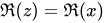 . The formula provides analytic continuation up to, but not beyond, the nearest singularities of
  to the line .
- Growth: must be of exponential type less than in this strip, satisfying
 for some , as .
Choice of the constant term
Analytic Continuation of Discrete Sums
The constant term , in the context of indefinite sums naturally extending the discrete summation, is often defined based on the respective empty sum.
For the inverse forward difference, , the typical summation equivalent is  so the empty sum is when
 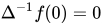 as it correlates to
For the inverse backward difference,  , the typical summation equivalent is
  so the empty sum is when
  as it correlates to
Normalization
In older texts relating to Bernoulli polynomials (predating more modern analytic techniques) the constant was often fixed using integral conditions.
Let
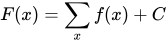
Then the constant is fixed from the condition
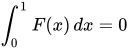
or

Alternatively, Ramanujan summation can be used:

or at 1

respectively.[13][14]
Summation by parts
Indefinite summation by parts:[15]


Definite summation by parts:

Period rules
If  is a period of function then
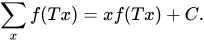
If is an antiperiod of function , that is  then
then
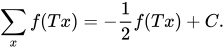
The unique analytic continuation of  defined as
 with exponential type less than in the imaginary direction where is entire and the constant term is chosen such that
  (the empty sum condition), satisfies a reflection formula.
Odd Functions
If is an odd function ( ), the unique analytic continuation satisfies:

This represents a point symmetry about  .
.
Even Functions
If is an even function (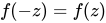 ), the unique analytic continuation satisfies:
 .
.
List of indefinite sums
Antidifferences of rational functions
For positive integer exponents, Faulhaber's formula can be used. Note that in the result of Faulhaber's formula must be replaced with due to the offset, as Faulhaber's formula finds rather than .
For negative integer exponents, the indefinite sum is closely related to the polygamma function:

For fractions not listed in this section, one may use the polygamma function with partial fraction decomposition. More generally,

where  are the Bernoulli polynomials,
  is the Hurwitz zeta function, and
  is the digamma function. This is related to the generalized harmonic numbers.
As the generalized harmonic numbers use reciprocal powers,  must be substituted for
  , and the most common form uses the inverse of the backward difference offset:

Here,  is the constant .
The Bernoulli polynomials are also related via a partial derivative with respect to :

Similarly, using the inverse of the backwards difference operator may be considered more natural, as:

Further generalization comes from use of the Lerch transcendent:

which generalizes the generalized harmonic numbers as  when taking . Additionally, the partial derivative is given by


Antidifferences of exponential functions

Antidifferences of logarithmic functions


Antidifferences of hyperbolic functions



where  is the q-digamma function.
Antidifferences of trigonometric functions





where is the q-digamma function.

where  is the normalized sinc function.
Antidifferences of special functions


where  is the incomplete gamma function.
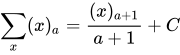
where  is the falling factorial.

(see super-exponential function)
See also
References
- ^ Man, Yiu-Kwong (1993), "On computing closed forms for indefinite summations", Journal of Symbolic Computation, 16 (4): 355–376, doi:10.1006/jsco.1993.1053, MR 1263873
- ^ Goldberg, Samuel (1958), Introduction to difference equations, with illustrative examples from economics, psychology, and sociology, Wiley, New York, and Chapman & Hall, London, p. 41, ISBN 978-0-486-65084-5, MR 0094249,
If  is a function whose first difference is the function
  , then is called an indefinite sum of and denoted by
; reprinted by Dover Books, 1986
- ^ Kelley, Walter G.; Peterson, Allan C. (2001). Difference Equations: An Introduction with Applications. Academic Press. p. 20. ISBN 0-12-403330-X.
- ^ "Handbook of discrete and combinatorial mathematics", Kenneth H. Rosen, John G. Michaels, CRC Press, 1999, ISBN 0-8493-0149-1
- ^ a b Markus Müller and Dierk Schleicher, How to Add a Noninteger Number of Terms: From Axioms to New Identities, Amer. Math. Mon. 118(2), 136-152 (2011).
- ^ a b Candelpergher, Bernard (2017). "Ramanujan Summation of Divergent Series" (PDF). HAL Archives Ouvertes. p. 3. Retrieved 2025-12-07.
- ^ a b Candelpergher, Bernard (2017). "Ramanujan Summation of Divergent Series" (PDF). HAL Archives Ouvertes. p. 23. Retrieved 2025-12-07.
- ^ Algorithms for Nonlinear Higher Order Difference Equations, Manuel Kauers
- ^ a b c "§2.10 Sums and Sequences". NIST Digital Library of Mathematical Functions. National Institute of Standards and Technology. Retrieved 2025-11-20.
- ^ a b Olver, Frank W. J. (1997). Asymptotics and Special Functions. A K Peters Ltd. p. 290. ISBN 978-1-56881-069-0.
- ^ Bernoulli numbers of the second kind on Mathworld
- ^ Ferraro, Giovanni (2008). The Rise and Development of the Theory of Series up to the Early 1820s. Springer Science+Business Media, LLC. p. 248. ISBN 978-0-387-73468-2.
- ^ Bruce C. Berndt, Ramanujan's Notebooks Archived 2006-10-12 at the Wayback Machine, Ramanujan's Theory of Divergent Series, Chapter 6, Springer-Verlag (ed.), (1939), pp. 133–149.
- ^ Éric Delabaere, Ramanujan's Summation, Algorithms Seminar 2001–2002, F. Chyzak (ed.), INRIA, (2003), pp. 83–88.
- ^ Kelley, Walter G.; Peterson, Allan C. (2001). Difference Equations: An Introduction with Applications. Academic Press. p. 24. ISBN 0-12-403330-X.
Further reading
- "Difference Equations: An Introduction with Applications", Walter G. Kelley, Allan C. Peterson, Academic Press, 2001, ISBN 0-12-403330-X
- Markus Müller. How to Add a Non-Integer Number of Terms, and How to Produce Unusual Infinite Summations
- Markus Mueller, Dierk Schleicher. Fractional Sums and Euler-like Identities
- S. P. Polyakov. Indefinite summation of rational functions with additional minimization of the summable part. Programmirovanie, 2008, Vol. 34, No. 2.
- "Finite-Difference Equations And Simulations", Francis B. Hildebrand, Prenctice-Hall, 1968