Hawking energy
Hawking energy (also called the Hawking mass) is a proposed quasi-local mass in general relativity associated with a closed spacelike 2-surface in spacetime. It was introduced by Stephen Hawking in 1968 as a simple geometric quantity intended to measure the mass or energy contained within a finite region, using only geometric data defined on the bounding surface rather than at infinity. [1] [2]
In general relativity, a quasi-local energy aims to assign an energy (or mass) to a finite spacetime region bounded by a closed surface. Unlike global notions such as the ADM mass, quasi-local quantities depend on the geometry of the chosen surface and generally require additional conditions to exhibit physically desirable properties. [2]
Definition
Let be a smooth closed spacelike 2-surface in a four-dimensional spacetime. At each point of , there exist two future-directed null vector fields orthogonal to the surface, one outgoing and one ingoing. The corresponding null expansions and measure the divergence of these families of null geodesics as they emanate orthogonally from . The Hawking energy is defined by



where denotes the area of and is its induced area measure. [2]


Physical interpretation
The null expansions and measure the divergence of outgoing and ingoing families of light rays orthogonal to the surface . Their product therefore encodes how bundles of light rays are focused or defocused by the spacetime geometry. From this perspective, the Hawking energy can be interpreted as a measure of the gravitational focusing of light caused by the matter content and curvature enclosed by .
Expression in a spacelike hypersurface
If lies in a spacelike hypersurface represented by an initial data set , where is a three-dimensional Riemannian manifold with metric and is the second fundamental form of as embedded in the ambient spacetime, the product of null expansions can be expressed in terms of the geometry of . In this setting, it can be written using the mean curvature of (the trace of the second fundamental form of in ) and the trace of restricted to . In this case, the Hawking energy takes the form



This formulation is commonly used in mathematical relativity, particularly in the time-symmetric case , where the expression reduces to a Willmore-type functional of the surface. [2]

Properties and limitations
Despite its limitations, including the fact that it is not positive or monotonic in general, the Hawking energy has played an important role in both mathematical and physical aspects of general relativity. It has been extensively studied and used in the analysis of geometric inequalities, black hole physics, and the behavior of gravitational fields under geometric flows, and it serves as a foundational example in the development of other quasi-local mass definitions. [2]
Positivity
The Hawking energy is not positive in general. A simple example is provided by Euclidean space: when evaluated on closed surfaces in flat three-dimensional space, the Hawking energy is non-positive and vanishes only for round spheres. In this sense, generic surfaces in flat space have strictly negative Hawking energy.
Nevertheless, the Hawking energy is known to be non-negative for certain special classes of surfaces under additional geometric and physical assumptions. In particular, consider a spacelike hypersurface for which the extrinsic curvature vanishes (a time-symmetric initial data set). In this case, the dominant energy condition reduces to the requirement that the underlying Riemannian manifold has non-negative scalar curvature. Under these assumptions, the Hawking energy is non-negative on stable constant mean curvature surfaces [3] and on area-constrained Willmore surfaces, that is, on critical points of the Willmore functional under an area constraint.[4]. In more general (non time-symmetric) initial data sets, significantly fewer positivity results are known.
Rigidity
In the context of quasi-local mass definitions, a rigidity result typically refers to the expectation that if the quasi-local energy of a surface vanishes, then the geometry enclosed by the surface must be flat, or correspond to a region of Minkowski spacetime. In this sense, rigidity results are meant to identify situations in which vanishing quasi-local energy implies the absence of gravitational fields.
For the Hawking energy, rigidity results are known only in very restricted settings. In particular, consider a time-symmetric initial data set satisfying the dominant energy condition, so that the underlying Riemannian manifold has non-negative scalar curvature. In this setting, if the Hawking energy vanishes on an almost round constant mean curvature surface, then the region enclosed by the surface is isometric to a Euclidean ball. [5]
Beyond this case, no general rigidity results are currently known for the Hawking energy, particularly in non time-symmetric initial data sets or without additional geometric assumptions.
Monotonicity
In the Schwarzschild metric, the Hawking mass of any sphere about the central mass is equal to the value of the central mass.


A result of Geroch[6] implies that Hawking mass satisfies an important monotonicity condition. Namely, if has nonnegative scalar curvature, then the Hawking mass of is non-decreasing as the surface flows outward at a speed equal to the inverse of the mean curvature. In particular, if is a family of connected surfaces evolving according to


where is the mean curvature of and is the unit vector opposite of the mean curvature direction, then

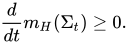
Said otherwise, Hawking mass is increasing for the inverse mean curvature flow.[7]
Hawking mass is not necessarily positive. However, it is asymptotic to the ADM[8] or the Bondi mass, depending on whether the surface is asymptotic to spatial infinity or null infinity.[9]<
See also
References
- ^ Hawking, S. W. (1968). "Gravitational Radiation in an Expanding Universe". Journal of Mathematical Physics. 9 (4): 598–604. Bibcode:1968JMP.....9..598H. doi:10.1063/1.1664615.
- ^ a b c d e Szabados, László B. (2004). "Quasi-Local Energy-Momentum and Angular Momentum in GR: A Review Article". Living Reviews in Relativity. 7 (4) 4. Bibcode:2004LRR.....7....4S. doi:10.12942/lrr-2004-4.
- ^ Christodoulou, Demetrios; Yau, Shing-Tung (1988). "Some remarks on the quasi-local mass". Mathematics and General Relativity (Santa Cruz, CA, 1986). Contemporary Mathematics. Vol. 71. American Mathematical Society. pp. 9–14. doi:10.1090/conm/071/954405. ISBN 978-0-8218-5079-4.
- ^ Lamm, Tobias; Metzger, Jan; Schulze, Felix (2011). "Foliations of asymptotically flat manifolds by surfaces of Willmore type". Mathematische Annalen. 350 (1): 1–78. doi:10.1007/s00208-010-0550-2.
- ^ Sun, Jiacheng (2017). "Rigidity of Hawking mass for surfaces in three manifolds". Pacific Journal of Mathematics. 292 (1). Mathematical Sciences Publishers: 257–282.
- ^ Geroch, Robert (December 1973). "Energy extraction*". Annals of the New York Academy of Sciences. 224 (1): 108–117. Bibcode:1973NYASA.224..108G. doi:10.1111/j.1749-6632.1973.tb41445.x. ISSN 0077-8923. S2CID 222086296.
- ^ Hoffman 2005, Lemma 9.6
- ^ Section 4 of Shi, Yuguang; Wang, Guofang; Wu, Jie (2008). On the behavior of quasi-local mass at the infinity along nearly round surfaces. arXiv:0806.0678.
- ^ Section 2 of Finster, Felix; Smoller, Joel; Yau, Shing-Tung (2000-06-01). "Some Recent Progress in Classical General Relativity". Journal of Mathematical Physics. 41 (6): 3943–3963. arXiv:gr-qc/0001064. Bibcode:2000JMP....41.3943F. doi:10.1063/1.533332. S2CID 18904339.
Further reading
- Section 6.1 in Szabados, László B. (December 2004). "Quasi-Local Energy-Momentum and Angular Momentum in GR: A Review Article". Living Reviews in Relativity. 7 (1) 4. Bibcode:2004LRR.....7....4S. doi:10.12942/lrr-2004-4. ISSN 2367-3613. PMC 5255888. PMID 28179865. S2CID 40602589.
- Hoffman, David A., ed. (2005). Global theory of minimal surfaces: proceedings of the Clay Mathematics Institute 2001 Summer School, Mathematical Sciences Research Institute, Berkeley, California, June 25-July 27, 2001. Clay mathematics proceedings. Providence, RI : Cambridge, MA: American Mathematical Society; Clay Mathematics Institute. ISBN 978-0-8218-3587-6.