Gymnopogon ambiguus
| Gymnopogon ambiguus | |
|---|---|
| Scientific classification | |
| Kingdom: | Plantae |
| Clade: | Tracheophytes |
| Clade: | Angiosperms |
| Clade: | Monocots |
| Clade: | Commelinids |
| Order: | Poales |
| Family: | Poaceae |
| Subfamily: | Chloridoideae |
| Genus: | Gymnopogon |
| Species: | G. ambiguus
|
| Binomial name | |
| Gymnopogon ambiguus (Michx.) Britton, Sterns & Poggenb.
| |
Gymnopogon ambiguus, commonly called bearded skeletongrass,[1] is a species of grass that is native to southeastern North America.[2]
Description
G. ambiguus is a perennial. It may reach between 3 and 7 decimeters (approximately 11.8 to 27.5 inches) in height. Its leaves may reach a length of 6 centimeters and their width ranges between 2 and 8 millimeters.[3]
Distribution and habitat
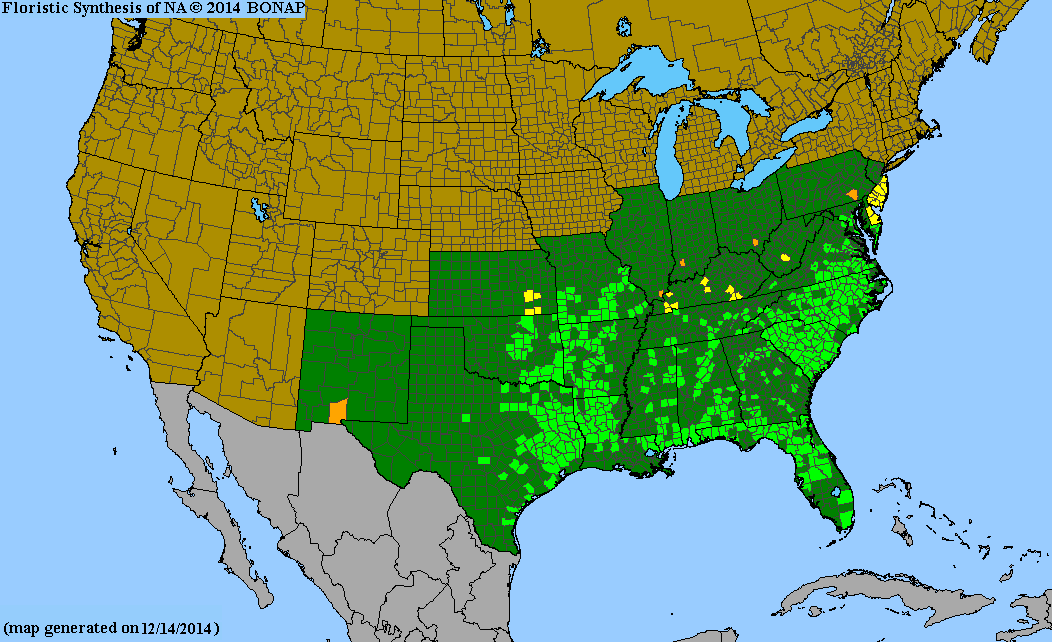
This species' range extends from Pennsylvania to Illinois and south to Texas through Florida.[4]
G. ambiguus can be found in habitats such as prairies, woodlands, barrens, and dry fields.[5]
References
- ^ NRCS. "Gymnopogon ambiguus". PLANTS Database. United States Department of Agriculture (USDA). Retrieved 17 November 2019.
- ^ Kartesz, John T. (2019). "Gymnopogon ambiguus". County-level distribution map from the North American Plant Atlas (NAPA). Biota of North America Program (BONAP).
- ^ Radford, Albert E., Harry E. Ahles, and C. Ritchie Bell. Manual of the Vascular Flora of the Carolinas. 1964, 1968. The University of North Carolina Press. 118. Print.
- ^ "USDA Plants Database". plants.usda.gov. Retrieved 2025-08-25.
- ^ Weakley, A.S. 2020. Flora of the Southeastern United States. Edition of 20 October 2020. University of North Carolina at Chapel Hill, Chapel Hill, North Carolina.