Glasser's master theorem
In integral calculus, Glasser's master theorem explains how a certain broad class of substitutions can simplify certain integrals over the whole real line from to The integrals in question must be construed as Cauchy principal values, and a fortiori it is applicable when the integral converges absolutely. It is named after M. L. Glasser, who introduced it in 1983.[1]


A special case: the Cauchy–Schlömilch transformation
A special case called the Cauchy–Schlömilch substitution or Cauchy–Schlömilch transformation[2] was known to Cauchy in the early 19th century.[3] It states that if

then

where PV denotes the Cauchy principal value and is a function which is integrable on the real line at least in the sense of the Cauchy principal value.

The master theorem
If , , and are real numbers and


then

Examples
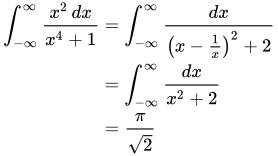
where the first equality comes from cancelling , the second from Cauchy–Schlömilch, and the last one from a substitution and the integral of the arctangent function.

References
- ^ Glasser, M. L. "A Remarkable Property of Definite Integrals." Mathematics of Computation 40, 561–563, 1983.
- ^ T. Amdeberhnan, M. L. Glasser, M. C. Jones, V. H. Moll, R. Posey, and D. Varela, "The Cauchy–Schlömilch transformation", arxiv.org/pdf/1004.2445.pdf
- ^ A. L. Cauchy, "Sur une formule generale relative a la transformation des integrales simples prises entre les limites 0 et ∞ de la variable." Oeuvres completes, serie 2, Journal de l’ecole Polytechnique, XIX cahier, tome XIII, 516–519, 1:275–357, 1823