Euclidean neighborhood retract
In mathematics, especially algebraic topology, an Euclidean neighborhood retract or a ENR for short is a topological space that is (or homeomorphic to) a subset of a Eucldean space , some n, that is a retract of some neighborhood of the subset.

Definition and results
By definition, a topological space X is called a Euclidean neighborhood retract or an ENR if there is an embedding for some n such that is a retract of some neighborhood of it; i.e., there is a map such that is the identity (such is called a retraction).[1] It follows that an ENR is necessarily locally compact and locally contractible in geometric topology sense.


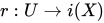


The fundamental result here is the following
Theorem (Borsuk)—[2] Let X be a locally compact and locally contractible space. If there is an embedding then there is a retraction from some neighborhood U to .

The theorem implies in particular that the above retract map r in the definition is actually not part of the data of the definition of an ENR. The theorem also implies many familiar spaces are ENRs; e.g., a topological manifold,[3][4] a finite CW-complex,[5] a real semi-algebraic set are all ENRs. A subset of that is not locally compact, like , is a non-example of an ENR.

See also
References
- ^ Bredon 2013, Appendix E.
- ^ Bredon 2013, Theorem E.3.
- ^ Bredon 2013, Corollary E.5. in the compact case
- ^ https://mathoverflow.net/questions/248092/every-topological-manifold-is-a-enr-reference in the general case.
- ^ Bredon 2013, Corollary E.8.
- Bredon, G.E. (2013). Topology and Geometry. Graduate Texts in Mathematics. Vol. 139. Springer Science & Business Media.
- Hatcher, Allen (2002). Algebraic topology. Cambridge ; New York: Cambridge University Press. ISBN 978-0521795401.