Einstein–Brillouin–Keller method
The Einstein–Brillouin–Keller (EBK) method is a semiclassical technique (named after Albert Einstein, Léon Brillouin, and Joseph B. Keller) used to compute eigenvalues in quantum-mechanical systems. EBK quantization is an improvement from Bohr–Sommerfeld quantization which did not consider the caustic phase jumps at classical turning points.[1] This procedure is able to reproduce exactly the spectrum of the 3D harmonic oscillator, particle in a box, and even the relativistic fine structure of the hydrogen atom.[2]
History
The first paper by Albert Einstein in 1917 generalized Bohr–Sommerfeld quantization as part of the old quantum theory.[3][1] Einstein also discussed that the method was not generalizable for chaotic systems.[3][1] The paper was influential for Louis de Broglie thesis in 1924 and Erwin Schrödinger reformulation of quantum mechanics in terms of the Schrödinger equation in 1926.[1]
Another correction to Bohr–Sommerfeld quantization was introduced by Léon Brillouin in 1926,[4] who also introduced the same year the WKB approximation.[5] Mathematician Rudolf Ernest Langer also introduced his Langer correction in 1937.[5]
Einstein's formulation however was mostly ignored, until its independent discovery by Joseph Keller in 1958.[1][6] Keller derived his equation from the WKB approximation and introduced the correction of caustic phase jumps at classical turning points.[1] In 1972, mathematician Viktor Maslov formalized the concept in terms of Maslov indexes.[5]
Ian C. Percival reintroduced Einstein's paper to the physics community in 1973,[7] and coined the term Einstein–Brillouin–Keller method.[1]
In 1976–1977, Michael Berry and Michael Tabor derived an extension to Gutzwiller trace formula for the density of states of an integrable system starting from EBK quantization.[8][9][10]
Procedure
Given a separable classical system defined by conjugate coordinates , in which every pair describes a closed function or a periodic function in , the EBK procedure involves quantizing the line integrals of over the closed orbit of :



where is the action-angle coordinate, is a positive integer, and and are Maslov indexes. corresponds to the number of classical turning points in the trajectory of (Dirichlet boundary condition), and corresponds to the number of reflections with a hard wall (Neumann boundary condition).[10]


Examples
1D Harmonic oscillator
The Hamiltonian of a simple harmonic oscillator is given by
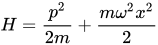
where is the linear momentum and the position coordinate. The action variable is given by



where we have used that is the energy and that the closed trajectory is 4 times the trajectory from 0 to the turning point .


The integral turns out to be
- ,

which under EBK quantization there are two soft turning points in each orbit and . Finally, that yields


- ,

which is the exact result for quantization of the quantum harmonic oscillator.
2D hydrogen atom
The Hamiltonian for a non-relativistic electron (electric charge ) in a hydrogen atom is:

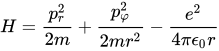
where is the canonical momentum to the radial distance , and is the canonical momentum of the azimuthal angle . Take the action-angle coordinates:



For the radial coordinate :


where we are integrating between the two classical turning points ()


Using EBK quantization :



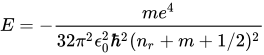
and by making the spectrum of the 2D hydrogen atom [11] is recovered :


Note that for this case almost coincides with the usual quantization of the angular momentum operator on the plane . For the 3D case, the EBK method for the total angular momentum is equivalent to the Langer correction.


See also
References
- Duncan, Anthony; Janssen, Michel (2019). "5. Guiding Principles". Constructing quantum mechanics (First ed.). Oxford, United Kingdom; New York, NY: Oxford University Press. ISBN 978-0-19-884547-8.
- ^ a b c d e f g Stone, A.D. (August 2005). "Einstein's unknown insight and the problem of quantizing chaos" (PDF). Physics Today. 58 (8): 37–43. Bibcode:2005PhT....58h..37S. doi:10.1063/1.2062917.
- ^ Curtis, L.G.; Ellis, D.G. (2004). "Use of the Einstein–Brillouin–Keller action quantization". American Journal of Physics. 72 (12): 1521–1523. Bibcode:2004AmJPh..72.1521C. doi:10.1119/1.1768554.
- ^ a b Einstein, Albert (1917). "Zum Quantensatz von Sommerfeld und Epstein" [On the Quantum Theorem of Sommerfeld and Epstein]. Deutsche Physikalische Gesellschaft, Verhandlungen (in German). 19: 82–92.
- ^ Brillouin, L. (1926-12-01). "Remarques sur la mécanique ondulatoire". Journal de Physique et le Radium (in French). 7 (12): 353–368. doi:10.1051/jphysrad:01926007012035300. ISSN 0368-3842.
- ^ a b c Dong, Shi-Hai (2011-07-09). Wave Equations in Higher Dimensions. Springer Science & Business Media. ISBN 978-94-007-1917-0.
- ^ Keller, Joseph B. (1958-06-01). "Corrected bohr-sommerfeld quantum conditions for nonseparable systems". Annals of Physics. 4 (2): 180–188. doi:10.1016/0003-4916(58)90032-0. ISSN 0003-4916.
- ^ Percival, I C (1973). "Regular and irregular spectra". Journal of Physics B: Atomic and Molecular Physics. 6 (9): L229 – L232. doi:10.1088/0022-3700/6/9/002. ISSN 0022-3700.
- ^ Berry, M.V.; Tabor, M. (1976). "Closed orbits and the regular bound spectrum". Proceedings of the Royal Society A. 349 (1656): 101–123. Bibcode:1976RSPSA.349..101B. doi:10.1098/rspa.1976.0062. S2CID 122040979.
- ^ Berry, M.V.; Tabor, M. (1977). "Calculating the bound spectrum by path summation in action-angle variables". Journal of Physics A. 10 (3): 371. Bibcode:1977JPhA...10..371B. doi:10.1088/0305-4470/10/3/009.
- ^ a b Brack, M.; Bhaduri, R.K. (1997). Semiclassical Physics. Adison-Weasly Publishing.
- ^ Basu, P.K. (1997). Theory of Optical Processes in Semiconductors: Bulk and Microstructures. Oxford University Press.