Daniele Guglielmo Gatti
| Personal information | ||||||||||||
|---|---|---|---|---|---|---|---|---|---|---|---|---|
| Born | 6 November 1987 (age 38) Tradate, Northern Italy | |||||||||||
| Chess career | ||||||||||||
| Country | Italy | |||||||||||
| Peak rating | 1824 | |||||||||||
Medal record
| ||||||||||||
Daniele Guglielmo Gatti (born 6 November 1987) is an Italian chess composer.
Biography
He began composing chess problems in 2015, initially focusing on selfmates and then exploring other genres, including endgame studies.[1][2] In early 2025, he published an endgame study that achieved a complete Babson task (4/4) in a legal and economic setting.[3] This has been considered one of the most difficult unsolved challenges in chess composition since its original formulation by American chess composer Joseph Ney Babson in 1884.[4][5][6][7][8][9][10]
In 2025, Gatti also publicly disclosed his diagnosys of Asperger's Syndrome and intellectual giftedness, explaining how these conditions have influenced his work in the field of chess composition, expecially through hyperfocus and pattern recognition.[11]
Gatti is a registered nurse[12] and lives on the Southern Dolomites.[10]
Development of the Babson study
In the past, building a correct chess problem showing the task in a sound and legal setting was considered extremely difficult or even impossible, although some composers in the end succeeded (but none of them achieved the theme in a perfect form, without duals in mainlines and also in sidelines[13]). However, the feasibility of the task in form of a classic endgame study was still completely unknown.[4][5][6][7][8][9][14]
Gatti's study was developed from a scheme created by Israeli-American International FIDE Master for chess composition Gady Costeff,[15] which showed a complete Babson task theme in an endgame study setting, but in an illegal position and with presence of promoted pieces (three white Knights on the board).[16][17] The scheme had originally been created in 2011, and Costeff spent over a decade, working in secret, attempting to construct a legal version. In his 2024 article on EG, he acknowledged the illegality of the position but chose to publish it as a demonstration, inviting other composers to explore possible improvements.[16] Costeff declaration was: "The position is unreachable by a single capture. For example, if Ph2 could start on g3, the position would be reachable. I composed this [setting] in 2011 and tried for a decade to make it legal. The pleasure of 45 years of research and learning is far more dear to me than any publication honours. I do not care at all if the study is left out of the award for being illegal. I do think it is interesting and readers would be interested in how a Babson may look."[16]
After having seen Costeff's scheme, Gatti began working independently on the same theme and, after approximately 45 days, published a sound Babson task in EG n. 239 (January 2025).[3] The study was dedicated to Gady Costeff, who was acknowledged as a source of inspiration and a pioneer of the research in the field.[10][3][18]
In his article, directly following the editorial on EG, Gatti wrote: "When I saw the diagram, I had what you might call an intuition. I understood that creating this incredible task was possible. I didn’t know how yet, but I knew that it would become an obsession for me. The Babson Task had always fascinated me, as every task in chess problem always did and always will (especially promotion tasks and Allumwandlung forms!), and now that I saw it so apparently close to being fully realized, I decided that I would focus all my energy on achieving it, no matter how much time or personal resources I would have to spent. Gady's words to me, impressed in my memory, were: “The easiest path to know if a legal Babson exists is to compose one!”"[18]
There is a historical precedent for this story, namely the long, unsuccessful attempts by French composer Pierre Drumare to obtain a Babson Task in the form of a directmate problem. After more than twenty years, he managed to create a sound but illegal position, and shortly thereafter abandoned the idea, claiming that the Babson Task would have never been solved as a directmate in a satisfactory setting. Just an year later, Leonid Yarosh succeeded in obtaining the theme in a directmate problem, with a legal and economical position, for the first time in history.[8][9]
Gatti later published on "Sinfonie Scacchistiche", an Italian magazine dedited to chess problems and studies, an article where he explains the challenges encountered, the method of work adopted and also shows the most significant failed attempts during the composition process, until the final outcome.[19]
Reception and criticism
Following its publication, the study was featured on various national[10][20][21][22][23][24][25][26] and international[27][28][29][30][31][32][33][34][35][36][37][38][39][40][41][42] platforms, such as official chess news websites, specialized literature, as well as reposts on chess blogs, thematic discussion forums and social networks.
Reactions from chess composition community
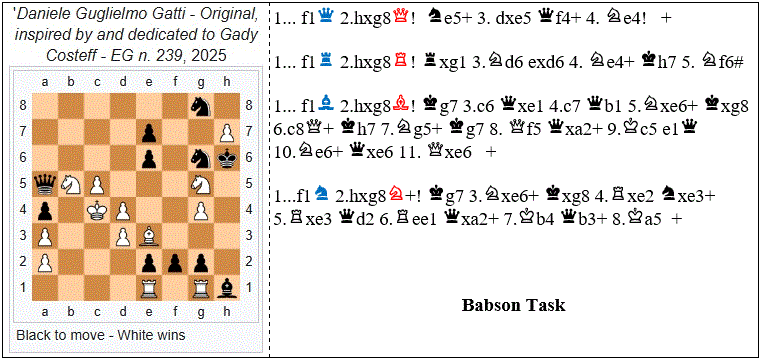
Inspired by and dedicated to Gady Costeff
Black to move – White wins
Complete solution in the Babson task page
| a | b | c | d | e | f | g | h | ||
| 8 | 8 | ||||||||
| 7 | 7 | ||||||||
| 6 | 6 | ||||||||
| 5 | 5 | ||||||||
| 4 | 4 | ||||||||
| 3 | 3 | ||||||||
| 2 | 2 | ||||||||
| 1 | 1 | ||||||||
| a | b | c | d | e | f | g | h | ||
Ukrainian chess critic, International FIDE Master for chess composition[15] and former WCCI World Champion Serhiy Didukh referred to it literally as a "chess miracle"[35] in his website "Chess Study Art". He later included the study in his digital book "100 Memorable Studies", published on the same site.[43]
The study also received recognition by Harold van der Heijden which praised the study as an "incredible achievement",[3] and by former WCCI World Champion Steffen Slumstrup Nielsen.[10][3]
Werner Keym, a German chess composer, chess writer and expert in problems showing castling, en passant capture and pawn promotion,[44][45] also praised it with the words "incredible achievement"[41] in his book "Problem Chess Art – A Subjective Anthology", writing on the description of the solution: "Perhaps the study of the century?"[41]
German GM and FIDE Master for chess composition[46] Jan Michael Sprenger contributed a comment on Didukh's website, describing it as "a rather elegant position given the complexity of the task.", remarking on the speed of its realization.[47]
Dutch endgame studies composer Martin van Essen also analyzed the study during a masterclass directed at the Schaakvereniging Paul Keres club in Utrecht, later publishing the entire video on YouTube.[48][49]
Norwegian IM and FIDE Master for chess composition Geir Sune Tallaksen Østmoe[46] also commented the realization of the study, writing that "the impossible task proved possible" in a post on X.[50]
Reactions from OTB chess players
Outside the composition community, the study was featured by Austrian GM and National Champion Felix Blohberger in an instructional YouTube video,[51] and by Armenian Super-GM Levon Aronian, who left a brief video comment on his Instagram page about the topic.[52]
Controversials
Some discussion was raised regarding the initial stipulation of the study. While the Babson Task traditionally begins with White to move, the study in question starts with Black to move, and some composers pointed out that this does not configure a true Babson Task. This choice, while uncommon, is however legally permissible in endgame studies field. About the topic, Harold van der Heijden noted: “The composer also indicated that it is a pity that the study starts with BTM. When you put the wK on c3, the only move is 1.Kc4. Steffen advised that BTM is a lesser problem than wK in check in the initial position, and I fully agree."[3]
Chess composition career
In 2018, following the achievement of the required standard (PReMO system), Gatti received the title of National Master of Chess Composition from the independent organism "Associazione Problemistica Italiana",[53] affiliated with the Italian Chess Federation.[1][2]
In 2022, he participated in the 11th World Team Championship for chess composition (WCCT), achieving a 19th individual placement in section F (Selfmates), the best Italian placement for that edition.[54]
In 2024, after having reached 3rd position in the previous edition held in 2020,[55] he won the 5° Italian Chess Composition Championship.[56]
In 2024, one of his original studies was selected and presented by Judit Polgar at the 'Global Chess Festival', held in Budapest on 17 September, for the project 'Chess Artistry Adventure', organized in memory of GM and chess composer Pal Benko.[57][58]
He is FIDE International Judge of Chess Compositions since July 2025.[59]
As of 2025, Gatti realized around 1000 chess compositions (650 problems and 350 endgame studies), receiving a total of 200 awards in national and international tournaments.[2]
Publications
"Professione Problemista – Avvicinamento alla composizione scacchistica" (Messaggerie Scacchistiche – 2022).[60]
References
- ^ a b "Galleria Compositori Italiani". www.bestproblems.it. Retrieved 10 August 2025.
- ^ a b c "Selection of studies composed by Gatti Daniele Guglielmo (1987)". arves.org. Retrieved 28 June 2025.
- ^ a b c d e f van der Heijden, Harold (2025). "Editorial". Eg (2025). XXXI (239): 3.
- ^ a b Hoffmann, Peter (2025). "100 Jahre Babson-Task im orthodoxen Direktmatt" (PDF). Independent Book (in German).
- ^ a b Hoffmann, Peter. "Der Babson-Task in der Studie" (PDF). Independent Book (in German).
- ^ a b "Underpromotion Milestones". Chess News. 25 October 2024. Retrieved 31 August 2025.
- ^ a b "Underpromotion Milestones – part two". Chess News. 6 November 2024. Retrieved 1 September 2025.
- ^ a b c "Underpromotion Milestones – part 3". Chess News. 28 November 2024. Retrieved 31 August 2025.
- ^ a b c "The Everest of chess problems". Chess News. 23 May 2023. Retrieved 14 November 2025.
- ^ a b c d e "Le mosse vincenti del sovramontino Gatti: è nel gotha mondiale del gioco degli scacchi". Corriere delle Alpi (in Italian). 8 January 2025. Retrieved 28 June 2025.
- ^ Gatti, Daniele Guglielmo (29 June 2025). "Pensare "storto" per creare dritto – Scacchi, composizione e neurodivergenza". Spazio Asperger Onlus (in Italian). Retrieved 8 November 2025.
- ^ "Ricerca Albo | Iscrizione all'albo di un professionista FNOPI". fnopi (in Italian). Retrieved 25 August 2025.
- ^ "The perfect Babson". Chess News. 1 December 2018. Retrieved 14 November 2025.
- ^ Krabbè, Tim. "The Babson Task". timkr.home.xs4all.nl. Retrieved 2 October 2025.
- ^ a b "International masters – WFCC". Retrieved 11 November 2025.
- ^ a b c "Babson Task by Gady Costeff". arves.org. Retrieved 28 June 2025.
- ^ McShane, Luke (14 November 2024). "The Babson task". The Spectator. Retrieved 14 November 2025.
- ^ a b Gatti, Daniele Guglielmo (2025). "The Babson Task". EG. XXXI (239): 4–5.
- ^ Gatti, Daniele Guglielmo (2025). "I miei fallimenti prima del Babson". Sinfonie Scacchistiche. IV (262): 417–422.
- ^ Garofalo, Antonio (2025). "Babson Task in the field of studies" (PDF). Best Problems (115): 814.
- ^ "Il veneto Daniele Gatti ha risolto il Babson Task! – Comitato Regionale Veneto Scacchi" (in Italian). 5 August 2025. Retrieved 5 August 2025.
- ^ "Torre & Cavallo Scacco! – N. 4 luglio-agosto 2025". Messaggerie Scacchistiche (in Italian). Retrieved 30 June 2025.
- ^ "Fare il problemista (con Daniele Gatti)". L’Infilata (in Italian). 1 April 2025. Retrieved 30 June 2025.
- ^ "Dopo ben 141 anni un italiano ottiene il primo studio "Babson Task" corretto e legale". Uno Scacchista (in Italian). 28 January 2025. Retrieved 30 June 2025.
- ^ "Scacchierando.it" (in Italian). Retrieved 8 November 2025.
- ^ Federazione Scacchistica Italiana. "Daniele Guglielmo Gatti ha risolto il Babson Task, un problema che teneva impegnati gli specialisti da 140 anni". X (in Italian). Retrieved 14 November 2025.
- ^ "The Babson Task – A modern realization". šachy.cz (in Czech). 14 August 2025. Retrieved 17 August 2025.
- ^ "The Babson Task – A modern realization". Chess News. 14 August 2025. Retrieved 16 August 2025.
- ^ "Studien-Babson | Rund um die Retroanalyse". www.thbrand.de (in German). Retrieved 16 August 2025.
- ^ Widlert, Kjell (2025). "Mannen som ville göra Babson-task". Springaren (in Swedish). 3 (173).
- ^ "Chess Composers: November 6th". Chess Composers. 5 November 2012. Retrieved 9 August 2025.
- ^ Popov, Grigory (2025). "Первый в истории таск Бабсона для этюдов". SuperProblem.ru (in Russian).
- ^ "Teljes Babson legális kezdőállásból". Magyar Sakkvilag (in Hungarian). 3: 36. March 2025.
- ^ "Eine Studie". forum.computerschach.de. Retrieved 20 July 2025.
- ^ a b "Таск Бабсона – Chess Study Art" (in Russian). 2 February 2025. Retrieved 30 June 2025.
- ^ "Arves – Homepage". arves.org. Retrieved 30 June 2025.
- ^ Salmerón, Florencio (28 August 2025). "La Tarea de Babson: Una Realización Moderna en la Composición Ajedrecística". Reseña de las mejores partidas de ajedrez (in Spanish). Retrieved 13 September 2025.
- ^ "The Babson Task is one of the holy grails of chess composition, where every possible promotion for Black is met by an identical promotion for White" (in Russian). Retrieved 13 September 2025.
- ^ Gvozdjak, Peter (2025). "Štúdia storočia". Pat a Mat (in Slovak). XII (131): 3.
- ^ "The Babson Task – A modern realization – Le Chevalier %". Le Chevalier. 14 August 2025. Retrieved 24 October 2025.
- ^ a b c Keym, Werner. "Problem Chess Art – A Subjective Anthology" (PDF). Independent book: 86–87.
- ^ "La plus belle étude d'échecs de tous les temps ?". fr.linkedin.com (in French). Retrieved 8 November 2025.
- ^ "100 Memorable Studies – Chess Study Art" (in Russian). 31 January 2025. Retrieved 30 June 2025.
- ^ "Keym, Werner 1942". www.arves.org. Retrieved 8 November 2025.
- ^ "Werner Keym: Problem Chess Art". Chess News. 8 October 2025. Retrieved 8 November 2025.
- ^ a b "FIDE-masters – WFCC". Retrieved 11 November 2025.
- ^ "Находки Клинкова – Chess Study Art" (in Russian). 12 October 2024. Retrieved 30 June 2025.
- ^ "Masterclasses". Schaakvereniging Paul Keres (in Dutch). 1 September 2019. Retrieved 9 August 2025.
- ^ Schaakvereniging Paul Keres (12 June 2025). Do 12 juni 19:00 – Masterclass De Babson Task door Martin van Essen!. Retrieved 20 July 2025 – via YouTube.
- ^ "Geir Sune Tallaksen Østmoe – The impossible task proved possible". X. 16 January 2025. Retrieved 11 November 2025.
- ^ GM Felix Blohberger (7 April 2025). The Chess Problem That Took 140 Years to Solve. Retrieved 30 June 2025 – via YouTube.
- ^ "150-year-old chess dream finally becomes reality – Levon Aronian". Instagram. Retrieved 11 November 2025.
- ^ "Accademia del Problema – Associazione Problemistica Italiana". www.accademiadelproblema.org. Retrieved 14 November 2025.
- ^ "11th WCCT – WFCC". Retrieved 9 August 2025.
- ^ Agostini, Valerio (2020). "4° Campionato Italiano di Composizione". Sinfonie Scacchistiche (141): 460.
- ^ Agostini, Valerio (2024). "5° Campionato Italiano Assoluto di Composizione". Sinfonie Scacchistiche (in Italian). 2 (156): 309.
- ^ "Chess Artistry Adventure 2024". arves.org. Retrieved 9 August 2025.
- ^ "CHESS ARTISTRY 2024". www.globalchessfestival.com. Retrieved 6 August 2025.
- ^ "International judges – WFCC". Retrieved 18 July 2025.
- ^ "Professione problemista : avvicinamento alla composizione scacchistica | WorldCat.org". search.worldcat.org (in Italian). Retrieved 2 October 2025.
Bibliography
- Krabbé, Tim (1986). De man die de Babson task wilde maken. Nova Zembla. ISBN 9070711117.
- Hooper, David; Whyld, Kenneth (1992). "Babson Task". The Oxford Companion to Chess (2nd ed.). Oxford University Press. ISBN 0-19-280049-3.
- Morse, Jeremy (1995), Chess Problems:Tasks and Records. Faber and Faber. - Contains a chapter on the Babson Task.