C/2000 W1 (Utsunomiya–Jones)
| Discovery[1] | |
|---|---|
| Discovered by | Syogo Utsunomiya Albert F. A. L. Jones |
| Discovery site | Aso, Kumamoto, Japan MJUO, New Zealand |
| Discovery date | 18 November 2000 |
| Orbital characteristics[4][5] | |
| Epoch | 11 December 2000 (JD 2451889.5) |
| Observation arc | 58 days |
| Number of observations | 440 |
| Aphelion | ~70,000 AU (inbound) ~1,670 AU (outbound) |
| Perihelion | 0.321 AU |
| Semi-major axis | ~35,000 AU (inbound) ~835 AU (outbound) |
| Eccentricity | 0.9999996 |
| Orbital period | millions of years (inbound) ~24,000 years (outbound) |
| Max. orbital speed | 74.3 km/s (166,000 mph)[2] |
| Inclination | 160.16° |
| 10.766° | |
| Argument of periapsis | 51.509° |
| Last perihelion | 26 December 2000 |
| Next perihelion | Disintegrated[3] |
| TJupiter | –0.661 |
| Earth MOID | 0.101 AU |
| Jupiter MOID | 0.838 AU |
| Physical characteristics | |
| Comet total magnitude (M1) | 12.6 |
| Comet nuclear magnitude (M2) | 20.5 |
| 5.5 (2000 apparition)[6] | |
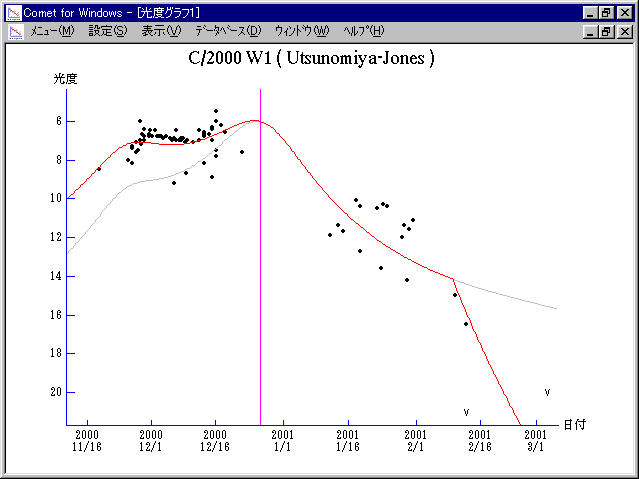
C/2000 W1 (Utsunomiya–Jones) is a non-periodic comet from the Oort cloud discovered on 18 November 2000, by Syogo Utsunomiya and Albert F. A. L. Jones.[7] The comet reached up to apparent magnitude 5.5,[6] but was only 27 degrees from the Sun in mid-December 2000.[8]
Orbit
The comet has an observation arc of 58 days allowing a reasonable estimate of the orbit. Though the near-perihelion orbit solution shows the comet to be on a hyperbolic trajectory,[5] the orbit of a long-period comet is properly obtained when the osculating orbit is computed at an epoch after leaving the planetary region and is calculated with respect to the center of mass of the Solar System. Using JPL Horizons, the barycentric orbital elements for epoch 2020-Jan-01 generate a semi-major axis of 835 AU (124,900 million km), an aphelion distance of 1,670 AU (250,000 million km), and a period of approximately 24,000 years.[4]
C/2000 W1 came to perihelion on 26 December 2000 when it passed 0.321 AU (48.0 million km) from the Sun.[5] It was last observed in February–March 2001 when it faded suddenly and probably disintegrated.[3][9]
References
- ^ S. Utsunomiya; A. L. Jones; et al. (26 November 2000). D. W. Green (ed.). "Comet C/2000 W1 (Utsunomiya–Jones)". IAU Circular. 7526 (1). Bibcode:2000IAUC.7526....1N. ISSN 0081-0304.
- ^ "Horizons Batch for 2000-Dec-26 perihelion velocity". JPL Horizons. Retrieved 22 January 2023.
- ^ a b "Split Comets (and observed to disintegrate or fade out)". International Comet Quarterly. Retrieved 31 August 2011. (magnitude chart)
- ^ a b Horizons output. "Barycentric Osculating Orbital Elements for Comet C/2000 W1 (Utsunomiya-Jones)". Retrieved 2 March 2011. (Solution using the Solar System Barycenter and barycentric coordinates. Select Ephemeris Type:Elements and Center:@0)
- ^ a b c "C/2000 W1 (Utsunomiya–Jones) – JPL Small-Body Database Lookup". ssd.jpl.nasa.gov. Jet Propulsion Laboratory. Retrieved 2 March 2011.
- ^ a b J. G. S. Aguiar; A. Amorim; A. Pearce; S. Yoshida (20 December 2000). D. W. Green (ed.). "Comet C/2000 W1 (Utsunomiya–Jones)". IAU Circular. 7546 (3). Bibcode:2000IAUC.7546....3A. ISSN 0081-0304.
- ^ Andreas Kammerer. "Analysis of past comet apparitions: C/2000 W1 (Utsunomiya-Jones)". Archived from the original on 19 July 2011. Retrieved 2 March 2011.
- ^ "Horizons Batch for 2000-Dec-16 solar angle". JPL Horizons. Retrieved 22 January 2023.
- ^ A. C. Gilmore (6 March 2001). D. W. Green (ed.). "Comet C/2000 W1 (Utsunomiya–Jones)". IAU Circular. 7594 (2). Bibcode:2001IAUC.7594....2G. ISSN 0081-0304.
External links
- C/2000 W1 at the JPL Small-Body Database
- C/2000 W1 (Utsunomiya–Jones) at Seiichi Yoshida's website