The Aisin AW TF-8# SC series is a 6-speed automatic transmission designed for use in transverse engine applications produced by Aisin Seiki. It is built in Anjō, Japan,[1] and is also called TF-80SC[2] (AWF21), AF40-6, AM6,[3] AW6A-EL and TF-81SC (AF21).[4] All-wheel drive transfer cases can be fitted to the AWTF-80 SC.
It uses a Lepelletier gear mechanism,[5] an epicyclic/planetary gearset, which can provide more gear ratios with significantly fewer components. This means the Aisin AW TF-8# SC series is actually lighter than its five-speed predecessors.
The Ford 6R, GM 6L, and ZF 6HP transmissions are based on the same globally patented gearset concept. The AWTF-80 SC is the only one for transverse engine installation.
Gear Ratios[a]
| Model
|
First
Delivery
|
Gear
|
Total Span
|
Avg.
Step
|
Components
|
| R
|
1
|
2
|
3
|
4
|
5
|
6
|
Nomi-
nal
|
Effec-
tive
|
Cen-
ter
|
Total
|
per
Gear[b]
|
|
|
| Aisin AWTF-80
|
2005
|
−3.394
|
4.148
|
2.370
|
1.556
|
1.155
|
0.859
|
0.686
|
6.049
|
4.949
|
1.687
|
1.433
|
3 Gearsets
2 Brakes
3 Clutches
|
1.333
|
|
|
| ZF 6HP All
|
2000[c]
|
−3.403
|
4.171
|
2.340
|
1.521
|
1.143
|
0.867
|
0.691
|
6.035
|
4.924
|
1.698
|
1.433
|
|
|
- ^ Differences in gear ratios have a measurable, direct impact on vehicle dynamics, performance, waste emissions as well as fuel mileage
- ^ Forward gears only
- ^ first transmission to use this 6-speed gearset concept
|
|
|
Specifications
Combined Parallel and Serial Coupled Gearset Concept For More Gears And Improved Cost-Effectiveness
Main Objectives
The main objective in replacing the predecessor model was to improve vehicle fuel economy with extra speeds and a wider gear span to allow the engine speed level to be lowered (downspeeding). The layout brings the ability to shift in a non-sequential manner – going from gear 6 to gear 2 in extreme situations simply by changing one shift element (actuating clutch E and releasing brake A).
Extent
In order to increase the number of ratios, ZF has abandoned the conventional design method of limiting themselves to pure in-line epicyclic gearing and extended it to a combination with parallel epicyclic gearing. This was only possible thanks to computer-aided design and has resulted in a globally patent for this gearset concept. The AWTF-80 is based on the 6HP from ZF, which was the first transmission designed according to this new paradigm. After gaining additional gear ratios only with additional components, this time the number of components has to decrease while the number of ratios still increase. The progress is reflected in a much better ratio of the number of gears to the number of components used compared to existing layouts.
Gearset Concept: Cost-Effectiveness[a]
With
Assessment
|
Output:
Gear
Ratios
|
Innovation
Elasticity[b]
Δ Output : Δ Input
|
Input: Main Components
|
| Total
|
Gearsets
|
Brakes
|
Clutches
|
|
|
AWTF-80
Ref. Object
|


|
Topic[b]
|


|


|


|


|
| Δ Number
|

|

|

|

|

|
| Relative Δ
|
Δ Output

|
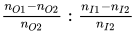
 · ·
|
Δ Input

|

|

|

|
|
|
AWTF-80
Aisin TB-50LS[c]
|
6[d]
5[d]
|
Progress[b]
|
8
9
|
3[e]
3
|
2
3
|
3
3
|
| Δ Number
|
1
|
-1
|
0
|
-1
|
0
|
| Relative Δ
|
0.200

|
−1.800[b]
 · ·
|
−0.111

|
0.000

|
−0.333

|
0.000
|
|
|
AWTF-80
3-Speed[f]
|
6[d]
3[d]
|
Market Position[b]
|
8
7
|
3[e]
2
|
2
3
|
3
2
|
| Δ Number
|
3
|
1
|
1
|
-1
|
1
|
| Relative Δ
|
1.000

|
7.000[b]
 · ·
|
0.143

|
0.500

|
−0.333
|
0.500
|
|
|
- ^ Progress increases cost-effectiveness and is reflected in the ratio of forward gears to main components.
It depends on the power flow:
- parallel: using the two degrees of freedom of planetary gearsets
- to increase the number of gears
- with unchanged number of components
- serial: in-line combined planetary gearsets without using the two degrees of freedom
- to increase the number of gears
- a corresponding increase in the number of components is unavoidable
- ^ a b c d e f Innovation Elasticity Classifies Progress And Market Position
- Automobile manufacturers drive forward technical developments primarily in order to remain competitive or to achieve or defend technological leadership. This technical progress has therefore always been subject to economic constraints
- Only innovations whose relative additional benefit is greater than the relative additional resource input, i.e. whose economic elasticity is greater than 1, are considered for realization
- The required innovation elasticity of an automobile manufacturer depends on its expected return on investment. The basic assumption that the relative additional benefit must be at least twice as high as the relative additional resource input helps with orientation
- negative, if the output increases and the input decreases, is perfect
- 2 or above is good
- 1 or above is acceptable (red)
- below this is unsatisfactory (bold)
- ^ Direct Predecessor
- To reflect the progress of the specific model change
- ^ a b c d plus 1 reverse gear
- ^ a b of which 2 gearsets are combined as a compound Ravigneaux gearset
- ^ Reference Standard (Benchmark)
- 3-speed transmissions with torque converters have established the modern market for automatic transmissions and thus made it possible in the first place, as this design proved to be a particularly successful compromise between cost and performance
- It became the archetype and dominated the world market for around 3 decades, setting the standard for automatic transmissions. It was only when fuel consumption became the focus of interest that this design reached its limits, which is why it has now completely disappeared from the market
- What has remained is the orientation that it offers as a reference standard (point of reference, benchmark) for this market for determining progressiveness and thus the market position of all other, later designs
- All transmission variants consist of 7 main components
- Typical examples are
|
|
|
Gearbox control
To reduce external wiring as well as to provide a constant environment for the transmission control module (TCM), it is located inside the transmission housing. Gear shifting is managed by a computer program that oversees a clutch-to-clutch actuation that allows one clutch engage the instant the clutch from the previous gear disengages. When idling and with the foot brake depressed neutral gear is selected automatically. This helps to reduce internal temperatures and improve the fuel economy.
Features
| Maximum shift speed
|
7,000/min
|
6,500/min
|
| Maximum torque
|
350 N⋅m (258 lb⋅ft)
|
400 N⋅m (295 lb⋅ft)
|
| Torque converter diameter
|
260 mm (10.2 in)
|
| Length
|
358 mm (14.1 in)
|
| Weight
|
90 kg (198 lb)
|
Gearset Concept: Layout
A conventional 5-pinion planetary gearset and a compound Ravigneaux gearset is combined in a Lepelletier gear mechanism,[5] to reduce both the size and weight. It was first realized in 2000 with the 6HP from ZF Friedrichshafen. Like all transmissions realized with Lepelletier transmissions, the AWTF-80 SC also dispenses with the use of the direct gear ratio, making it one of the very few automatic transmission concepts without such a ratio.
It also has the capability to achieve torque converter lock-up on all 6 forward gears, and disengage it completely when at a standstill, significantly closing the fuel efficiency gap between automatic and manual transmissions.
Gearset Concept: Quality
The ratios of the 6 gears are evenly distributed in all versions. Exceptions are the large step from 1st to 2nd gear and the almost geometric steps from 3rd to 4th to 5th gear. They cannot be eliminated without affecting all other gears. As the large step is shifted due to the large span to a lower speed range than with conventional gearboxes, it is less significant. As the gear steps are smaller overall due to the additional gear(s), the geometric gear steps are still smaller than the corresponding gear steps of conventional gearboxes. Overall, therefore, the weaknesses are not overly significant. As the selected gearset concept saves up to 2 components compared to 5-speed transmissions, the advantages clearly outweigh the disadvantages.
In a Lepelletier gearset,[5] a conventional planetary gearset and a composite Ravigneaux gearset are combined to reduce both the size and weight as well as the manufacturing costs. Like all transmissions realized with Lepelletier transmissions, the 6L also dispenses with the use of the direct gear ratio and is thus one of the very few automatic transmission concepts without such a ratio.
Gear Ratio Analysis
In-Depth Analysis
With Assessment[a][b][c]
|
Planetary Gearset: Teeth[d]
Lepelletier Gear Mechanism
|
Count
|
Nomi-
nal[e]
Effec-
tive[f]
|
Cen-
ter[g]
|
| Simple
|
Ravigneaux
|
Avg.[h]
|
|
|
| Model
|
Version
First Delivery
|
S1[i]
R1[j]
|
S2[k]
R2[l]
|
S3[m]
R3[n]
|
Brakes
Clutches
|
Ratio
Span
|
Gear
Step[o]
|
Gear
Ratio
|
R

|
1

|
2

|
3

|
4

|
5

|
6

|
| Step[o]
|
 [p] [p]
|

|
 [q] [q]
|

|

|

|

|
| Δ Step[r][s]
|
|
|

|

|

|

|
|
Shaft
Speed
|

|
|
|

|

|

|

|
Δ Shaft
Speed[t]
|

|

|

|

|

|

|

|
Specific
Torque[u]
|
 [v] [v]
|
 [v] [v]
|
 [v] [v]
|
 [v] [v]
|
 [v] [v]
|
 [v] [v]
|
 [v] [v]
|
Efficiency
 [u] [u]
|

|

|

|

|

|

|

|
|
|
Aisin
AWTF-80 SC
|
450 N⋅m (332 lb⋅ft)
2005[6]
|
50
90
|
36
44
|
44
96
|
2
3
|
6.0494
4.9495
[f][p]
|
1.6865
|
| 1.4333[o]
|
Gear
Ratio
|
−3.3939[p][f]

|
4.1481

|
2.3704[q]

|
1.5556

|
1.1546[s]

|
0.8593

|
0.6857[t]

|
| Step
|
0.8182[p]
|
1.0000
|
1.7500[q]
|
1.5238
|
1.3472
|
1.3436
|
1.2532
|
| Δ Step[r]
|
|
|
1.1484
|
1.1311
|
1.0027[s]
|
1.0722
|
|
| Speed
|
-1.2222
|
1.0000
|
1.7500
|
2.6667
|
3.5926
|
4.8272
|
6.0494
|
| Δ Speed
|
1.2222
|
1.0000
|
0.7500
|
0.9167
|
0.9259
|
1.2346
|
1.2222[t]
|
Specific
Torque[u]
|
–3.3023
–3.2568
|
3.9956
3.9204
|
2.3127
2.2841
|
1.5444
1.5389
|
1.1471
1.1434
|
0.8553
0.8532
|
0.6813
0.6791
|
Efficiency
[u]
|
0.9730
0.9596
|
0.9632
0.9451
|
0.9757
0.9636
|
0.9929
0.9893
|
0.9935
0.9903
|
0.9953
0.9928
|
0.9936
0.9904
|
|
|
| ZF 6HP
|
All[c] · 2000[w]
|
37
71
|
31
38
|
38
85
|
2
3
|
6.0354
4.9236
[f][p]
|
1.6977
|
| 1.4327[o]
|
Gear
Ratio
|
−3.4025[p][f]

|
4.1708

|
2.3397[q]

|
1.5211

|
1.1428
[s][t]

|
0.8672

|
0.6911

|
| Step
|
0.8158[p]
|
1.0000
|
1.7826[q]
|
1.5382
|
1.3311
|
1.3178
|
1.2549
|
| Δ Step[r]
|
|
|
1.1589
|
1.1559
|
1.0101[s]
|
1.0502
|
|
| Speed
|
-1.2258
|
1.0000
|
1.7826
|
2.7419
|
3.6497
|
4.8096
|
6.0354
|
| Δ Speed
|
1.2258
|
1.0000
|
0.7826
|
0.9593
|
0.9078[t]
|
1.1599
|
1.2258
|
Specific
Torque[u]
|
–3.3116
–3.2665
|
4.0186
3.9436
|
2.2837
2.2559
|
1.5107
1.5055
|
1.1359
1.1325
|
0.8633
0.8613
|
0.6867
0.6845
|
Efficiency
[u]
|
0.9733
0.9600
|
0.9635
0.9455
|
0.9761
0.9642
|
0.9931
0.9897
|
0.9939
0.9910
|
0.9955
0.9932
|
0.9937
0.9905
|
|
|
| Actuated Shift Elements
|
| Brake A[x]
|
|
❶
|
❶
|
❶
|
❶
|
|
|
| Brake B[y]
|
❶
|
|
|
❶
|
|
❶
|
|
| Clutch C[z]
|
|
|
❶
|
|
|
|
❶
|
| Clutch D[aa]
|
❶
|
❶
|
|
|
|
|
|
| Clutch E[ab]
|
|
|
|
|
❶
|
❶
|
❶
|
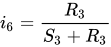
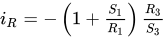
| Geometric Ratios
|
Ratio
R & 3 & 6
Ordinary[ac]
Elementary
Noted[ad]
|

|

|
|
|

|

|
|
|
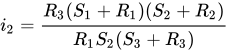
Ratio
1 & 2
Ordinary[ac]
Elementary
Noted[ad]
|

|
|

|

|
|
|
Ratio
4 & 5
Ordinary[ac]
Elementary
Noted[ad]
|
|

|
|

|
| Kinetic Ratios
|
Specific
Torque[u]
R & 3 & 6
|

|

|

|
|
|
Specific
Torque[u]
1 & 2
|

|

|
|
|
Specific
Torque[u]
4 & 5
|

|

|
|
|
- ^ Revised 16 November 2025
- ^ The AWTF80 SC-transmission is based on the Lepelletier gear mechanism, first realized in the ZF 6HP gearbox
- ^ a b Other gearboxes using the Lepelletier gear mechanism see infobox
- ^ Layout
- Input and output are on opposite sides
- Planetary gearset 1 is on the input (turbine) side
- Input shafts are R1 and, if actuated, C2/C3 (the combined carrier of the compound Ravigneaux gearset 2 and 3)
- Output shaft is R3 (ring gear of gearset 3: outer Ravigneaux gearset)
- ^ Total Ratio Span (Total Gear/Transmission Ratio) Nominal
 - A wider span enables the
- downspeeding when driving outside the city limits
- increase the climbing ability
- when driving over mountain passes or off-road
- or when towing a trailer
- ^ a b c d e Total Ratio Span (Total Gear/Transmission Ratio) Effective
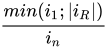 - The span is only effective to the extent that
- the reverse gear ratio
- matches that of 1st gear
- see also Standard R:1
- ^ Ratio Span's Center
 - The center indicates the speed level of the transmission
- Together with the final drive ratio
- it gives the shaft speed level of the vehicle
- ^ Average Gear Step
 - With decreasing step width
- the gears connect better to each other
- shifting comfort increases
- ^ Sun 1: sun gear of gearset 1
- ^ Ring 1: ring gear of gearset 1
- ^ Sun 2: sun gear of gearset 2: inner Ravigneaux gearset
- ^ Ring 2: ring gear of gearset 2: inner Ravigneaux gearset
- ^ Sun 3: sun gear of gearset 3: outer Ravigneaux gearset
- ^ Ring 3: ring gear of gearset 3: outer Ravigneaux gearset
- ^ a b c d Standard 50:50
— 50 % Is Above And 50 % Is Below The Average Gear Step —
- With steadily decreasing gear steps (yellow highlighted line Step)
- and a particularly large step from 1st to 2nd gear
- the lower half of the gear steps (between the small gears; rounded down, here the first 2) is always larger
- and the upper half of the gear steps (between the large gears; rounded up, here the last 3) is always smaller
- than the average gear step (cell highlighted yellow two rows above on the far right)
- lower half: smaller gear steps are a waste of possible ratios (red bold)
- upper half: larger gear steps are unsatisfactory (red bold)
- ^ a b c d e f g Standard R:1
— Reverse And 1st Gear Have The Same Ratio —
- The ideal reverse gear has the same transmission ratio as 1st gear
- no impairment when maneuvering
- especially when towing a trailer
- a torque converter can only partially compensate for this deficiency
- Plus 11.11 % minus 10 % compared to 1st gear is good
- Plus 25 % minus 20 % is acceptable (red)
- Above this is unsatisfactory (bold)
- see also Total Ratio Span (Total Gear/Transmission Ratio) Effective
- ^ a b c d e Standard 1:2
— Gear Step 1st To 2nd Gear As Small As Possible —
- With continuously decreasing gear steps (yellow marked line Step)
- the largest gear step is the one from 1st to 2nd gear, which
- for a good speed connection and
- a smooth gear shift
- must be as small as possible
- A gear ratio of up to 1.6667 : 1 (5 : 3) is good
- Up to 1.7500 : 1 (7 : 4) is acceptable (red)
- Above is unsatisfactory (bold)
- ^ a b c From large to small gears (from right to left)
- ^ a b c d e Standard STEP
— From Large To Small Gears: Steady And Progressive Increase In Gear Steps —
- Gear steps should
- increase: Δ Step (first green highlighted line Δ Step) is always greater than 1
- As progressive as possible: Δ Step is always greater than the previous step
- Not progressively increasing is acceptable (red)
- Not increasing is unsatisfactory (bold)
- ^ a b c d e Standard SPEED
— From Small To Large Gears: Steady Increase In Shaft Speed Difference —
- Shaft speed differences should
- increase: Δ Shaft Speed (second line marked in green Δ (Shaft) Speed) is always greater than the previous one
- 1 difference smaller than the previous one is acceptable (red)
- 2 consecutive ones are a waste of possible ratios (bold)
- ^ a b c d e f g h i Specific Torque Ratio And Efficiency
- The specific torque is the Ratio of
- output torque

- to input torque

- with

- The efficiency is calculated from the specific torque in relation to the transmission ratio
- Power loss for single meshing gears is in the range of 1 % to 1.5 %
- helical gear pairs, which are used to reduce noise in passenger cars, are in the upper part of the loss range
- spur gear pairs, which are limited to commercial vehicles due to their poorer noise comfort, are in the lower part of the loss range
- ^ a b c d e f g Corridor for specific torque and efficiency
- in planetary gearsets, the stationary gear ratio
 is formed via the planetary gears and thus by two meshes is formed via the planetary gears and thus by two meshes
- for reasons of simplification, the efficiency for both meshes together is commonly specified there
- the efficiencies
 specified here are based on assumed efficiencies for the stationary ratio specified here are based on assumed efficiencies for the stationary ratio
- of
 (upper value) (upper value)
- and
 (lower value) (lower value)
- for both interventions together
- The corresponding efficiency for single-meshing gear pairs is

- at
 (upper value) (upper value)
- and
 (lower value) (lower value)
- ^ First gearbox on the market to use the Lepelletier gear mechanism
for comparison purposes only
- ^ Blocks R2 and S3
- ^ Blocks C2 (carrier 2) and C3 (carrier 3)
- ^ Couples C1 (carrier 1) and S2
- ^ Couples C1 (carrier 1) with R2 and S3
- ^ Couples R1 with C2 (carrier 2) and C3 (carrier 3)
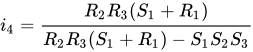
- ^ a b c Ordinary Noted
- For direct determination of the ratio
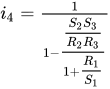
- ^ a b c Elementary Noted
- Alternative representation for determining the transmission ratio
- Contains only operands
- With simple fractions of both central gears of a planetary gearset
- Or with the value 1
- As a basis
- For reliable
- And traceable
- Determination of specific torque and efficiency
|
|
|
Applications
See also
References
- ^ a b "GM Engine Original Equipment Manufacturer | GM Powertrain" (PDF). Archived (PDF) from the original on 24 September 2015. Retrieved 16 September 2015.
- ^ "Volvo Car Bookstore". Archived from the original on 26 March 2015. Retrieved 13 September 2015.
- ^ "Archived copy" (PDF). Archived from the original (PDF) on 4 March 2021. Retrieved 4 June 2017.
{{cite web}}: CS1 maint: archived copy as title (link)
- ^ "Archived copy" (PDF). Archived from the original (PDF) on 4 March 2016. Retrieved 2 January 2015.
{{cite web}}: CS1 maint: archived copy as title (link)
- ^ a b c Riley, Mike (1 September 2013). "Lepelletier Planetary System". Transmission Digest. Archived from the original on 21 June 2023. Retrieved 3 March 2023.
- ^ Kasuya, Satoru; Taniguchi, Takao; Tsukamoto, Kazumasa; Hayabuchi, Masahiro; Nishida, Masaaki; Suzuki, Akitomo; Niki, Hiroshi (2005). "AISIN AW New High Torque Capacity 6-Speed Automatic Transmission for FWD vehicles". SAE Transactions. 114: 1193–1201. ISSN 0096-736X. JSTOR 44725152. Archived from the original on 20 July 2020. Retrieved 9 July 2020.
- ^ a b c d "Replacement Aisin Warner TCC Linear Solenoid with Black Connector". Rostra Powertrain Controls. Archived from the original on 22 May 2018. Retrieved 16 January 2019.
- ^ a b c d e "Archived copy" (PDF). Archived from the original (PDF) on 4 March 2016. Retrieved 16 September 2015.
{{cite web}}: CS1 maint: archived copy as title (link)
- ^ "LUXGEN U6 VIETNAM". luxgen-motor.vn (in Vietnamese). Archived from the original on 11 August 2017. Retrieved 25 February 2018.
- ^ a b "Volvo Car USA, LLC. Bookstore:RTJ21096-2009-06-10". www.volvotechinfo.com. Archived from the original on 4 March 2016. Retrieved 26 November 2017.
- ^ a b c d e "Volvo Car USA, LLC. Bookstore:TJ26840-2014-11-06". Archived from the original on 17 June 2016. Retrieved 26 November 2017.
- ^ "Kraftstoffbetriebene Heizung, D5244T, TF-80SC" [Fuel powered heater, D5244T, TF-80SC] (Accessory installation instructions) (in English and German). Volvo Car Customer Service. Archived from the original on 25 February 2018. Retrieved 25 February 2018.
- ^ "437: Transmission control module (TCM), TF-80SC AWD" (PDF). Volvo Car Corporation. 23 December 2013. Archived (PDF) from the original on 25 February 2018. Retrieved 25 February 2018.
- ^ Volvo Car Corporation (2008). "Models - S80 - Technical Data - Volvo Car UK Media Newsroom". Archived from the original on 4 March 2016. Retrieved 13 September 2015.
- ^ a b c "Volvo Car USA, LLC. Bookstore:RTJ20857-2009-04-15". www.volvotechinfo.com. Volvo Cars of North America. 15 April 2009. Archived from the original on 25 February 2018. Retrieved 25 February 2018.
- ^ "Volvo V50 owner's manual (MY12)" (PDF). Volvo Car Corporation. 2011. p. 312. Archived (PDF) from the original on 13 April 2016. Retrieved 16 January 2019. · German: Volvo V50 Betriebsanleitung (Modelljahr 2012)
External links